Spaghettis à l’ail et huile d’olive

spaghetti garlic oil2Did Marco Polo really introduce spaghetti to Italy when he returned from China in 1295? Apparently not. This ancient food — noodles, in one form or another — existed in China for millennia before the intrepid Italian adventurer arrived there, but it also existed in the Middle East and North Africa long before Marco Polo’s voyage, and most likely made its way to Europe from there. The French have enjoyed it for centuries…

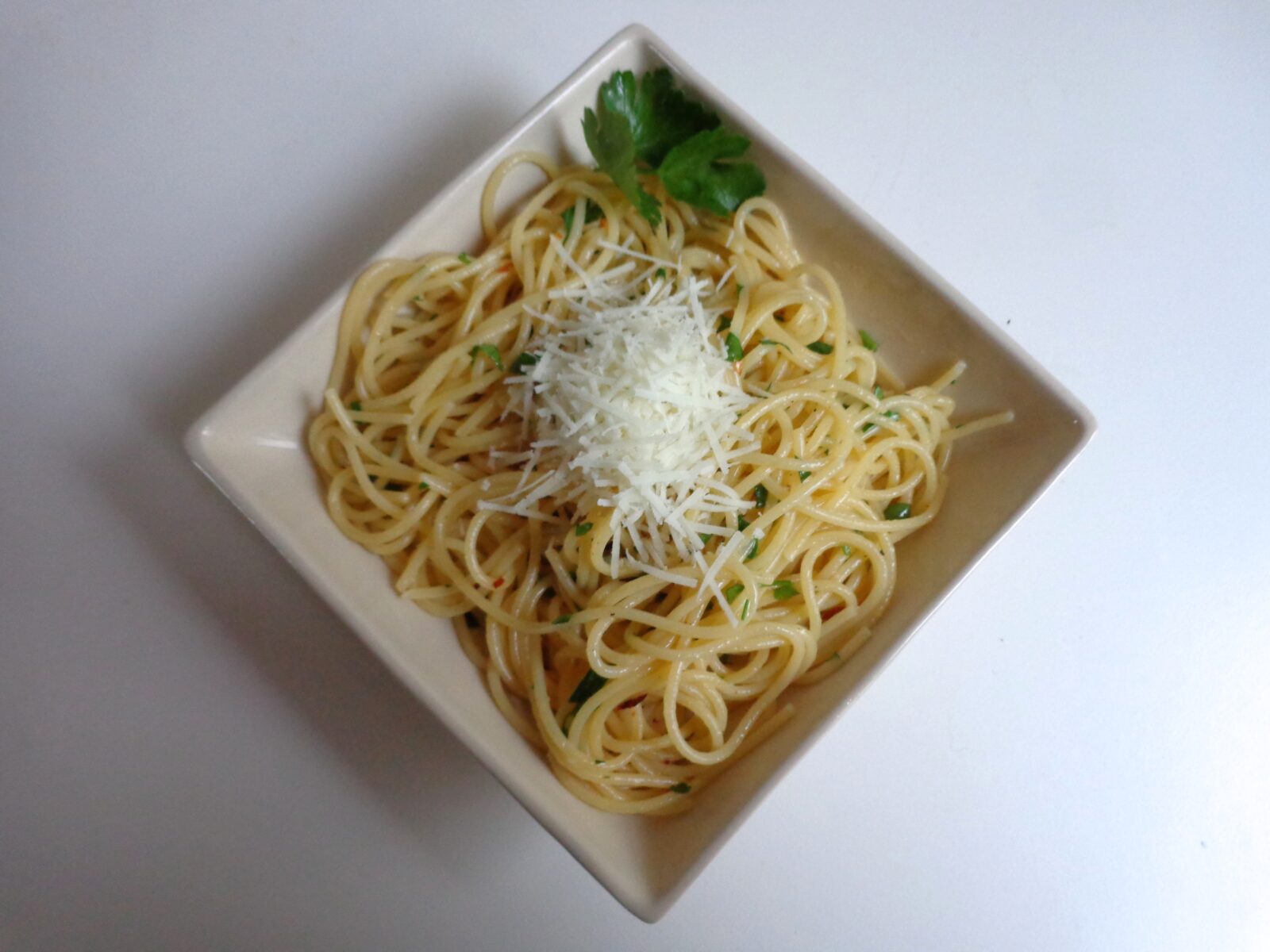
Spaghettis à l’ail et huile d’olive / Spaghetti with garlic and olive oil

In this recipe, steaming spaghetti is added to a mixture of minced raw garlic, extra virgin olive oil and finely chopped parsley — a French touch. It releases a fabulous aroma, and you can bring it to the table as is or with the addition of grated parmesan, cayenne pepper if you like extra spice, chopped raw cherry tomatoes, sautéed shrimp or all of the above. Personally, I prefer it unadorned. It is a perfect peasant food, simple and oh so tasty.

So when did spaghetti reach France? The history of pasta is rather unclear, but here are a few factlets I’ve been able to piece together: 1) Noodles made from millet dating back to 2000 B.C. were found buried in a clay pot in central China by an archaeological dig in 2005 — in other words, they were 4,000 years old. 2) The process of turning grain into pasta may well have made its way west from China along the Silk Route, reaching the Biblical lands. It was mentioned in the Jerusalem Talmud, written in Aramaic, in the 5th century A.D. — 700 years before Marco Polo set forth. 3) Pasta reached Europe even earlier than that. A noodle machine was uncovered in the ruins of Pompeii, the ancient city near Naples that was destroyed by a volcanic eruption in 79 A.D. 4) According to one theory, pasta was introduced to Italy from Greece, the evidence being of the etymological variety (the Greek word pastos meaning ‘sprinkled with salt’). I was unable to verify this, but I did also read that in Greek mythology there is a tale about Vulcan, god of fire, ‘pushing dough through a device that converts it into thin, edible threads.’ 5) According to another theory, pasta moved north across the Mediterranean from Libya, where it had arrived via Arabs from the Middle East. 6) The historian Al-Idrissi wrote about encountering spaghetti in Sicily in the 12th century, well before Marco Polo’s birth.

I’m not a historian, so please correct me if any of this is wrong, or if you have additions to make. What I can say is that pasta has featured on Parisian menus for quite some time, having presumably made its way north from the French Mediterranean. In fact, when Thomas Jefferson encountered pasta while serving as American ambassador to Paris, he liked it so much that he brought a macaroni machine back to the United States in 1789. Pasta today is one of the most popular dishes among the French. The rustic version in today’s recipe is one of the simplest, and tastiest. I hope you’ll enjoy it.

Happy cooking.
Posted in 9. Pasta, Rice, Grains | Tagged , , , , , , , | 1 Comment

Salade niçoise

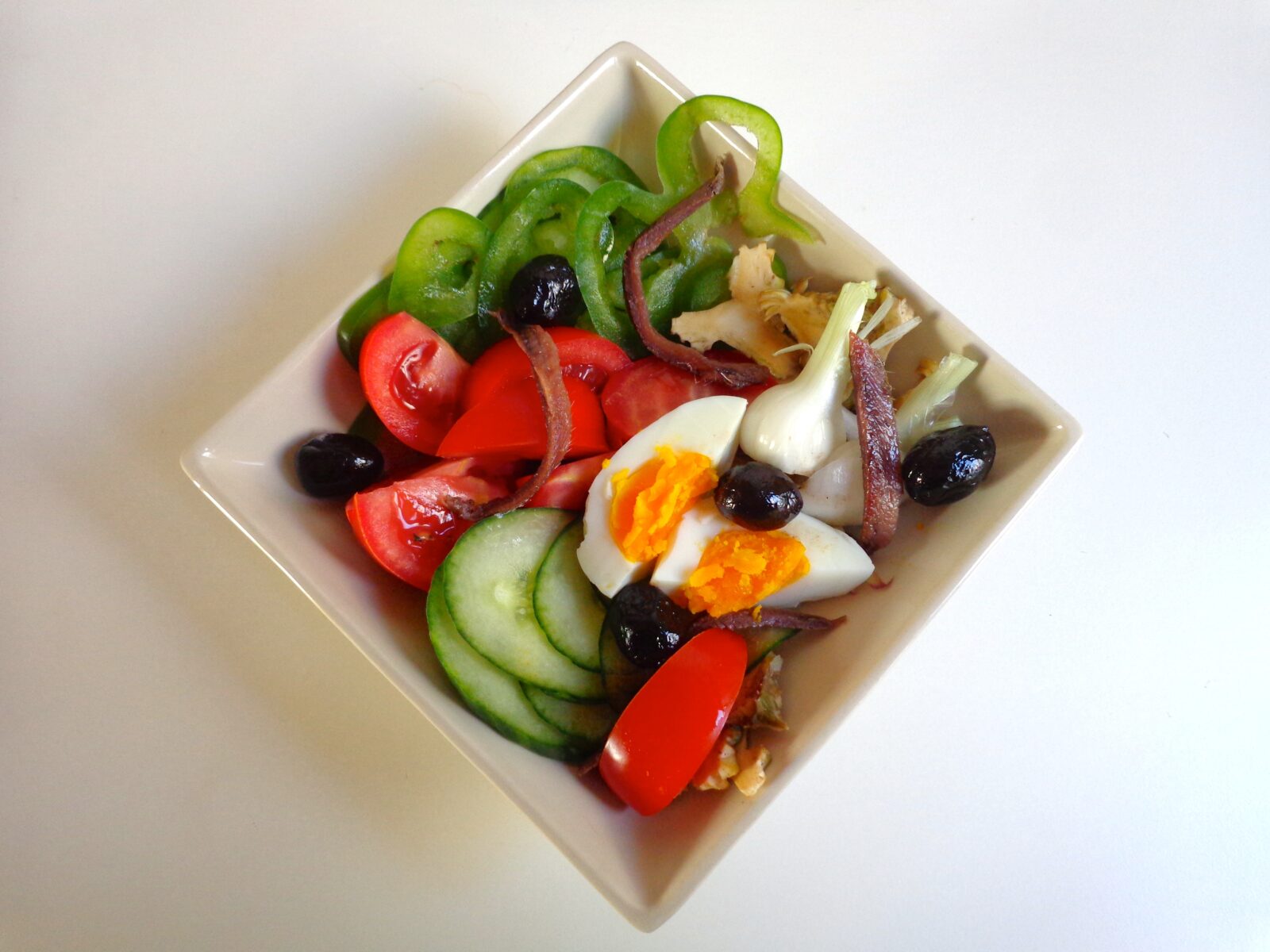
salade nicoise2Salade niçoise is a dish so evocative that you can probably remember where you were when you first tasted one. In my case, it was in … Nice, where I spent three weeks digging for pre-Neanderthal man as a student in the summer of 1969. We would wander into town along the Mediterranean, find a little café, order wine and something to eat. Once I ordered a salade niçoise — and was in heaven. But what, exactly, is salade niçoise?

Salade niçoise / Salade niçoise

These days in France a salade niçoise usually comes with tuna on top, but that was not part of the original recipe. Nor were other ingredients that are often seen today, like green beans, potatoes, rice or — say it ain’t so — sweet corn. No, mes amis, in the beginning a salade niçoise contained only local ingredients: tomatoes, small white onions, anchovies, perhaps some mesclun (mixed tender leaves) or basil and, of course, olive oil.

Over time, other ingredients were added — hard-boiled eggs, still warm; little black olives from the Nice region; green peppers, cucumbers, radishes, celery hearts or raw artichoke hearts, all thinly sliced; or fresh broad beans. Tuna, which was not widely fished a couple hundred years ago, was included only on feast days. And the salad was specific to Nice and its immediate region. Even today, my favorite Provençal cookbook, Andrée Maureau’s Recettes en Provence, contains no mention of salade niçoise. That’s how local it is.

Today’s recipe sticks close to the original. It’s a tangy, flavor-packed salad, perfect for warm summer days. It makes a fine starter or main course, accompanied by crusty bread and a bottle of chilled dry rosé. You can also serve it tucked inside a crusty roll drizzled with olive oil, as they do in Nice, where the sandwich is called pan bagnat. This being a creative cooking site, you may of course improvise by adding whatever other ingredients appeal. There are no rules here. Except for one: no sweet corn, please!

Happy cooking.

Posted in 3. Salads | Tagged , , , , , , , , , , | 5 Comments

Filet de bar sauce vierge

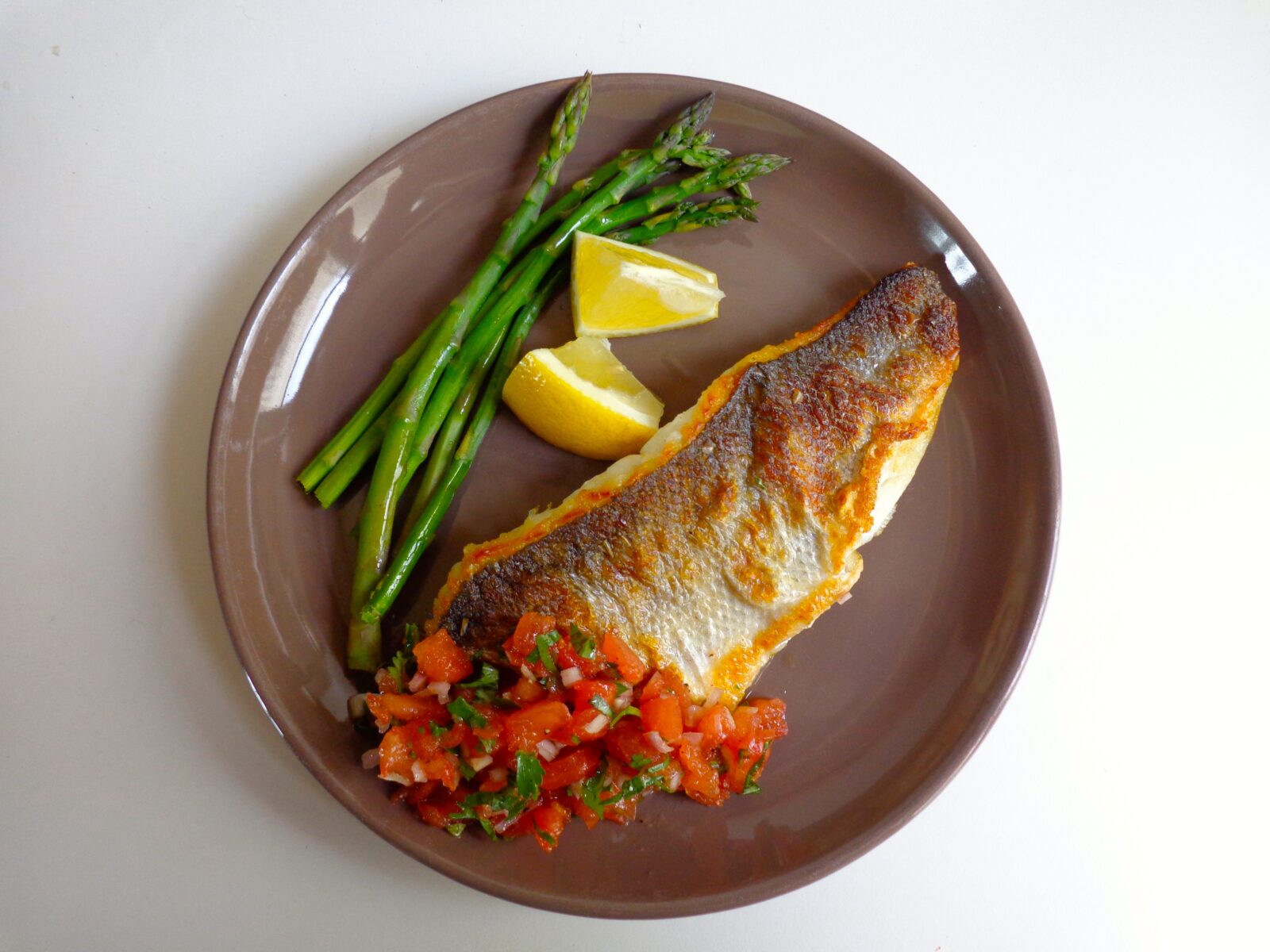
sea bass salsa2Sea bass is a highly prized fish in France. It is often grilled on a barbecue in summer with long, flowery fennel stalks for an aromatic flavor. But no barbecue is needed for this dish. The sea bass is pan-seared in olive oil and served with sauce vierge — a French salsa of tomatoes, shallots and fresh basil that translates literally as ‘virgin sauce’. With fresh veggies and a wedge of lemon, it makes a fine dish as we head into warm weather.

Filet de bar sauce vierge / Pan-seared sea bass with French salsa

But what about sauce vierge? I spent some time looking into how it got its name, but have not yet found an answer. Is it ‘virgin’ because it is uncooked (untouched by heat)? Because it calls for virgin olive oil? Or for some other reason? According to one theory, it may have been named for England’s Queen Elizabeth I, the Virgin Queen, who reigned from 1558 to 1603. But that is simply outlandish, if only because the tomato — brought from the Americas to Europe by the Spanish conquistadors — was not cultivated in Britain until the 1590s, and was at that time thought by the English to be poisonous.

What I can say is that sauce vierge is quite popular in Paris these days, appearing often on bistro menus, usually to accompany fish. It clearly has southern roots, and by southern I mean Provence — or even Italy. It could easily be mistaken for the uncooked tomato sauce served over pasta by Italians in hot weather, topped with grated parmesan or ricotta salata. Over the years it has made its way north. But when did it first appear?

Julia Child makes no mention of sauce vierge in her extensive compendium of French sauces in Mastering the Art of French Cooking, Volume 1, first published in 1961. (I don’t have Volume 2, so couldn’t check.) According to bits and pieces gleaned on the Web, the sauce was popularized in the 1980s by Michel Guérard, the guru of nouvelle cuisine. (His version used garlic instead of shallots, and tarragon instead of basil.) But if he popularized it, who invented it? If anyone out there has an answer, please let me know.

And, in the meantime, happy cooking!

Posted in 5. Fish and Shellfish | Tagged , , , , | 2 Comments

Quiche aux épinards et pignons de pin

spinach pine nut quiche1There’s a Mediterranean flavor to this quiche with spinach, pine nuts and parmesan. Perfect for lunch, accompanied by a salad and a glass of rosé, it’s a fine dish as we head into the sunny days of spring. It can also be a starter at suppertime, or the star of a Mediterranean-style buffet, with a selection of salads and spreads: tapenade, tomatoes with fresh herbs, spicy eggplant caviar, chick peas with cumin and dill, a salad of mixed greens.

Quiche aux épinards et pignons de pin / Spinach quiche with pine nuts and parmesan

But is this really a quiche? Or is it rather a savory tart (tarte salée)? And what’s the difference? The borderlines aren’t clear, but in general a quiche has more eggs and cream than a savory tart in proportion to the other ingredients. In this case, to achieve a dense, green, flavor-packed dish, I mixed the spinach with two eggs instead of the usual four, and used just half a cup of cream. But when it emerged from the oven, it tasted more like a quiche than a tart, hence its name. The parmesan adds an edge, and the pine nuts provide an additional burst of flavor, making this quiche, tart, whatever, really special.

And now out of the kitchen and into a different kind of heat. Although this is a cooking blog, as a journalist I cannot resist a little foray this week into the political life of France, where a drama with Mediterranean flavor — Greek, to be specific — is playing out between Marine Le Pen, leader of the National Front, and her father, Jean-Marie Le Pen, who founded the far-right party 43 years ago. She says he went too far when he recently repeated his notorious remark that the Nazi gas chambers were ‘a detail of history’. He says she wants him dead. And she is effectively hoping to kill him politically off by bringing him before a disciplinary committee that could boot him out of the party.

Marine Le Pen, blonde, rough and shrewd, has over the last few years led her party to heights her father could never achieve. In the recent elections for seats on county councils, the Front won 25 percent of the vote — although, under an oddity of the French electoral system, the party received only 62 of the 4,072 seats, which works out to 1.5 percent. And by the way, no mainstream French newspaper has yet (to my knowledge) commented on the unfairness of this system in a democracy…

Will she follow through with parricide? Jean-Marie Le Pen retains a hard-core following in the Front, even as his daughter has sought to ‘de-demonize’ the party. He says his daughter is being manipulated, dismissing her suggestion that he step down from politics. But even as she maintains the party’s hard line on immigration and its anti-European Union rhetoric, she can no longer abide her father’s offensive provocations — like his comments this week praising the Vichy regime during World War II — which may have appealed to previous generations on the extreme right but are alienating to younger voters.

At stake is the political future of France. Marine Le Pen has succeeded in shifting the dialogue by tapping into mounting frustration in a country that may still have fabulous food and wine, wonderful art and fashion, and a high-minded literary tradition, but where people are feeling so squeezed economically and so revolted by mainstream politicians who have failed to address their concerns that they are looking for fresh solutions.

If Marine Le Pen exorcises her father, she is likely to broaden the appeal of the Front. At this stage, she has virtually no chance of being elected president of France, despite speculation to the contrary from some quarters — because a majority of the electorate, myself included, cannot accept her party’s xenophobic platform. But she has taken on a role that is essential in every democracy, and that the French political establishment has proven impotent to perform in recent years. She is a true opposition leader. And I, for one, hope that she continues to speak out and push the boundaries of political debate.

Happy cooking.

Posted in 4a. Savory Tarts and Tartines | Tagged , , , , , , , , | 2 Comments

Fromage blanc aux pistaches et miel

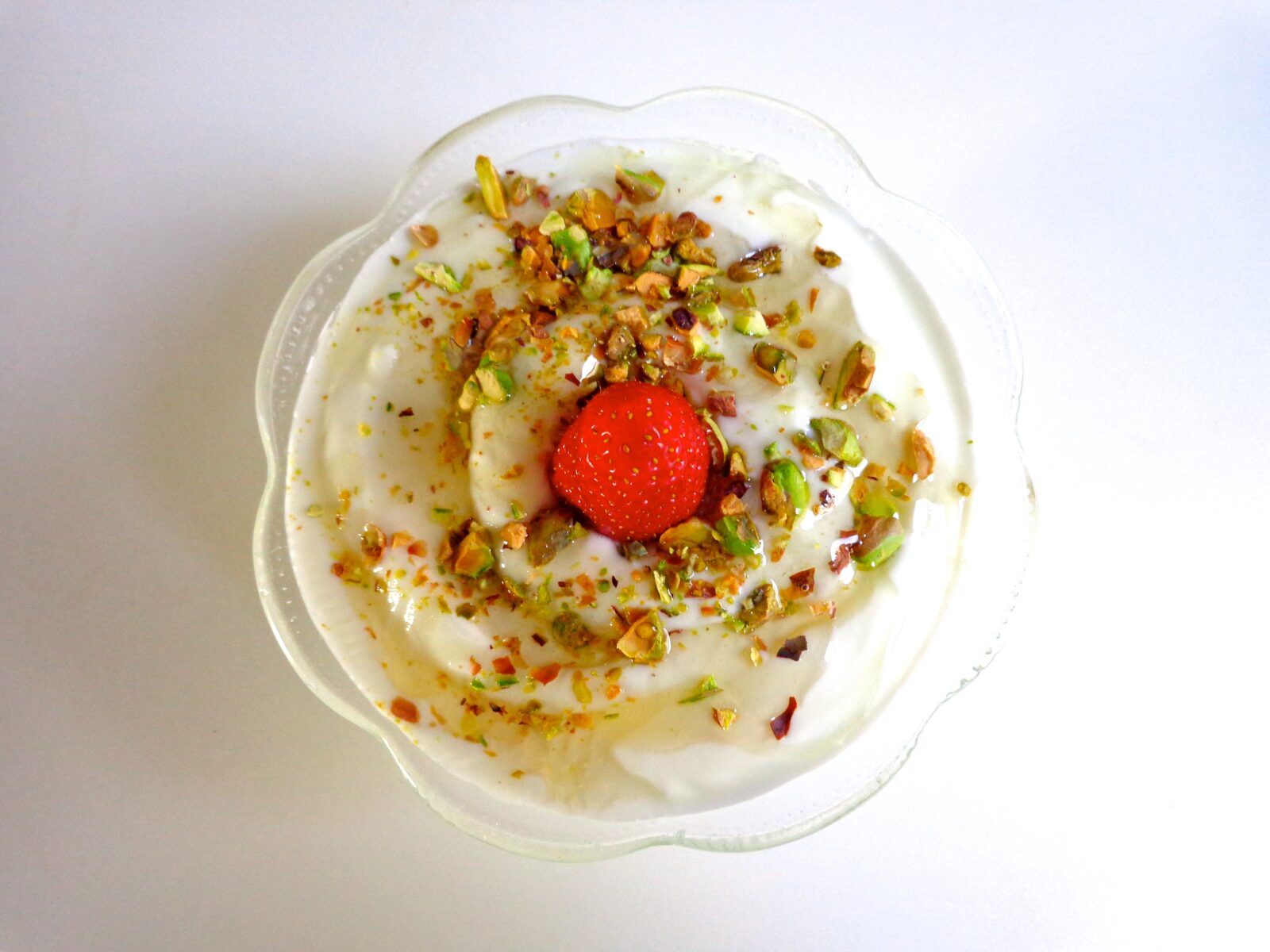
fromage blanc pistaches6I first discovered this light dessert at Yard, the erstwhile restaurant of Shaun Kelly, one of my favorite Parisian chefs. Crushed roasted pistachios and honey marry marvelously atop a bowl of fromage blanc, the fresh and creamy cheese that is ubiquitous in France. Elsewhere, the same effect may be achieved with Greek yogurt. Add a strawberry, and you’ll bring your meal to a spectacularly easy and scrumptious conclusion.

Fromage blanc aux pistaches et miel / Creamy cheese with pistachios and honey

The question — and it’s one I’ve asked myself for 40 years, since I first moved to Paris — is why this delightful form of fresh cheese is not available everywhere. The closest American equivalent, when I was growing up, was cottage cheese, which is actually not equivalent at all. While fromage blanc is smooth, cottage cheese has curds. Large or small, the curds were enough to put me off, possibly because of the image of a spider coming down beside Little Miss Muffet as she was ‘eating her curds and whey.’

In addition, cottage cheese is salty, while fromage blanc is neutral and can thus be used in both sweet and savory dishes. A revelation, upon arriving here, was that it can be used to make cheese cake with far greater ease than the dry ‘baker’s cheese’ my grandmother recommended for her cheesecake recipe from Russia. (It was a truly artisanal recipe. To my mother’s disdain and my delight, it called, among other things, for ‘one-half eggshell water’ — presumably to lighted up the leaden baker’s cheese.)

That recipe probably originally featured tvorog, the Russian version of fromage blanc. It is similar but slightly grainy and crumbly, and a bit tangy, while the French version is completely smooth and delicately bland (in a good way). Tvorog is a relative of quark (pronounced qvark), the German variety of fromage blanc, which shares its crumbly quality. If linguists are to be believed, the words tvorog and quark are related. Both varieties are used across eastern Europe in dishes like blintzes, pierogi (stuffed dumplings) and the Russian Easter cake known as paskha.

Thanks to globalization, French-style fromage blanc (or its relative, fromage frais) is now available in fine stores in cities from New York to London, and there’s no reason why this wonderful cheese should not make its way further afield in the months ahead. But if you cannot find it, or even if you can, this dessert works beautifully with Greek yogurt, which shares the smooth, creamy texture and delicate flavor of fromage blanc. Happy cooking!

Posted in Desserts | Tagged , , , , , , | Leave a comment

Tagine de veau aux petits pois et citron

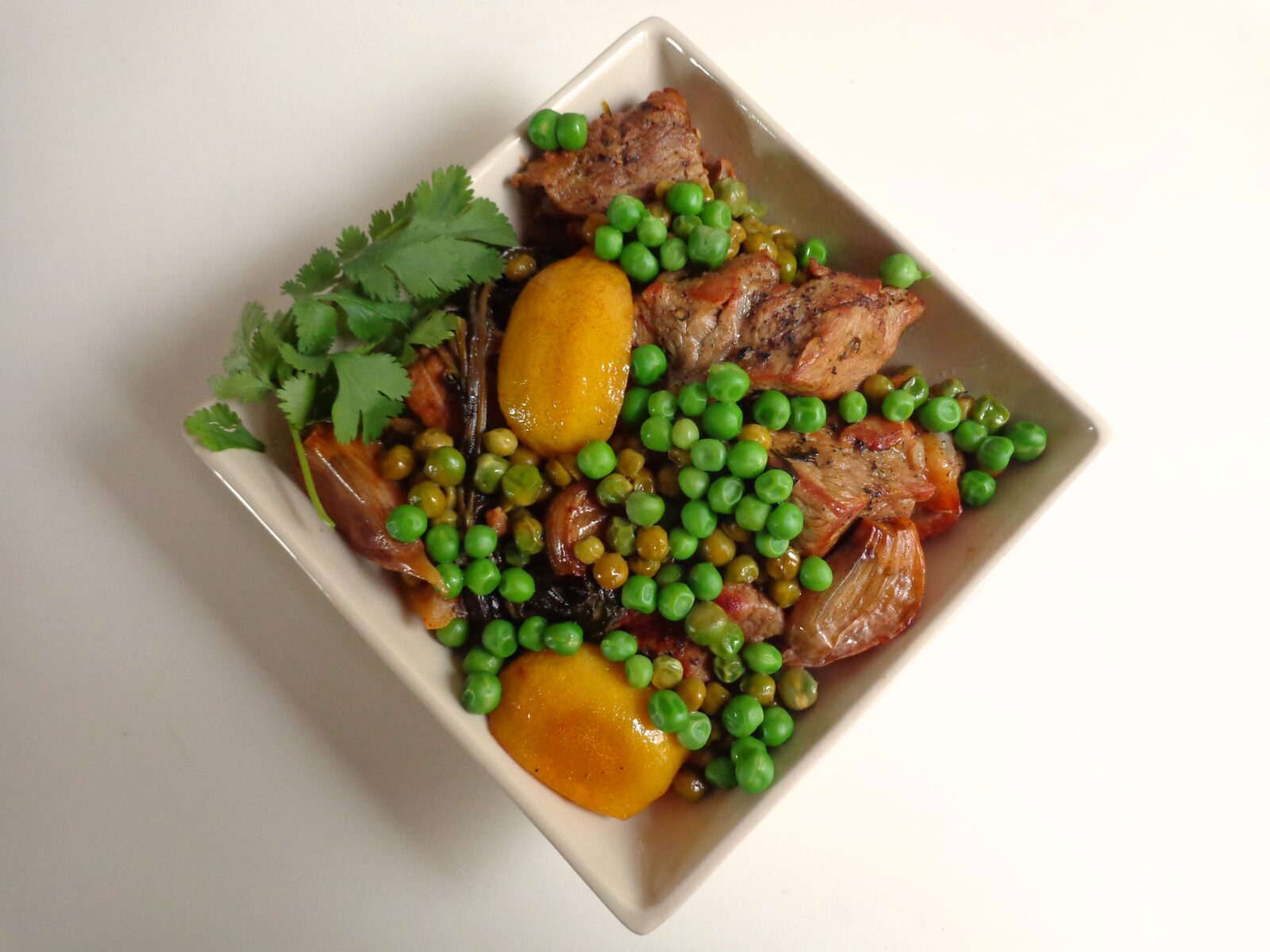
veal tagine1This Moroccan dish is unusual in that it uses fresh lemons, which marry perfectly with veal and first-of-the-season peas to create a zingy blend of flavors. The tartness of the lemon juice is softened by honey and cilantro, and the slow cooking results in a rich and succulent sauce. While lemon is often used in Moroccan cuisine, most recipes call for preserved lemons, which are pickled in salt and have a flavor so strong that they can be overwhelming.

Tagine de veau aux petits pois et citron / Veal tagine with fresh peas and lemon

Moroccan tagines, or stews, typically combine meat or poultry with fruit or olives in an exotic blend of flavors that can feel almost Persian. When I first arrived in Paris (40 years ago — sigh) it was hard to find a tagine on a menu anywhere but at a Moroccan restaurant. But times have changed, and tagines have entered the French repertoire. You can now encounter a tagine pretty much any day of the week at a neighborhood Paris bistro.

I like to serve tagines with couscous and a green salad on the side, although this is unorthodox — in Morocco, tagines are served in the clay pots in which they are cooked, with nothing on the side except perhaps some local flatbread. A meal would typically also include some Moroccan starters — like carrots with cumin, chick peas, spicy eggplant caviar, olives or roasted red peppers and tomatoes — and it would end with a light dessert, perhaps orange slices with cinnamon. Sound good?

Happy cooking!

Posted in 7. Meat Dishes | Tagged , , , , , , , , , , | Leave a comment

Omelette au chèvre frais et à la menthe

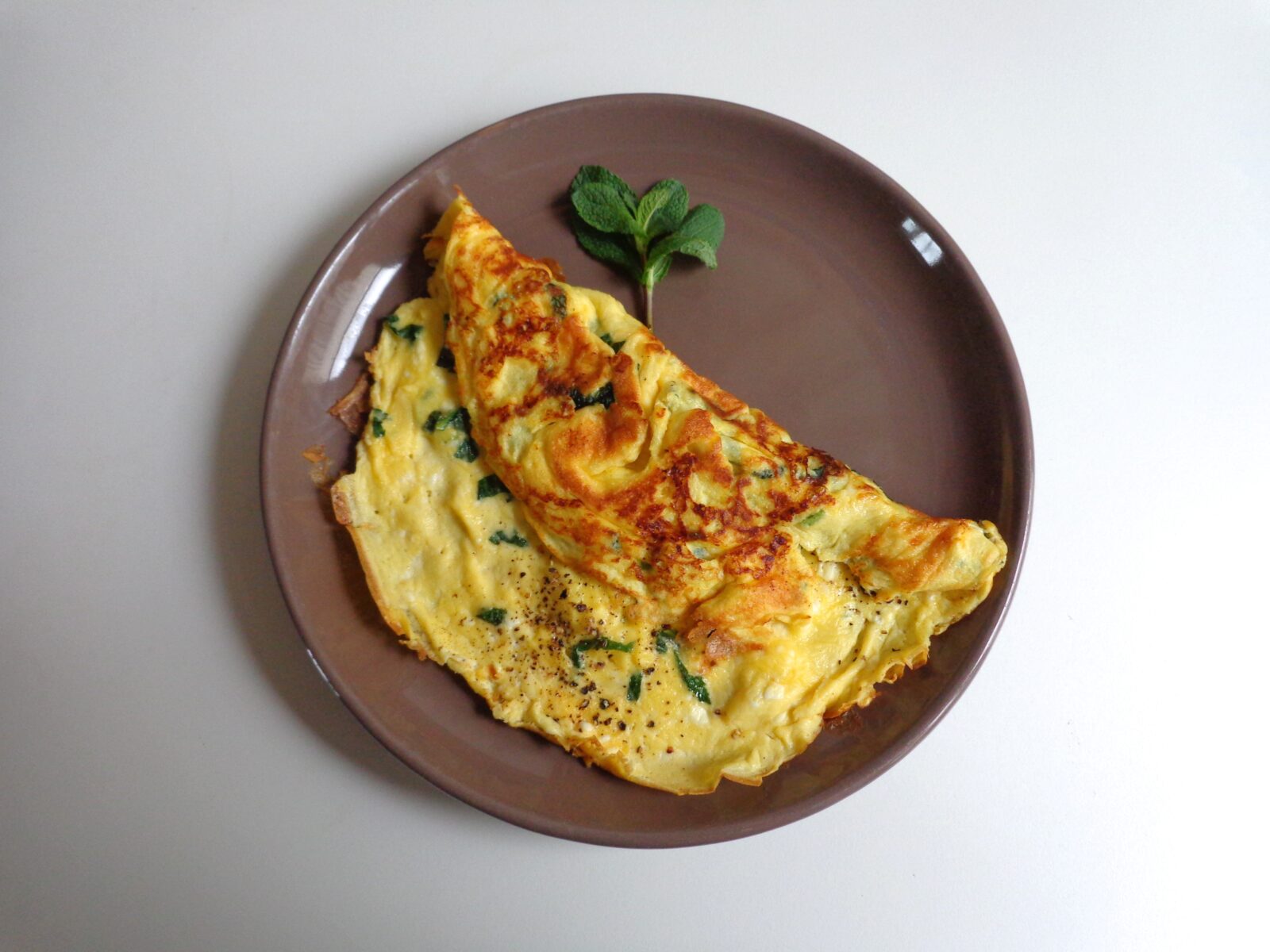
goat cheese omelet2Mint grows wild in Corsica, and little goats gambol on hillsides descending to pale blue seas. The sunlight is so intense and the Mediterranean vegetation so lush that the combination has earned Corsica the nickname ‘Isle of Beauty’. In this traditional Corsican omelet, mint and fresh goat cheese combine to create an earthy, vibrant flavor that may inspire you to dream of the island and — why not? — your next trip there.

Omelette au chèvre frais et à la menthe / Omelet with fresh goat cheese and mint

I’ve been to Corsica many times, usually to the northwest shore in the area between Calvi and l’Ile Rousse, a region known as La Balagne. The smell of the pines, the chirping of cicadas, the rustling of olive leaves, the sultry heat make it an irresistible spot for relaxation. The mint there is known as mintrastella — island mint — and grows nearly knee-high around little streams in the hills. Corsicans gather it to use not only in omelets, but in soups, savory tarts and deep-fried snacks.

One year we had to decamp in a rush from our rented house up in the hills overlooking the sea when wild fires encroached on the property. I grabbed my child, jumped into the car and drove like a madwoman down a rutted road crossed by lines of flames, hoping our vehicle wouldn’t catch fire and explode. We made it to the seaside, which was perfectly calm except for the hum of fire-fighting planes overhead. When we went back the next day, our house was intact but the garden had been transformed into a landscape of blackened tree trunks. My daughter, then 5, burst into tears.

Still, we returned the next year, to the same place, and found much of the vegetation restored. Corsica is magnetic, and I couldn’t stay away despite the drama of our previous visit. The light, the sounds, the wild odors and lovely sea, and of course the food — it is truly an island of beauty. Happy dreaming — and happy cooking.

Posted in 4. Omelets, Soufflés, Quiche | 2 Comments

Salade de pissenlits aux lardons

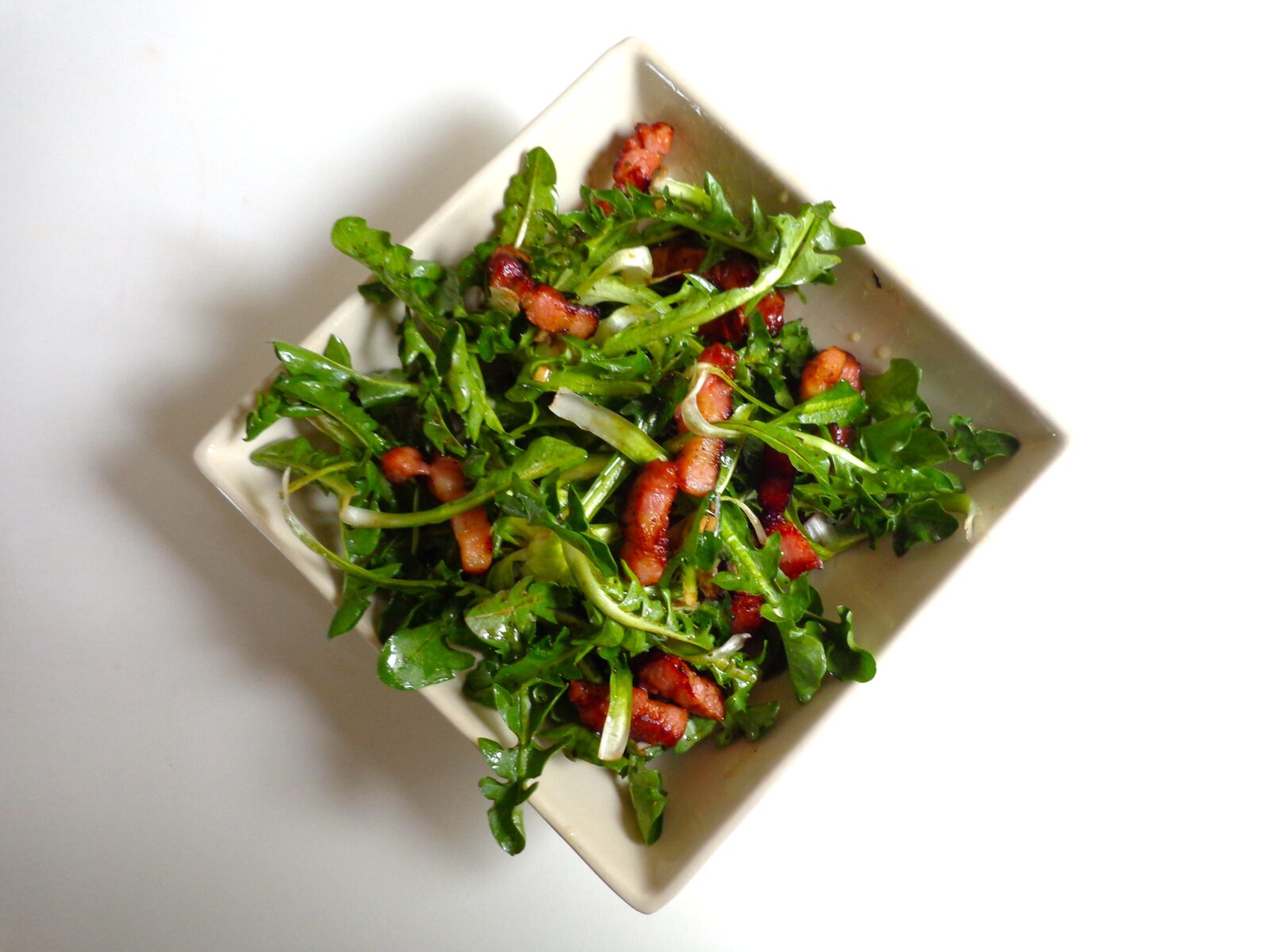
dandelion bacon salad1What to do with those pesky dandelions that pop up at this time of year? The French solution: make a salad. The slightly bitter leaves marry perfectly with bacon, which is how I first discovered this salad, at a Parisian brasserie many years ago. It is sometimes served with croutons or eggs, or both. These days dandelion salad is seen less often at restaurants, so I make it myself. Crisp, fresh and incredibly nutritious, it’s a fine way to bounce into spring.

Salade de pissenlits aux lardons / Dandelion salad with bacon

My most memorable experience making dandelion salad was in Moscow, where spring comes a couple months later than in France. I was at the dacha of an acquaintance with my friend Lindy Sinclair, who in those days wrote a cooking column for The Moscow Times. When we spotted a lawn bursting with fresh dandelions, we gathered them into a basket, fried some bacon and made the salad. She later included dandelion salad in her cookbook The Wistful Gourmet (which is now available for viewing online). Lindy, who now divides her time between London and the Ardèche region of south-central France, blogs regularly about her superb garden at fruitfulresearch.com.

I’ve often wondered why dandelion, which derives from the medieval French dents-de-lion (‘lion’s teeth’, because of the jagged edges), has turned into the far less elegant pissenlit (‘piss in bed’) in current French. Apparently it has to do with the diuretic qualities of the leaves, although I have never experienced this effect myself. The French, with their long rural history, have many colorful expressions linked to plants, and the dandelion is no exception. My favorite: manger des pissenlits par la racine — ‘eating dandelions from the roots up’, meaning the situation you’ll find yourself in once you’re dead.

Which I hope will not be anytime soon for any of us. Happy cooking.

Posted in 3. Salads | Tagged , , , , , , , | 1 Comment

Poulet à la citronnelle façon Thaï

chicken lemongrass2And now for something completely different… With the proliferation of Asian restaurants and groceries in Paris, as in many other cities, Thai cooking is currently within reach of anyone who wants to try it. And thanks to my sister-in-law, who sent me a fabulous Thai cookbook for my birthday last fall, I have been trying it quite a bit. So here, for the first time on The Everyday French Chef, is a Thai-style recipe with a French touch.

Poulet à la citronnelle façon Thaï / Chicken with lemongrass, Thai style

The trick to making this dish is to simplify by cutting out hard-to-find ingredients. But don’t tell anyone — they won’t guess, because the flavor is supremely Thai. The one essential ingredient is the lemongrass. Here in Paris it is available at some outdoor markets and at Asian grocery shops. After experimenting, I found that it’s entirely possible to leave out more exotic ingredients, like galangal, kaffir lime leaves or coriander root, and substitute simpler ingredients, for example lime juice and fresh cilantro.

The cookbook I received for my birthday has been a perfect guide. It is New Thai Food by Martin Boetz, who runs a Thai restaurant in Sydney. For anyone who’s really serious about Thai cooking, I highly recommend it. His book does not contain this recipe, although it certainly inspired me to try my hand at Thai cooking — and to innovate. Chicken with lemongrass has now become a staple in our home, and wins applause when I serve it for guests. So if you enjoy Thai flavors but prefer to cook in an everyday style, do give it a try.

Meantime, I learned this week that Saveur magazine has opened nominations for its annual Blog Awards. If you enjoy The Everyday French Chef,  I would be thrilled to be nominated by you in any one (or more) of the various categories, which include Best Writing, Best-Designed Blog and Most Delicious Food, among many others. Click here to go to the awards page. Nominations close on March 13.

Happy cooking!

Posted in 6. Poultry | Tagged , , , , , , | 4 Comments

Cake apéritif aux olives, lardons et pistaches

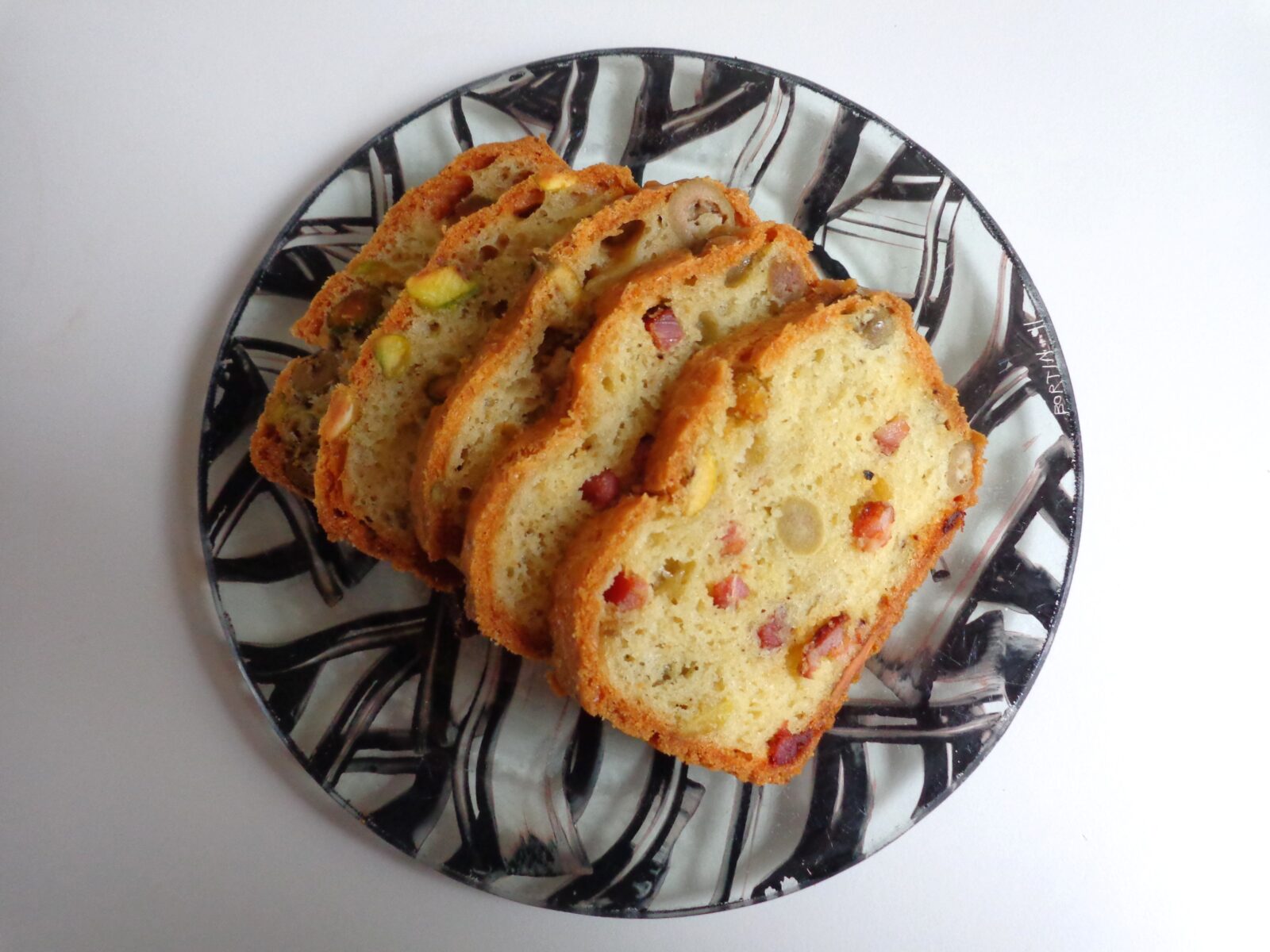
cake olives1Guests are coming and you’d like to do something really special for a festive cocktail hour? This rich and savory apéritif cake, studded with olives, bacon and pistachios, will knock their socks off. I discovered it a couple of weeks ago when invited to dinner by my friend Valérie, a transcendent cook whose recipes have appeared on this site before. She served it with a dry white as guests gathered beside the fire in her casual/arty Paris apartment.

Cake apéritif aux olives, lardons et pistaches / Savory cake with olives, bacon and pistachios

Since readers have been asking me lately to describe the order of dishes in a typical French meal, I thought I might share with you the dinner that Valérie prepared. (Of course, her dinners are anything but typical. But the dishes came along in the usual order).

We began around the fire with the savory cake, wonderful tarama she had picked up at a neighborhood bistro, Le Taxi Jaune, and thinly sliced saucisson sec, the dried French sausage that looks like hard salami but tastes completely different. When we repaired to the table, Valérie served as a first course une crème de choufleur — not a soup but a satiny purée of cauliflower, blended smooth (she later confessed) by the addition of cold butter.

The main course was a seven-hour leg of lamb, meaning that it had been roasted at low temperature for … seven hours, resulting in ever-so-tender slices, served with sliced carrots that had been in the roasting pan, slow-cooked turnips and leeks, and potatoes baked in their jackets. Too much of a good thing?

No, because we went on to a salad of tender leaves and a spectacular cheese platter, with pungent Saint Nectaire from central France, a goat cheese, a fruity Comté and — imported from England — Stilton. And yet there was more to come…

At this point, I must admit, I was feeling like I couldn’t take another bite. But out came the dessert — a vanilla cream with truffles, served in deep small cups — and as the oohs and aahs erupted around the table, I dipped in my spoon. Pure bliss.

Valérie’s husband, Philippe, has the accent of southwest France and is well-versed in the products of that sunny region. He served a variety of regional reds with the various courses. When we’d had the last drop, we returned to the fireside for more conversation and a welcome pause. But then they brought out the chocolates…

The damage? Two kilos, according to my bathroom scale the next morning. But it was worth it. A couple days of cabbage soup, and the kilos had melted away.

Happy cooking!

Posted in 1. Starters | Tagged , , , , , , | 4 Comments