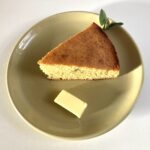
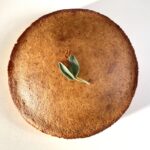
 Fresh sage adds an element of surprise and delight to this American classic, cornbread, which can be made on this side of the Atlantic by substituting polenta for cornmeal. And although cornbread is traditionally served mainly on Thanksgiving in the northern United States, it makes a great addition to any meal where roast chicken, duck or game is on the table. So you can wait for the holiday, or you can fire up the oven and try it right now.
Polenta à la sauge cuite au four / Cornbread with fresh sage
To be honest, I am not an expert in the field of cornbread. I had to test this recipe three times to get it right, and I owe my success to my American friend Nancy, who holds a doctorate or some such in all matters Thanksgiving. I started by trying to make baked polenta with parmesan, which turned out flat and rather dry. I moved on to a cornbread recipe made with milk instead of buttermilk — again, flat and dry. Finally I went out and found some buttermilk in Paris (aka lait fermenté or babeurre), as well as some baking soda (bicarbonate). The result is the fluffy, sage-infused cornbread shown in the photo.
This was, of course, not my first attempt at cornbread. But I don’t do it often. I celebrate Thanksgiving most years with a friend who does the turkey and stuffing, while I bring the cranberries, sweet potatoes, green beans and salad, and other guests bring the cornbread and pies. However, I did have one notable effort with cornbread some years back when a French television station, Arte, asked me to take part in a series they were shooting in which three-star French chefs were asked to recreate dishes shown in famous paintings.
 In my case, this involved the 1943 Normal Rockwell painting called Freedom From Want in which an American family is portrayed as the turkey is presented at a Thanksgiving table. The idea was that the three-star chef, Georges Blanc, would make the turkey and accoutrements. I was asked to bring the cranberry sauce. Fine. I am indeed an expert at cranberry sauce.
But the night before I was due to head to Georges Blanc’s three-star restaurant in Vonnas, about an hour north of Lyon, the head of the Arte team called me in a panic and asked me to bring cornbread as well. The problem? They had asked the baker reputed to be the best in Paris to make the cornbread, and he had made … a crusty oval loaf of French country bread with a little cornmeal in it. Nothing to do with real cornbread.
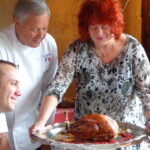 What to do, what to do? I called Nancy, who explained to me about using polenta instead of cornmeal. I got up the next morning at 6 a.m. and set to work. My first attempt was an abject failure, but I tried again and produced a reasonable semblance of cornbread. Then I raced to the train station with cranberry sauce and cornmeal in tow. On arrival, I found that Georges Blanc’s version of Thanksgiving turkey was minuscule but delicious.
I have written about this experience previously on this blog — click here to see the story — and have to say that it was a huge amount of fun. When thinking about what to post for Thanksgiving this year, I came up with the idea of adding fresh sage, one of my favorite herbs. And so, dear readers, I invite you to consider this recipe, for your holiday — Oct. 12 for Canadians, Nov. 26 for Americans — or for any other occasion.
 Happy cooking.


Dear Meg,
I can’t wait to try your polenta with sage! But, like Mike, I never associated cornbread with the northern U.S. I came to love it when I was served it in the south.
And stuffing? For Jim’s dinners, I had a cornbread and chestnut stuffing that was very popular…. A chacun son goût!
Hi Mary. You’re absolutely right. Of course cornbread is mainly associated with the south! I just meant that, in the north and in my experience, it is often served on Thanksgiving and not so much during the rest of the year. As for our dear departed friend Jim Haynes, a southern lad who was raised (partially) in Louisiana before moving on to Edinburgh and then London and then Paris, where he lived for more than 50 years, I’m sure he just adored your cornbread and chestnut stuffing when you cooked at his legendary dinners. So sorry I missed it! Bises, Meg
Cornbread is not a northern mainly thanksgiving dish. It’s very firmly a southern staple commonly served with BBQ and if it was to be on a thanksgiving table it would commonly be made into a cornbread stuffing/dressing. Thought i could trust this site to have accurate information but that ship has sailed.
Hi Mike. So I guess I didn’t express myself very well. I wrote that cornbread is served in the northern United States mainly on Thanksgiving, which I believe to be true, but left implicit that it is served all year round in the southern United States. Should have spelled that out. For what it’s worth, I would love to have some cornbread with BBQ in the U.S. south. But I’ve only been there once and that was a long time ago. On Thanksgiving here in Paris, my American friends and I generally make a bread-and-chestnut stuffing for the turkey. We wouldn’t dream of turning cornbread into stuffing. It is far too precious and delicious. I’m glad you’ve been satisfied with the site until now, and do hope you’ll stick around. Best, Meg