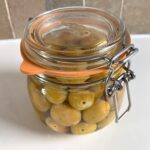
 Almost every year towards the end of summer I find myself piling plums into jars, covering them with eau de vie (clear brandy), adding some sugar and sealing them up to be ready in time for the holidays. The jars need to rest for at least two months. When you open them, the flavor of the fruit has infused the alcohol, creating a heady, heavenly concoction that may be served after dinner in pretty little glasses, as you’d serve a digestif, for example Cognac.
Prunes à l’eau de vie / Plums in brandy
The recipe is laughably simple and can be made with any type of plums, although the smaller varieties work best. And if eau de vie is hard to find where you live, a flavorless vodka may be substituted with excellent results. You rinse the plums, prick them with a toothpick, place them in jars with hermetic seals (no need to sterilize), add the alcohol plus a few spoonfuls of sugar, and that’s it. After sealing the jars, you shake them to help the sugar dissolve, repeating this a few times a day for a day or two. Then you put them away in a cool, dark place, like a cupboard, to let them mature.
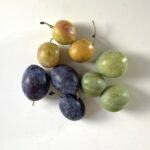 This year I used two types of plums — small, sweet yellow mirabelle plums, which are grown across France, particularly in Alsace-Lorraine in the northeast, and small blue plums, known here as quetsches, which are a bit more tart. In the past I have also used greengage plums (Reine-Claude), but they tend to be larger, which is a consideration as you want to be able to fit a plum or two into each little glass.
Preserving fruit in alcohol has a long tradition in France. The alcohol of choice is eau de vie, which is distilled from fruit. I generally use a variety sold as ‘Alcool pour Fruits’ that is 35% alsohol by volume, which is the minimum you need for this recipe. But I’ve also used vodka or regular brandy on occasion, or you could try matching the alcohol to the fruit, for example preserving plums using slivovitz, the clear plum brandy from eastern Europe.
My favorite homemade varieties are with plums and, in June, with cherries, both of which are also available in shops. Another type, which is less commonly seen now than when I first arrived in France five decades ago, is the amusingly named confiture de vieux-garçons (jam for old bachelors), in which the fruits are piled into a very large jar and doused in alcohol as they come into season. So you could have, for example, successive layers of cherries, apricots, peaches, plums and grapes. (I have never done this.)
France also specializes in fruit-flavored eau de vie, but this is impossible to make at home unless you have a license and a still. Popular varieties include Framboise (raspberry) and Mirabelle, as well as Poire Williams (pear), which is sometimes sold with a whole pear in the bottle. This absolutely mystified me when I first got here. How do they fit the full-grown pear into the thin-necked bottle? Well, it turns out they don’t. What they do is to insert a blossoming pear branch into an empty bottle and let the pear grow to maturity inside it. Once the pear is ready, they cut the branch and add the alcohol.
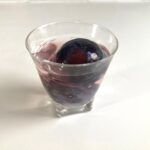 When I still had my farmhouse in Burgundy, I had many hilarious evenings with friends when dinner ended with cherries or plums à l’eau de vie. It was all the more fun because our garden had fruit trees, so I was able to pick the cherries and plums myself before having my way with them in the kitchen. You can use jars of any size for this recipe — a couple of large ones to keep at home, and smaller ones to give away. They make great Christmas presents.
Happy cooking.


