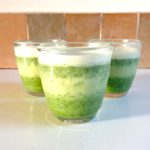
 This fantastic recipe comes to me from Rodolphe Paquin, chef at the bistro Le Repaire de Cartouche down the street from me. Its genius is not just the use of garden clippings that are normally discarded, but also the addition of whipped cream, which turns the soup into a frothy confection. Serve it in small quantities as a dinner-party palate teaser before moving on to the first course. Or be totally decadent and make a pot of it just for yourself.
Crème aux herbes potagères / Soup of mixed garden greens
For the ecologically minded, it’s hard to imagine a better soup than this. The Rodolphe Paquin original uses carrot fronds, radish leaves, watercress or sorrel and fresh tarragon, along with whatever other greens he may have on hand. The greens are cooked in a gentle broth, with the whipped cream swirled in at the last minute. When I first tasted it, I had to have the recipe, and Monsieur Paquin, being a generous gent, was happy to oblige. I then served it at a dinner, and the guests virtually swooned in delight.
This is food from yesteryear, with a contemporary touch. Moving on, let’s consider the food of tomorrow. The international edition of The New York Times ran a special section on the subject this week, and I was so surprised by what I read in an article by Chris Horton that I’d like to pass it along.
Can you imagine that 3-D food printing is already underway? One machine on the market will produce a pizza ready for baking — all you need to do is to fill its capsules with the ingredients. A Spanish chef with two Michelin stars — Paco Pérez of Miramar in Llança near the Mediterranean coast, just a few miles south of the French border — is turning out quiche lorraine with another 3-D printer, known as the Foodini. The printers can create food tailored to an individual’s specific nutritional requirements or turn out pasta in shapes that cannot be made by hand. For the moment, all they apparently lack is an oven.
The article reported that 3-D garden farming, while still in development, is also on the way. A machine called the FarmBot will use a mechanical arm to plant, water and weed a small garden plot. This will be on my mind today when I head down to my garden in Burgundy, which hasn’t been tended much this year and is a mass of weeds. On the other hand, just as I doubt I’ll ever invest in a 3-D food printer — cooking is too much fun to relinquish to a machine — I don’t think I’ll be buying a farming robot anytime soon.
Getting my hands into the dirt and planting seeds that will turn into food is one of my great pleasures in life. Harvesting home-grown produce and bringing it to the table gives me such joy that I find myself thanking Mother Nature for her abundance as I sit down to eat. Forget about 3-D food printers. As we approach the Thanksgiving season, let us be thankful for the world as we know it, for the satisfaction we take in preparing delicious, healthy food in our home kitchens with our own hands. Food like an elegant, frothy soup of mixed garden greens.
Happy cooking.
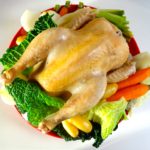 Every French school child learns that, back in around 1600, ‘good King Henri IV’ wanted to put a chicken in every pot. How much truth there is in this legend is still being debated by historians. What is incontestable, though, is that the dish called poule au pot to this day carries royal connotations. And yet, it is so simple. A chicken (or a hen) is boiled with vegetables to make a two-dish supper: first the soup, then the chicken and veggies.
 Soufflés are often regarded as too difficult to attempt at home. I found this to be true when, as a young woman inspired by Julia Child, I set out to make one. Julia’s recipe for cheese soufflé in Mastering the Art of French Cooking stretches across nine pages, with long paragraphs on subjects like how to beat egg whites by hand. Not to be intimidated, I tried — with dubious results. Only after moving to Paris did I discover there is an easier way.
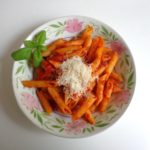 We’ve been having a September heat wave. Maybe this explains why so many Paris bistros are featuring Italian dishes at the moment. Most popular seems to be the assiette italienne, typically melon, parma ham, tomatoes, mozzarella and basil. But pasta is omnipresent too. At the ultra-trendy café Merci the other day, the special was a salad of pasta in pesto. In tune with this spirit, I decided to post one of my favorite pasta recipes.
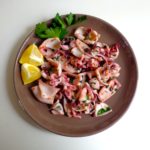 We just returned from a week at the shore in southwest France, where the beaches are vast, the waves are impressive and the food is fantastic. One of the specialties I most love in that corner of the world is squid grilled with garlic and parsley. The squid are cooked using a method the French call aller-retour, or back and forth, a phrase most commonly seen on round-trip tickets. In culinary usage, the phrase means that the food is placed on an extremely hot grill and cooked very quickly on one side (aller) and then the other (retour).
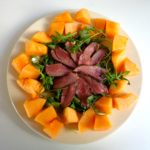 When the French say melon, they are generally referring to one particular type of melon. It is small and round, about 4-6 inches (10-15 cm) in diameter, with dark green stripes over a pale exterior and an intoxicatingly sweet orange interior. It is similar to cantaloupe, but more fragrant. The most highly reputed come from Cavaillon, in Provence, while the most widely sold are called Charentais. All pair delightfully with duck.
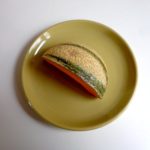 It is a mystery why the melons over here are so much sweeter than those found in the States. Perhaps because the sun in southern France is more intense, or maybe there’s another reason. If you have an idea, please let us know.
 When summer finally rolls around over here, our kitchen goes Mediterranean. The sultry breezes make it easy to forget that Paris is in northern France, far from the turquoise waters. Salads from Provence, Spain, Greece, Morocco and Lebanon appear, eggplant and tomatoes in many guises come to the table. And spicy meat dishes can play a starring role, for example meatballs of ground lamb topped with a yogurt sauce and fresh herbs.
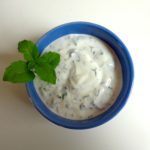 Dear readers of The Everyday French Chef: Normally I only post on Fridays, but today I am giving you a bonus recipe to compensate those of you who may have tried to access my site and instead found a blank page. Yes, you guessed right. My site was hacked again, and was down for about 24 hours. The problem is partially resolved now, allowing me to post this recipe for a delightfully light starter for a summer meal, or anytime of year.
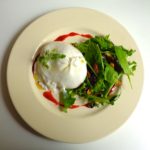 A whole creamy burrata beside a nest of tender greens strewn with roasted hazelnuts and surrounded by a drizzle of raspberry sauce — I wish I had dreamt up this combination myself. But in fact I was served it at a neighborhood bistro, and have been dreaming about it ever since. The combination creates an explosion of flavors that is, frankly, kind of addictive, with the very lightly sweetened raspberry sauce as an exclamation point.
 A highlight of the French summer is the rosy-cheeked apricot, which arrives from the south, generally Provence, and appears in abundance at farmers’ markets at this time of year. And a delight of the French table is a tart of apricots with almond cream. The flavors marry perfectly, the almonds adding a touch of majesty to the humble fruit. Serve it with a glass of something dry and bubbly, and prepare for applause…


