 The Basque country of southwest France is much appreciated for its culinary contributions. Across the Pyrenees in Spain, three-star chefs have taken regional cuisine to new heights of refinement. In France, Basque cooking retains its earthy traditions. The dish known as poulet basquaise sets grilled chicken on top of sautéed sweet peppers, tomatoes, onions and garlic, with a hint of spice. The result is a rustic, satisfying dish.
Poulet basquaise / Basque chicken with peppers and tomatoes
This is country fare, and there are as many versions as there are households nestled amid the mountains. Sometimes cubes of dry-cured country ham are added, sometimes not. The dish is often flavored with piment d’Espelette, made from mild local red peppers. But whatever the version, the dish is based on piperade — the sautéed pepper-tomato combo.
 Peppers are popular throughout the southwest, and come in many varieties, from mild to searingly hot. They are often smaller and thinner than bell peppers. I found some Basque-style peppers at my local market last weekend when shopping for ingredients. They were red, yellow and orange. I added a green bell pepper to achieve the right color combination.
When I served the dish to a couple of friends on Tuesday, a question arose. Why is the dish called poulet basquaise when poulet (chicken) is a masculine word in French, while basquaise is feminine? The answer is that usage has elided the words à la, meaning ‘in the style of.’ The same is true of boeuf bourguinon, and probably many other dishes.
As we enjoyed the dish indoors, there was a raucous tumult outside, for June 21 in Paris marks not just the solstice but also the annual Fête de la Musique, when people pour into the streets to hear the performance of anyone with a microphone and enough nerve. A woman in front of the pizzeria across the street was giving voice to a barely recognizable version of Lucy in the Sky With Diamonds. The crowd started dancing. Noisy, but fun.
We had started our meal with melon and Bayonne cured ham, and planned to finish with strawberries but had to stop. Poulet basquaise, typically served with rice, is quite filling, and we had had enough of everything but wine.
That was Tuesday. Now it’s Friday morning and Britain has voted to leave the European Union. The result is a terrible shock for those of us who believe that the EU, despite its unwieldiness and questionable political decisions, has been a bulwark against the kind of European divisions that led to the second World War. Already we are seeing a domino effect, with rightist populist leaders in France and Holland calling for similar referendums.
My feeling — and this is beyond the usual scope of this blog, so if you are not interested in politics, please don’t read on — is that EU leaders erred badly a) when they opened the union’s borders to citizens of member countries whose poor flooded into richer lands, creating national identity crises, and b) by allowing unelected European policy makers to make decisions affecting national budgets for unrepresented populations, creating resentment over loss of national sovereignty.
I was up much of the night following the British election returns. Until 3 in the morning, the BBC was still running polls predicting a solid victory for the Remain camp. By 6, it was clear that those who chose to Leave had won by more than a million votes. Wishful thinking on the part of the pollsters? Who knows? It is a gray dawn over here.
And on that note, happy cooking.
 One of the rites of spring is a trip to the market for fresh peas, which appear in abundance in June. In this recipe, the peas are blended into a textured soup enlivened with a hint of peppery mint. Serve the soup hot or cold, as is or topped with thin strips of Parma ham, a dollop of crème fraîche, a spoonful of coconut cream or finely sliced shallots and mint leaves. Meaning that this is a soup for everyone — omnivores, vegetarians and vegans.
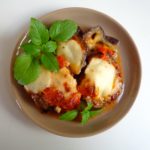 It’s been a long rainy spring. We needed a hint of summer. The solution? Eggplant gratin with homemade tomato sauce, topped with bubbly cheese. This is a lighter version of a familiar dish, also known as eggplant parmesan, because the eggplant slices are steamed instead of fried before going into the gratin dish. It’s fun to assemble — the whole family can get into the act. Add a sprig of fresh basil and voilà. Summer has arrived.
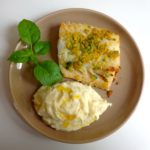 ‘I do not cook, I practice art.’ These words, pronounced by the divine actress Stéphane Audran toward the end of the film Babette’s Feast, give voice to the feelings of many of us when we enter the kitchen. Such were my feelings when I set out to duplicate a dish I had recently tasted at a nearby bistro. The dish? Cod crusted with pistachios, and served alongside a creamy purée of potatoes flavored with horseradish. Simply divine…
 Over the last couple of weeks, I have been on a cooking spree, revisiting dishes already on the site in order to update their photos. The first is
  The second revisited recipe is
 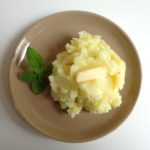 I have also added a bistro classic that was long overdue —
 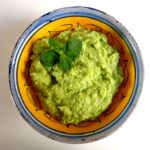 Consider this a Mediterranean version of guacamole. Fava beans (aka broad beans) are cooked to tenderness and puréed with olive oil, lemon and garlic, with a little cayenne pepper for bite. A perfect spread as warm spring days edge toward the sumptuous evenings of summer. Right? That’s what I thought when I made this spread for guests a couple of weeks ago. But I was wrong. April in Paris was a bust this year. Truly the cruelest month…
 I first encountered this spread maybe 20 years ago at the home of a Lebanese woman who lived around the corner from me in Paris. A superlative cook, she used canned fava beans for the spread, and this is a fine option in other seasons. You can also make the spread with frozen fava beans, a huge convenience as it allows you to dispense with shelling the beans (and they need to be shelled twice…). But in spring, fresh beans are best.
 The other day I wandered into a local lunchtime place and was served the most delectable quiche I’d tasted in a long time. Both light and rich, it veritably hummed with the flavors of spring — in the form of green asparagus and oyster mushrooms. The place was the Rose Bakery. I wrote to them to ask for the recipe, but they didn’t reply. Never mind. I made it anyway.
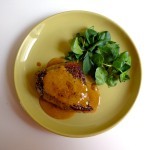 A dish that can bring down the house — literally — is steak au poivre, the classic French bistro offering of tender beef crusted with cracked black pepper and topped with a cognac-cream sauce. When I embarked on this recipe, my kitchen nearly went up in flames — twice! The skillet I used to pan sear the steak caught fire when I started the sauce, with bright yellow flames shooting two feet into the air. Oh là là…
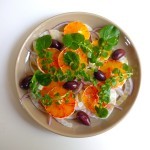 One recent Sunday during a visit to England, I was lucky enough to be invited to lunch in the picturesque town of Sevenoaks, in Kent south of London. My friends served me a spectacular meal, beginning with a salad of ruby-streaked blood oranges piled on thinly sliced finocchio and red onion, and scattered with Kalamata olives and watercress. Blood oranges would still be in season when I got home to France. I had to have the recipe.
 Can you imagine that tiramisu, the ubiquitous feather-light confection, did not exist half a century ago? It certainly was nowhere to be found in Paris when I arrived in the 1970s, having only just been invented (apparently), although its origins are in dispute. What cannot be contested is that this wonderful dessert of sweetened cheese layered with ladyfingers dipped in coffee is not only a crowd pleaser, but easy and fun to prepare.
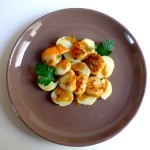 Sea scallops, Brittany style — dusted with flour, tenderly sauteed in butter and drizzled with a creamy sauce — make a fine winter’s dish. But what does this recipe have to do with the Way of Saint James, the historic pilgrimage route to Santiago de Compostela in northwestern Spain? Quite a lot, as it turns out, for the saint known as ‘Santiago’ in Spanish is ‘Saint Jacques’ in French, and along the route he gave his name to the humble scallop.
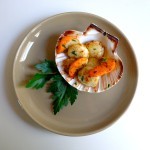 And why Brittany style? That’s a question I failed to answer, although my best guess is that scallops and butter are popular in the region. Brittany, of course, is surrounded by sea, and shellfish may be found there in abundance. The potato also has an important history in Brittany, where it came into wide use during a famine in the mid-18th century. In this recipe, the scallops may be paired with sliced potatoes, as shown in the photo above, or with potatoes boiled in their jackets. Another nice touch is to serve them in their shells.


