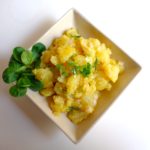
 You may say po-TAY-to, I may say po-TAH-to, but the French say “apples of the earth” (pommes de terre), perhaps an indication of their esteem for the humble spud. And French potato salad, simple and earthy, has a taste all its own. Unlike American potato salad, it has no mayonnaise. Unlike the German version, it leaves out the bacon. No, the French bathe potatoes in a vinaigrette while still warm, add chopped shallots and herbs — et voilà.
Salade de pommes de terre / French potato salad
This rustic culinary masterpiece was first presented to me shortly after I arrived in Paris as a student, served on the mixed veggie plate known as an assiette de crudités. It was surprisingly pungent, but also soothing. Over the years friends served it in many variations — warm or cold, with parsley or chives (or both), with dill or chervil or tarragon. Usually the vinaigrette contains Dijon mustard. When it does not, the dish becomes pommes à l’huile and is often served beside oil-cured herring.
Given the global renown of a culinary invention associated with this country — French fries — it is hard to imagine that pommes de terre were once so controversial that they were actually banned by the French Parliament. They were thought to cause leprosy and other ailments. This was back in 1748, before the Revolution and also before a certain Antoine-Augustin Parmentier revolutionized French thinking on the potato.
Captured by the Germans during the Seven Years War, Parmentier was forced to eat thin potato soup — and didn’t fall ill or die. Upon his return to Paris, he used his background as a pharmacist to conduct experiments with the potato. The more convinced he became of the potato’s nutritional value, the more creative he became in his struggle to persuade a dubious public. He planted a potato patch and had it guarded by day but not by night, inciting Parisians, who thought the plants must be valuable, to steal them — and try them. At one point he invited luminaries including Benjamin Franklin to a potato dinner.
By this time, potatoes — which had been brought to Europe from Peru by the Spanish conquistadors in the 1500s — were popular in Ireland, England and Germany, and had been brought back across the Atlantic to North America. The French finally lifted their ban during a period of famine in the late 1700s, even growing potatoes in the Tuileries Gardens to feed the populace. Parmentier today is viewed as a national hero. I live not far from Avenue Parmentier, a large Paris thoroughfare. Various dishes are named in his honor, most notably hachis parmentier, or ground meat topped by mashed potatoes.
Getting back to French potato salad, there are now many variations on the basic recipe. When researching this blog post, I came across versions including pickles, cockles, goat cheese, honey, eggs, olives and even algae. Sure, you can put seaweed in your potato salad. But as an everyday French chef, I’ll choose the traditional recipe every time. It will soon be the season for new potatoes — the very best choice for this salad.
Happy cooking.
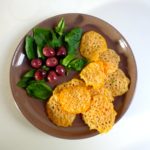 The wonderful French phrase l’heure de l’apéro means you’re done working and it’s time to kick off your shoes and settle in to a drink as a prelude to a pleasant evening. It’s like cocktail hour, but with a nuance of difference. The drinks are generally not cocktails but variations on wine, and on festive occasions — or even ordinary occasions — amuse-bouches are served with the drinks. For example, lacy chips baked from grated parmesan.
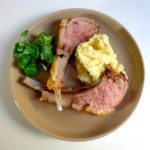 When is a lamb chop not a lamb chop? It may seem a minor distinction, but here in France a carré d’agneau (rack of lamb) is considered a different dish altogether than côtelettes d’agneau (lamb chops), the difference being that the meat is tender on all sides when the rack is sliced. The elegance makes it a dish for special occasions. Served with a sophisticated purée, for example of parsnips and cumin, it will add a touch of class to your table.
 A little lore was passed along to me by Robin from the butcher counter at
 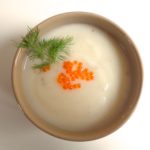 The humble cauliflower takes on elegance and class when transformed into crème de chou-fleur, a magnificent winter soup that is both light and packed with vitamins. It is essentially a purée of cauliflower with a spoonful of cream. Ground coriander seeds, lemon and dill enhance the flavor, while trout roe adds a bright touch — and more flavor. It makes a satisfying lunch dish and sparkles as a first course at dinnertime. Try it and see.
 Some days you just need comfort food — so why not make an apple strudel? This delightfully flaky dessert has been popular in France since it was introduced at Versailles by Marie-Antoinette, who came here from her native Austria after marrying the future Louis XVI. It is exceptionally easy to make these days thanks to the availability of filo dough, which eliminates the painstaking step of stretching out kneaded dough until it is paper thin.
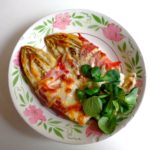 This recipe adds a couple of twists to a French classic, endives au jambon, which is enjoyed across the north of the country in the winter months. Twist Number 1: Dry-cured ham is used instead of the traditional baked ham. This adds sophistication and flavor. Twist Number 2: Cream is used instead of Béchamel sauce, making for a lighter dish. Travesty! Yes, for purists, but just try it.
 There is an art to making potato pancakes, known in French as galettes de pomme de terre, or potato flat cakes. The basic recipe is very simple — grate the potatoes, mix with a beaten egg, season with salt and pepper, and fry in oil or duck fat. A humble dish served in many forms around the world, potato pancakes are supremely satisfying when they come out crisp and light. But achieving this is more difficult than one might think.
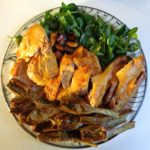 Roast duck is a festive dish in any season, but perhaps never better than in winter, enjoyed with a glass of hearty red beside a crackling fire. In this recipe, the duck is coated with a glaze of honey, thyme and balsamic vinegar, with garlic added to the roasting pan for a dish imbued with the flavors of southern France. Want to stay with the provençal theme? Serve the duck with pan-seared baby artichokes, this week’s second recipe.
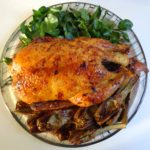 Duck is served in many guises in France, although it is rather rarely seen roasted whole. The most common versions are
 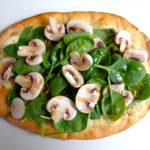 We’re galloping toward the holiday season, so this post kicks off a series of recipes that you may enjoy pre-, post- and during the end of year festivities — beginning with two tartes fines, the French version of pizza. The first marries bacon and fresh sage, while the second sets baby spinach and mushrooms on a layer of cream. These are of course not holiday dishes, but they’re perfect for serving between the feasts — quick, simple, crowd-pleasing.
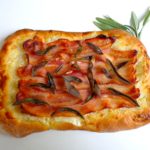 Tarte fine bacon et sauge
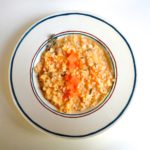 A couple weeks ago, on a bright October day, I made this dish for a friend who was coming to dinner. I’d had pumpkin risotto at lunch that week at Merci, a café with creative cuisine across the street from me, and found it so delightful I wanted to try my hand at it. Now, in this dreary season, it’s good to have dishes like this to turn to for solace. Pumpkin risotto is comfort food at its best, and escaping into the kitchen is, for me, a kind of zen.


