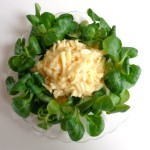
 It is always a comfort, on a cold, damp Paris day, to walk into a bistro at lunchtime and encounter a plate of céléri rémoulade, the classic French starter of grated celeriac bathed in a tangy mustard mayonnaise. This earthy salad is one of the dishes I longed for when far from France for long periods on journalistic assignments. You won’t find it in Moscow or Manila, nor for that matter in many of the trendy new cafés sprouting up in Paris. But what it may lack in chic it makes up for in flavor. A good reason to make it at home.
Céléri rémoulade / Celeriac remoulade
The key — once you have located one of the knobby, dirt-covered bulbs known variously as celeriac and celery root — is to make the remoulade sauce yourself, beginning with homemade mayonnaise. This is easily done, and the result bears no relation to the store-bought variety. If you’ve never tried it before, you can watch me make it in this video. The mayo is then enhanced with Dijon mustard and mixed with the grated root. It took me less than five minutes to prepare the salad shown in the photo above, and that includes making the mayo. (I was in a rush to watch CNN on the results of the elections in Iowa.)
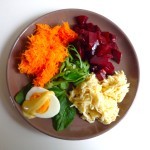 Celeriac remoulade can be served on its own as a starter, set on a bed of tender leaves or garnished with fresh herbs. But here in France it is most commonly seen as part of the mixed veggie starter known as assiette de crudités. It makes a magnificent partner to the other salads on the plate — most often of grated carrots, chopped beets, sliced cucumber and/or boiled potatoes, topped with vinaigrette and accompanied by half an egg.
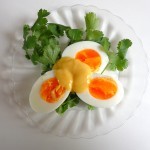 And speaking of eggs, while preparing this week’s post I took time to revisit another of my favorite classic French starters — oeufs durs mayonnaise. What could be simpler than eggs boiled just long enough to harden, their yolks remaining a bright orange-yellow, and topped with fabulous homemade mayonnaise? In this season where anything can happen politically, but where the weather (at least in Paris) is bound to remain relentlessly gray, we need — in fact, we deserve — a cheery start to a meal.
Happy cooking!
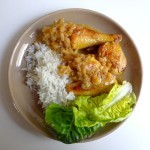 The French colonial empire once stretched across the globe, with the happy result — once independence was restored to the colonized — that the cuisine of many cultures is now available in France. Poulet yassa, or chicken marinated in a sauce of onions, lemon juice and mustard, is one such happy dish. Originally from the Casamance region of southern Senegal, it is now highly popular throughout former French West Africa, and also in Paris.
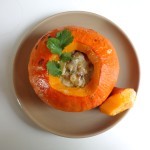 Back to Paris… Cold weather has finally set in, prompting me to revisit some of the winter dishes already posted here, with new photos. The first,
 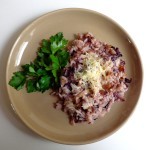 The second is a
 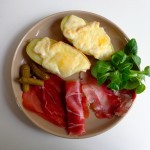 When winter comes to France, it’s time for raclette. This immensely popular dish of potatoes smothered in melted cheese, accompanied by cured meat and pickles, has come down from the Alps to become a favorite nationwide. It evokes memories of ski slopes, where of a snowy evening you could gather with friends to enjoy a restaurant meal of raclette, with a half-wheel of cheese brought to your table and melted under an electric grill.
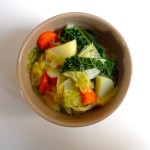 On the eve of the end-of-year holidays, here is a recipe that is renowned in France for its excess-fighting qualities. Ah oui, mes amis — once the festivities are over, it’s time to take action to counteract the effects of all the wonderful holiday dishes, sweets and drinks we may have indulged in. Rustic cabbage soup is the antidote. In fact, it is an open secret among French women and men who want to start the new year in their best form.
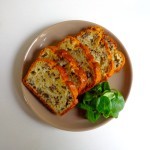 Walnuts and roquefort marry well, as they say. The combination turns up often in salads and as an after-dinner treat, perhaps with some pear slices alongside. In this savory cake, traditionally served in France at cocktail hour, the sharpness of the roquefort is offset every so slightly by the sweetness of the walnuts and the mild flavor of olive oil. It makes a festive offering for guests as we enter both the holiday season and the darkest days of the year.