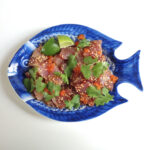
 I was inspired to make a carpaccio of tuna the other day after lunching in Montmartre at a place that served a fabulous version infused with Asian flavors. I didn’t think to ask for the recipe, so I had to wing it. In this version, ultrafresh tuna is flavored with a marinade of lime zest, lime juice, sesame oil, ginger and soy sauce, and topped with toasted sesame seeds and cilantro. For a gala touch, I added a sprinkle of trout roe.
Carpaccio de thon au citron vert / Carpaccio of tuna with lime
The restaurant, Che Tango, actually calls its dish ceviche of red tuna. So why, you may well wonder, am I calling mine carpaccio? Both involve raw fish — the difference is in how the fish is cut. In ceviche, which hails from Latin America, the fish is generally diced. In a fish carpaccio — a spinoff of Italy’s famous raw beef dish — it is served thinly sliced.
Carpaccio, which these days can involve meat, fish or veggies, takes its name from the 15th-century Venetian painter Vittore Carpaccio. The dish is said to have been invented in 1950 by Giuseppe Cipriano, the genial owner of the original Harry’s Bar in Venice, who wanted to please a client whose doctor had recommended she eat raw meat. He chose the name after visiting a Carpaccio retrospective that was on in Venice at the time — the color of the paper-thin raw beef resembled the vibrant reds in Carpaccio’s paintings.
With both beef and tuna carpaccio, there’s a trick to obtaining fine slices. Place the meat or fish in the freezer for ten minutes — this firms it up enough for easy slicing. You also, of course, need a very sharp knife, preferably sharpened just before slicing.
Vegetable carpaccios are a more recent entry to the repertoire. Most often seen in Paris is carpaccio de courgettes, in which thinly sliced raw zucchini is sprinkled with olive oil, salt and pepper, and topped with parmesan shavings. In a post on the differences between three raw food dishes — tartare, ceviche and carpaccio — the French chef Roberta Nacmias names carpaccio of porcini mushrooms (cèpes) as the king of veggie carpaccios. To the thinly sliced mushrooms, she says, ‘You add fine slices of white celery and white truffle. Then oil, salt and pepper, without forgetting to be generous with the parmesan’.
This set me wondering — are raw porcinis safe to eat? Research revealed that while many wild mushrooms are toxic when served raw, and some can be fatal, raw porcinis are merely difficult to digest. And indeed, the blogosphere has plenty of recipes for carpaccio de cèpes, often drizzled with hazelnut oil. Sounds great, but I’m not about to risk it.
As for tuna carpaccio, there’s no health risk as long as the fish is very fresh. It’s a light, flavorful dish that may be served on its own at lunchtime, perhaps followed by a green salad, or as the starter of a more elaborate meal. It would pair well with various Asian dishes on this site — Thai duck salad, Vietnamese noodle salad, cockles in satay sauce or lemongrass chicken — or with virtually any fish dish.
Happy cooking!
After writing this post, I called Che Tango to ask about their version of tuna carpaccio — and found that the recipe I came up with was quite similar. Their marinade is made of soy sauce, sesame oil, ginger, hot pepper, nuoc mam (Asian fish sauce) and garlic. And they, too, sprinkle the dish with toasted sesame seeds — white and black — and cilantro.
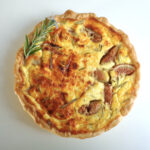 Fresh figs marry beautifully with goat cheese and rosemary, so I decided to combine them in a savory tart. I came up with this plan after my downstairs neighbor brought me a bucketful of figs — lush, plump and ultra flavorful — from her vacation place in Sardinia. Although it’s theoretically the height of fig season in France now, too, there’s been a dearth of homegrown figs this year, making me all the more grateful for the gift.
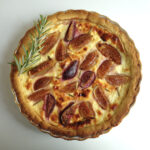 On my first go, I made the pastry myself, using the
 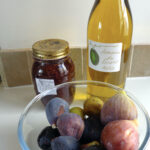 At left, the gifts from my neighbor: figs from her fig tree, her homemade fig jam (fabulous!), and a bottle of olive oil pressed from olives grown on her property.
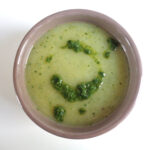 This zingy soup came about thanks to a visit I made to Provence last summer. While staying with friends in St-Rémy during a break between lockdowns, I came across an old cookbook of regional dishes and was intrigued to see a blended potato-leek soup that may be served cold or hot. It looked like something you’d expect to see further north — like a Provençal version of vichyssoise, in which the cream was replaced by pistou.
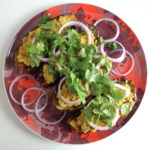 High summer is the time to make and enjoy this dish of roasted eggplant topped with a pungent walnut sauce. Traditionally served as a starter, it also makes a fine side dish or the star of a mezze spread. The walnuts are ground with garlic and fresh cilantro. Red wine vinegar and cayenne add tang, coriander seeds add spice, and celery adds a bit of crunch. It may not exactly be French — but it will have you saying ooh-là-là.
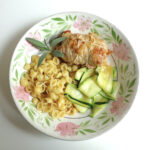 Paupiettes de veau, a classic bistro dish, are veal scallops stuffed with a savory meat filling. They are rarely made from scratch in French homes as they can be bought already stuffed from the butcher — and merely need to be braised before serving. But as I discovered, they’re fun to make and easier than one might think. The veal is folder around ground meat flavored with onion, garlic and herbs, then barded with bacon and tied up with string.
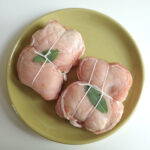 Preparation of paupiettes de veau begins by pounding the veal scallops to ensure they are thin enough to wrap around the stuffing. Tying them up is simple — it’s like wrapping a birthday present. Once stuffed, the paupiettes are browned on all sides and then braised in white wine or, sometimes, rosé.
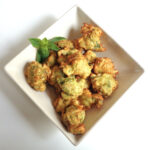 These light and crispy zucchini fritters are a French adaptation of a dish I discovered on a Greek island. Flavored with mint, dill, oregano and grated onion, they make a delightful start to a meal and may also be served at cocktail hour or as part of a mezze spread. Or you can serve them alongside grilled fish, meat, chicken or veggies. They marry extremely well with tzadziki. Add a bottle of chilled rosé, and you’ll feel like you’re in the Cyclades.
 So, on my second try with the zucchini fritters, I went with my instinct and folded a beaten egg white into the batter. Success! I made myself some tzadziki (see the bottom of
 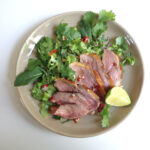 This Thai duck salad with French accents is a dish my friends ask for time and again when they come over. It combines Thai flavors — lemongrass, cilantro, Asian fish sauce, lime juice and red pepper — with the supremely French cut of duck known as magret, aka the breast, fat attached. The duck is cooked to a warm rosiness, then sliced and placed over or beside the herbal salad. Add a glass of chilled rosé, and lunch or dinner is ready.
 This is a very unusual crumble in that the strawberries are not baked but rather piled fresh into a glass and layered with crumble baked separately, whipped cream and homemade caramel sauce. The result is a light, fresh spring/summer dessert that is as lovely to behold as it is to eat. I can tell you that the crumble in this photo was devoured in seconds by my daughter, and its twin by her boyfriend. And this all came about thanks to French TV…
 A lovely way to serve an omelet in springtime is with freshly shelled peas, with a scattering of mint and scallions for an extra burst of flavor. You can add cheese, ham or bacon, baby spinach or arugula — anything your palate desires. The omelet is light, fresh and ultraquick to prepare. Peas straight out of the pod need to be cooked for only a minute. Then whip the eggs, swirl them into the pan, and lunch can be on the table in just ten minutes.
 My love of fresh peas translates into many other recipes:
 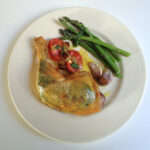 This dish of roast chicken with a garlicky basil sauce tucked under the skin was inspired by my friend Valérie, a superlative cook. It’s a spin-off from a venerable ancestor, poularde en demi-deuil, or ‘chicken in half mourning’, a specialty of Lyon in which truffle slices are slipped under the skin. As truffles are expensive and hard to come by, Valérie often substitutes herbal sauces. One of her favorites is pistou, the Provençal version of pesto.


