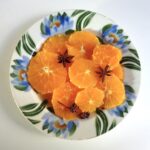
 This light, refreshing dessert of orange slices in a flavorful syrup is best in winter, when large sweet oranges are in season. I first tasted it at the home of my neighbor Manuela, a superior cook. But on that occasion she barely cooked. The main course was a platter of oysters and langoustines straight from the market. She followed up with the sliced oranges, which were so delightful I had to have the recipe. The star ingredient was star anise.
Salade d’oranges à la badiane / Sliced oranges with star anise
You can use any any oranges for the dessert, but the plumper and sweeter the better. The syrup is infused with cinnamon, vanilla, cloves and star anise, which translates beautifully into French as badiane. For me, star anise conjures up visions of Asian beaches with palm trees swaying in the wind. I use it often in Chinese cooking. More on that later.
If you haven’t used star anise before, it’s a seed pod that comes in the shape of … a star. It has a flavor similar to fennel seed, and can be found at high-end food shops and Asian groceries. According to amusingly varying accounts, the star anise was brought Europe in the 1500s either by Marco Polo or by an English sailor. If you’ve ever had the Vietnamese soup pho, you will have encountered its flavor.
This I knew, but what I didn’t know is that apéritifs like pastis and ouzo also get their anise flavor from star anise. The seed is prized in Asia for its medicinal properties, while in Europe it is used to make spiced tea and spiced wine. In the recipe for the orange slices, the spices are filtered out at the end, but star anise is so pretty that I use if for decoration.
Now back to Chinese cooking. A secret little known outside my immediate circle is that I’ve been experimenting with Asian cuisine in recent years. It all started when my sister-in-law sent me a Thai cookbook one Christmas (New Thai Food by Martin Boetz). Once I’d assembled the basic ingredients, I found it was easy to produce delicious Thai food at home for a fraction of the cost of a meal at the local Thai place.
During lockdown I branched out to Sichuan cuisine, again inspired by a local joint. This is where star anise came into the picture, along with another spice I now use a lot, sichuan peppercorn. One favorite is a cucumber salad with peanuts, another is shredded chicken in a spicy sauce. Lately I’ve been having a go at Chinese dumplings, for example with ground pork, Sichuan peppercorn and other spices, or with shrimp and lemongrass. If you can find the wrapper dough at an Asian shop it’s, pardon the mixed metaphor, a piece of cake.
I’ve thought about posting some of these Chinese/Sichuan recipes here, but since this is a French cooking site I’ve hesitated. However, if you consider that the French love Asian cooking, and that Chinese, Vietnamese, Japanese and Korean restaurants are doing a booming trade in Paris, then maybe Asian recipes are fair game. If you have an appetite for the occasional Asian dish on this site, please let me know. And in the meantime…
Happy cooking.
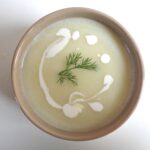 Hiding beneath its rather grand name, potage Parmentier is familiar to every child in France as potage poireaux-pommes de terre, or creamy leek-and-potato soup. It takes its name from Antoine Parmentier, who won royal approval of the potato (seriously!) on the eve of the revolution that toppled the kings of France. The soup — which unlike vichyssoise is served hot — makes a satisfying, and some would say elegant, winter dish.
 Bourride is a Mediterranean fish dish bathed in a sauce infused with garlic and inflected with hints of orange and sunshine. If you’ve been to the French Riviera you may have had the luck to encounter it. Elsewhere there’s little chance you would have run into this undeservedly lesser known cousin of bouillabaisse. I’ve rarely seen it in restaurants in Paris. Which is why, shortly after tasting it for the first time, I learned how to make it.
 Stuffed eggs topped with red caviar make a simple yet elegant dish that’s perfect for special occasions. Do I hear New Year’s Eve, anyone? Or brunch on the morning after? Most French takes on this dish call for the eggs to be scrambled. This recipe, with hard-boiled eggs, has a more Russian flavor. In the old days, Russians often served the eggs topped with black caviar — but with the sturgeon now an endangered species, red caviar is used instead.
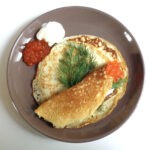 On occasions like New Year’s Eve, the eggs may be served as part of an hors d’oeuvre spread. They would marry well with
  If you’d like to serve something different this holiday season, why not consider côte de boeuf? A bone-in rib of beef that is served as steak, and not as a roast, côte de boeuf is a popular cut is France. It is ultratender, flavorful and easy to prepare. If you can convince your butcher to cut the meat as the French do, then this elegant dish would make a lovely centerpiece to a festive meal, perhaps accompanied, as shown here, by a cauliflower gratin.
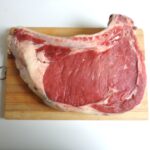 A côte de boeuf is the equivalent of an American ribeye steak, with the bone included. It is prepared in two stages. First the meat is pan-seared to seal in the juices. It is then roasted for a relatively short time in a very hot oven, allowed to rest briefly and sliced off the bone. Nothing is added until the very end, when the meat is salted and peppered. When buying the rib pictured here, I asked Marie Pacaud, who presides over the excellent Boucherie du Marais, whether to rub the meat with garlic. I received the French equivalent of fuhgeddaboudit: the Gallic shrug. ‘That would distort the flavor,’ she said drily.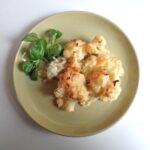
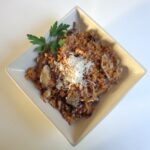 This unusual wild mushroom risotto is the creation of John O’Shea, the brilliant young British chef who presides over the kitchen at JJ Beaumarchais, a restaurant downstairs from my apartment. It is unusual first because instead of rice it uses épeautre, known in English variously as spelt or einkorn wheat, and second because, unlike most risottos, the ingredients are cooked separately and combined only just before serving.
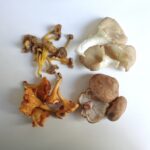 I made the dish three times last month, using a different combination of mushrooms each time. Pictured at right are four types I’ve tried. Going clockwise from the top left, they are in French, chanterelles, pleurotes, shitake and girolles. This may be a bit confusing, because what the French call girolles are called ‘chanterelles’ in English. But it doesn’t matter because you can use whatever is available in your area. I have also used the papery black mushrooms called trompettes de la mort (‘trumpets of death’), which despite their scary name are not poisonous and are indeed very popular over here.
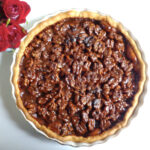 Walnut tart, a specialty of southwest France, is a favorite of mine in the autumn. The walnut pieces are bathed in a caramel sauce and then baked in a tender tart shell to produce a sweet, chewy confection — comfort food at its finest. This tart would make a nice innovation on Thanksgiving, and could add a festive touch on Christmas or New Years. With the holidays arriving, I wanted to share the recipe with you. There was only one problem…
 Can you imagine the slopes of Mount Etna after a volcanic eruption? This is how my tart came out of the oven, with hills and crannies that looked like solidified lava and were just as hard. I’d made the tart for a dinner party that evening, and my guests gamely agreed to try it. Not too bad, I guess, because they asked for more — although one remarked that he had never before seen a tart that looked like a lunar landscape.
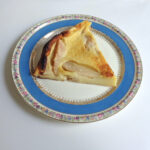 By the way, another autumn dessert I love is pear clafoutis, which I posted back in 2012, when this site was just getting started. I made it again recently and updated the recipe with a better photo. If you’d like to try it, the recipe is
 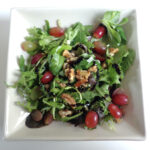 This is one of those French salads with an evocative name where the ingredients vary according to the whim of the chef. Salade vigneronne translates as ‘winemaker’s salad’, and in this version you’ll find tender leaves, walnuts, grapes and garlic in a balsamic vinaigrette, with optional add-ons such as smoked duck breast, dry-cured ham or croutons. It’s a salad I serve often in autumn. But when I surfed the web to see how others do it…
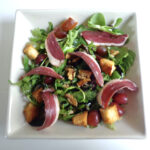 Getting back to salade vigneronne, my theory on why there are so many versions is that the name harks back to the tradition of winemakers serving hearty food to the workers they hire in autumn to pick their grapes. Although I’ve never participated in the vendanges (grape harvest), I hear it’s back-breaking work that deserves a substantial lunch. My lighter version of the salad may be served as a starter or as a lunch dish, followed perhaps by some cheese, and with a glass of red alongside. It would also make a nice dish to serve on the upcoming November holidays — Hanukah and Thanksgiving.
 Meantime, as to what else I’ve been up to in the kitchen, I made a wedding cake this past week. Great fun!
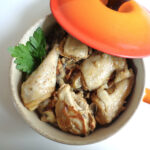 I was inspired to make this Normandy dish of chicken cooked in hard cider by the late great writer Marguerite Duras. Not that she made it for me, but I did enjoy meals at her house — more on that later. The dish originated as peasant fare for special occasions. The chicken is lightly browned, mushrooms, shallots and bacon are added, and the dish is then stewed in hard cider, with cream added at the end. By the way, Normandy grows a lot of apples.
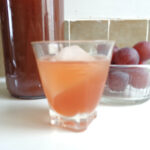 I discovered the apéritif known as ratafia one summer when the former owners of my cottage in Burgundy paid me a visit. As they admired the changes I’d made inside, I asked them how they had used the grapes growing on a sprawling vine outside. Since the grapes were too sour to eat, I had been leaving them to the birds. But I was sure that previous owners, including those who planted the grapevine in the first place, must have had a better idea.
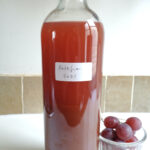 In Burgundy, where grapes are plentiful, making ratafia in the autumn is an annual pastime. And now that I’ve sold my cottage, I make it in Paris. It’s fun, inexpensive and the results are thoroughly enjoyable.


