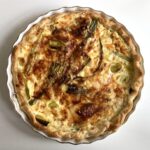
 A quiche brings out the best in the humble leek. Sautéd in butter to tenderness, bathed in a mixture of eggs, milk, cream and a dash of nutmeg, piled into a savory crust and topped with grated cheese, the leek rises from peasant status to nobility. And the beauty is that this quiche can be prepared very easily, especially if — as I did on a lazy Sunday (blush) — you use store-bought puff pastry (pâte feulletée) instead of making the crust from scratch…
Quiche aux poireaux / Leek quiche
Okay, I admit it. A homemade savory crust (pâte brisée) is far superior. And it’s not particularly difficult to produce. The key is having the butter at room temperature when you begin. Well, last Sunday I was in a hurry and the butter was stone cold. So I popped out to the supermarket and picked up the pastry, making sure to buy a “pur beurre” (pure butter) variety instead of one made with vegetable shortening.
 The quiche can make a meal in itself, accompanied by a salad — for example, in autumn, a salad of pears roasted with parmesan or a salad of lamb’s lettuce and beets. It can also be served as a starter for a more elaborate meal, followed perhaps by stuffed pumpkin (a great recipe, by the way) or roasted chicken, duck or beef and autumn veggies, and for dessert maybe a Tarte Tatin (apple upside-down tart) or walnut tart.
I’ve been thinking about autumn menus these days as we have two big birthdays coming up around here: my daughter is turning 25, and I’m turning… well… it’s such an improbable number that I won’t bother to mention it. For her birthday dinner, my daughter has requested foie gras followed by boeuf bourguignon and a celeriac-potato purée, with a pavlova (meringue topped with cream and fresh fruit) for dessert (recipe coming soon). As for me, I’m going with a Ukrainian-Georgian theme: blini with homemade gravalax, Georgian guinea hen, red bean salad with walnuts, etc.
These back-to-back events will be followed in short order by an election with the potential to change the world. My European friends are on pins and needles waiting for the result. They fear that a certain candidate, if elected, will pull the United States out of NATO — breaking up the alliance that has defended Europe for 75 years — and withdraw from the Paris climate accords. Everyone wants to know how I think this vote will turn out. Dear reader, I’m as much in the dark as everyone else. All I can say is, I voted. Did you?
Happy cooking.
 The beauty of a vegetable gratin is that it can be made with virtually any veggies you wish. I made a gratin of potatoes, carrots, leeks and baby spinach last month when the gray, rainy weather set in after our all too brief summer season in Paris. A week later it was back on our table by popular demand. The veggies are steamed, bathed in a
  The mixed veggie gratin may be served as a main course with a salad alongside for a simple meal, or as a side dish for a more elaborate meal. In autumn, you could begin with a seasonal starter, like a
  This zingy smoked herring salad proved a winner when I was asked to cook for 50 people at a party in Normandy in late August. It was meant to be served on the night of the party as part of a salad buffet to accompany a mechoui — slow-roasted lamb cooked over an open pit. But the 30 or so guests who had arrived by noon had it for lunch, which worked out well as I hadn’t really made enough for 50. Reader, they ate it all and asked for more.
 Pasta with broccoli, sausage, olive oil and red pepper flakes is a family favorite that I tend to make when cooler weather sets in — which has suddenly happened in Paris after a couple of warm months that went by in a flash. We had a hailstorm yesterday and overnight the temperature dipped to 6º C (43º F). It’s enough to send you scrambling for a warm quilt and a bottle of hearty red, which goes well with this spicy, garlic-infused dish.
 If you’re serving this pasta to guests and would like to add a dessert, I’d recommend
  This fluffy cheese omelet, a classic of French cuisine, is the last thing I expected to write about when I returned from Provence last week. I’d picked up three new recipes, including one for a fabulous garlic spread that is served in the region but largely unavailable elsewhere in France. Well, dear readers, I made it twice — and both times it was a dismal failure. So I consulted my fridge to see what else I could make on short notice…
 This dish of fish in a tomato-coconut-lime sauce hails from Brazil, where it is known as moqueca. I discovered it at the home of a friend in the English countryside, and found it so wonderful that I had to share it with you. Jane, the friend in question, learned to make it while her husband was serving as a senior British diplomat in Brasília. They entertained a lot and, as she put it, this is a great party dish because it can be largely prepared in advance.
 This summery salad of roasted eggplant with tomatoes and sweet red pepper is a versatile dish that may be served as a starter, as a side dish, as part of a mezze spread or as the star of a vegetarian meal. It is similar to its French cousin,
  This deeply flavorful Moroccan dish of garlicky chicken infused with cumin and coriander on a bed of meltingly soft peas makes a fine family supper or a festive dish for special occasions. And as we are reaching the tail end of the season for fresh peas, this is a good time to try it out. The recipe is easy but takes time as the chicken needs to marinate before going into the oven. The peas are cooked separately, and everything is combined at the end.
 Forget maple syrup, bring on the powdered sugar. French toast, French style, is mainly served as a dessert or an afternoon snack. Known as pain perdu (‘lost bread’), it was a poor man’s dish until, according to lore, it was discovered by the nobility in the 16th century, becoming a favorite of King Henri IV. From the king’s table, French toast made its way abroad, and the rest is history.
 These days French toast is rarely seen on bistro menus. It is most commonly served in French homes for the afternoon goûter (snack), a national institution for French schoolchildren to tide them over until French dinnertime, around 8 p.m. But this can also be a sophisticated dish. Serve it at your next brunch, with fruit and/or bacon, and prepare for applause.
 French garlic soup from Provence is called aïgo boulido, which translates amusingly as ‘boiled water’. Well, you can believe me — it’s a lot tastier than hot water. The garlic is boiled until soft, allowed to steep with fresh sage, thyme and a bay leaf, puréed with an egg yolk and olive oil, and served over toast topped with freshly grated cheese. Pale yellow, creamy and deeply flavorful, it’s a delight to the palate and the eye.


