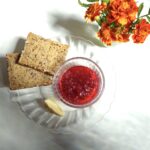
 When summer strikes, it’s time to head to the market for red currants — or, if you’re lucky enough to have them in your garden, to go on a picking spree. These jewel-like berries make a fabulous jam that is remarkably easy to prepare. Unlike cherries, plums or apricots, red currants do not need pitting. And unlike red currant jelly, the jam does not require the tricky step of squeezing the cooked berries through a cheesecloth (étamine).
Confiture de groseilles / Red currant jam
I’ve been making jam for many, many years, and red currant is one of my favorites. It’s not just the ease of preparation. It’s also the delightfully tangy flavor. Beyond the obvious uses for red currant jam — on toast, buttered bread or croissants — it also marries well with roast beef or chicken, much like cranberry sauce as a condiment with roast turkey.
And here’s another thing. You can use the same recipe with black currants (cassis), which make perhaps my all-time favorite jam. I would have included it today but black currants haven’t come on the market yet. We should start seeing them around mid-July.
 In the good old days, when I still had my country cottage in Burgundy, I had both red and black currants growing in the garden in profusion. Every year there was a tense moment in early summer when the berries started to ripen. I could only get down to the cottage on weekends. Who would get the ripe berries first, me or the birds? Sometimes the birds won, but I usually managed to pick enough for a batch or two of jam. And once the jam is in the jars, you can keep it for months or years.
Which brings me to another thing. How much jam is enough for a batch? If you set out to make a dozen jars, the process can seem overwhelming. Well, dear readers, sometimes I only make a jar or two at a time. So far this year I’ve made three pots of strawberry jam and two of red currant. Still to come are apricot jam, plum jam, blackberry jam and fig jam, and maybe some others as well. Preparing a batch of 2-4 jars takes less than an hour. By making small batches, you won’t get exhausted — and by the end of summer, you’ll have a lovely collection of jams in your cupboard.
Now for the good news. Making jam used to be a tedious process that involved melting paraffin to seal jam jars with special lids. I remember my mother, a great jam maker, standing heroically for hours over boiling pots of fruit and wax in the steamy heat of a Wisconsin summer. No more. As I learned upon arriving in France, paraffin is not needed to seal the jars, and no special jars are needed. Here’s how it works.
During the winter months, as you finish a jar of jam — store bought or homemade — you can remove the label and wash it. By the time jam-making season rolls around, you should have a collection of jars ready to go. On jam-making day, you sterilize the necessary number of jars and their lids for ten minutes in boiling water, then set them upside down to dry on a clean dish towel. When the jam is ready, you ladle it into the jars and screw on the lids. A vacuum will form as the hot jam cools, and this will preserve it perfectly.
Finally, I’d like to address the relative merits of jam vs. jelly. Fruits with a high pectin content, like red currants of quince, are often used to make jelly. But while jelly has its charms, making it at home can prove challenging. I learned this the hard way one year when a friend with a quince tree in his garden brought me a huge bagful. Fine, I thought, I’ll make quince jelly. I boiled them up with sugar, as the recipe specified, then attempted to squeeze the fruit through a cheesecloth to obtain the juice. Next thing I knew there was quince all over the ceiling and walls of my kitchen. Never tried that again…
 Jam is a different matter — easy to make, and so rewarding in the bleak midwinter when you open a jar and dip in a spoon. The intense burst of flavor as you taste the fruit will transport you back to blissful summer days. And you’ll have the satisfaction of knowing that you did it yourself. With just fruit and sugar.
Happy cooking.
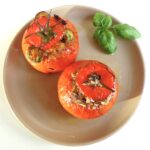 Stuffed tomatoes are one of the glories of French country cooking. This is peasant food at its finest, and fillings differ considerably. The traditional recipe, which hails from Provence, uses sausage meat, often in combination with beef or veal, and flavored with onion, garlic, herbes de Provence and fresh parsley or basil. In a lighter, vegetarian/vegan version, the tomatoes are stuffed with a filling similar to ratatouille, with a little bulghur added for heft.
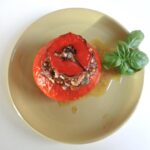 Fillings for tomatoes have evolved over the years in France. In the old days, leftover meat from boiled dishes such as
 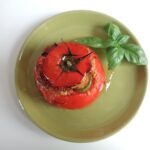 For the veggie filling, you can follow the recipe given here — with eggplant, zucchini, onions and garlic — or use your imagination. I’ve seen recipes that use combinations including potatoes, carrots, mushrooms, corn, pine nuts, raisins, goat cheese or olives. In all of these, the tomato pulp is also incorporated.
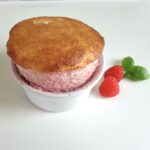 If you’ve never experienced a raspberry soufflé, it’s like tasting warm, fluffy, raspberry-flavored air. Sweet, light and ephemeral. And the good news is that this elegant dessert is remarkably easy to make. I’m not an expert on dessert soufflés, but when I saw Michel Guérard, one of France’s most venerated chefs, whip up a couple of small raspberry soufflés during a television feature, I knew I had to try to make them myself. Instant success!
 It’s only May and it’s already summer in the city in Paris — a great time to enjoy grilled pork brochettes with tomato, cucumber and red onion, even if you don’t have a barbecue. Today’s recipe adds a French twist to a Russian summertime favorite, shashlik. The secret is marinating the pork in — wait for it — red wine vinegar. I couldn’t believe this when a Russian friend first gave me the recipe. In France we mainly marinate in wine. But it works.
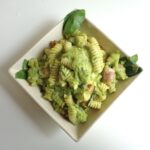 A culinary delight on a recent trip to Italy was an innovative pairing of twisty pasta and zucchini. This dish — the creation of my friend Gisella, a superlative cook — is not as simple as it sounds. The zucchini is cooked two ways so that the pasta is both bathed in a silky zucchini sauce and embellished with strips of sautéd zucchini. Grated parmesan, small squares of dry-cured ham and snipped fresh basil are added at the end.
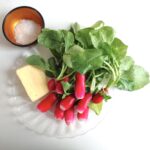 A quintessentially French dish that comes into its own in springtime is radis au beurre, or radishes with butter and salt. This traditional bistro fare makes a great start to a meal. I often serve radis au beurre at cocktail hour — fresher and much lighter than chips or nuts, especially if you go easy on the butter. Radis au beurre may also be served as a first course at the table, often accompanied by other back-to-the-land starters.
 One thing to note is that French radishes are rosy red with a white tip and elongated rather than round. They also tend to be less piquant than round varieties. (Strangely, they are referred to in English as ‘French breakfast radishes’, although I have never seen radishes served for breakfast over here.) No need to fret if you live elsewhere. Any red radishes would be fine for this dish.
 This dish of chicken in a creamy paprika sauce came about as a result of current events. I thought I’d like to make something Ukrainian in honor of a besieged nation, and I also wanted to add to the poultry dishes already on this site. My first idea, rather naturally, was chicken Kyiv (suprêmes de volaille à la Kyiv). But a little research showed that this dish, which by the way is quite complicated to make, is actually Russian in origin. Nyet.
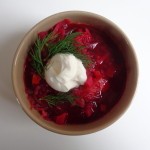 Grandma Anne was a good cook, although her imprecision with measurements drove my mother crazy. For example, her recipe for syrniki — little pancakes made with smooth cottage cheese and served with sour cream and jam — calls for ‘one half eggshell water’. I’d like to post this family recipe here one of these days, along with two more, Grandma Anne’s fabulous stuffed cabbages and her wonderful cheesecake.
  Meantime when thinking about today’s post I was surprised to realize that I’ve already posted two Ukrainian dishes on this site —
  Happy cooking.
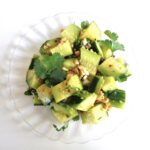 I discovered this spicy peanut-topped cucumber salad just as Sichuan cuisine began making it big in Paris. It’s on the menu of
 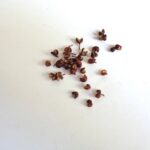 The key ingredient in this salad, as in many Sichuan recipes, is Sichuan peppercorn. It looks different from black peppercorn in that it’s a reddish brown and more wrinkled. Unlike hot red peppers (piments in French), Sichuan peppercorn is described as numbing rather than fiery. And its flavor is just unbeatable. You can find it at Asian grocery shops.
 The other day I decided to try to recreate a dish I vaguely remembered — cod with chickpeas, spinach and chorizo chips. It felt just right for a brisk, pre-spring sunny day. I checked my favorite Spanish cookbook, couldn’t find it. Ditto my Portuguese cookbook. Then I looked online, and found not a single recipe for this precise combination. So I winged it. Well, dear readers, my guest was happy. And in fact so was I.
 So whatever the origin of this particular dish, the flavors blend well. And, as I discovered, it is not just easy to make but has the significant advantage of being able to be prepared in advance. If you cook the chickpeas yourself — highly recommended — it’s best to start the evening before you plan to serve the dish. Tips on cooking chickpeas may be found
  Flamiche is a savory tart from Picardie made of leeks and cream encased in puff pastry. This is comfort food at its finest, perfect for cool days or nights as we wait for spring. Flamiche can stand on its own as a lunch dish or may be served as a starter in the evening, accompanied by a fruity red. Its versatility makes it a winner. Yet this pie from Picardie is rarely encountered in other parts of France, not to mention the rest of the world.


