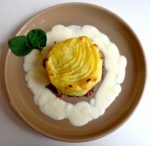
 Here’s a cold-weather dish that is both sophisticated and supremely French. Duck parmentier — shredded duck confit topped by puréed potatoes — has turned up on Paris bistro menus recently and I was lucky enough to be served this version in early December. It came surrounded by a parmesan cream sauce and, to quote a friend, it was absolutely divine. After finishing every bite, I asked the bistro owner for the recipe.
Parmentier de canard / Duck parmentier
The bistro in question was Chartier, in Levallois on the western edge of Paris. It’s the kind of place that you long to find but that is increasingly rare — a modern version of the classic bistro style, with an inventive menu that winks at past traditions. The owner, Thomas Chartier, a congenial man, was happy to share his culinary secrets.
Duck parmentier is a spinoff of the classic French dish hachis parmentier, or sautéed ground beef topped by mashed potatoes — the kind of food you might expect to find in school cafeterias, not at a classy joint for adults. Both are named for Antoine-Auguste Parmentier, the 18th century chemist credited with popularizing the potato in France.
In Monsieur Chartier’s version, duck confit is shredded and stirred into what he called a tombée de champignons, or thinly sliced mushrooms (wild and farmed) sautéed with onion until meltingly tender, before being topped by the puréed potatoes. For an extra flourish he adds an unctuous sauce of grated parmesan stirred into heavy cream.
In my version, I omitted the mushrooms for reasons of practicality — it’s not always possible to get hold of wild mushrooms, and without them this dish may be prepared in any season. I think it’s best in winter, though — a sublime comfort food that can be paired with a salad and a hearty bottle of red. If you’d like to add a starter, I’d suggest something light, perhaps smoked salmon, and for dessert possibly an apple or pear tart.
In the months ahead, I plan to bring you more French classics with a modern twist. This blog is now entering its fifth year and I’ve enjoyed every minute of it. Many thanks to all of you, dear readers. And on that note I’d like to wish you a very happy New Year and…
Happy cooking!
 I had a surprise recently when a friend from Alsace presented me with a recipe for butterbredel, small butter cookies in festive shapes that are traditionally served over the holidays. They’re not just pretty but incredibly easy to make. And fun! You can get the whole family involved. There are many variations on the recipe, but this one is the real thing. It’s from a bakery in Saverne, a small town near Strasbourg in northeastern France.
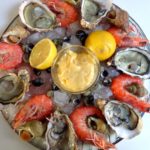 Sharing a shellfish platter in fond company is one of the great pleasures of life in France, particularly if you happen to be enjoying it by the sea. Add a bottle of crisp white and the sound of waves breaking against the shore, and you’re in for a romantic afternoon. This is of course not always possible. But with a little effort and ingenuity, you can create a shellfish platter at home. It makes a fine addition to a holiday meal.
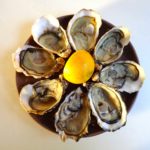 Assiette d’huîtres
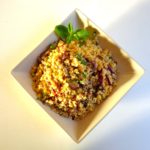 A guest was coming to dinner, a friend from the literary world. I didn’t want to have to spend a lot of time in the kitchen while he was here, yet wanted to produce a satisfying, palate-pleasing meal. What to do, what to do? After some considerable thinking, the solution appeared:
 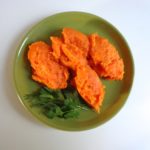 Moving on to the sweet potatoes, this is an ultrasimple recipe for a classic dish that is served every year in the United States in late November. But this succulent purée marries well with many dishes other than turkey and can be served throughout the autumn, or even throughout the year.
 You can find quiche lorraine in virtually any bakery or deli in France, but it is even better when made at home. The rich filling of eggs, milk cream, bacon and cheese fluffs up in the oven to marry delightfully with a buttery homemade crust. Served with a crisp white and a salad of tender leaves alongside, it makes a fine lunch dish or a great starter at suppertime. If you cut it into little squares, you can also serve it with drinks at cocktail hour.
 A salad of smoked fish makes a delightful lunch as the days grow cooler. In the salad pictured here, I used smoked mackerel, which is sold in France covered in crushed black pepper. Its tawny hues contrast nicely with the deep green of lamb’s lettuce and pale Belgian endive. Other options for the fish include smoked trout, smoked salmon or the perennial French favorite, smoked herring, a bistro classic that is popular here in the winter months.
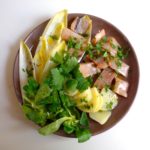 oil. In my salad version, the herring is chopped and accompanied by greens. It’s a bit lighter and brighter, and can make a proper lunchtime meal.
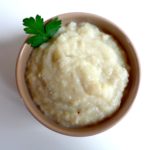 When the days draw shorter, a warming dish like finocchio purée provides comfort. Yet it is not one of your heavy comfort foods. Light, with a delicate flavor, this purée marries well with all sorts of autumn dishes — meat, fish or poultry, grilled or lovingly simmered — and makes a spectacular pairing with game. It also makes a fine addition to a vegetarian meal. And the beauty is that the finocchio growing season is … all year round.
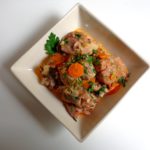 Sauté d’agneau is one of those great French classics that used to feature frequently on bistro menus, especially when the weather turned cool. These days this succulent lamb dish is harder to find in Paris restaurants, where current culinary fashion favors small plates of designer food. Nonetheless, it has been a personal favorite since I first tasted it many years ago at l’Entrepôt, an airy, veranda-style restaurant tucked away behind Montparnasse.
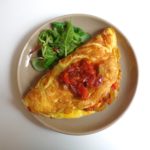 This tangy omelet hails from the French Basque country and is filled with the regional veggie dish known as piperade, a mixture of green peppers, tomatoes, onion, garlic and pepper slowly sautéed in olive oil until it reaches aromatic, spicy perfection. This is a good time of year to try it out, when peppers and tomatoes are at their prime. Unsuprisingly, the omelet is also known as omelette à la piperade. It makes a nice lunch or a light supper.
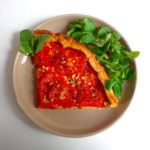 This is high season for French tomato tart, and the good news is that producing one is as easy as, well, pie. But there’s a secret ingredient without which this tart would lose its special French identity. No, I’m not talking about the garlic, thyme and olive oil that give French tomato tart the flavors of Provence. The secret ingredient from which the tart gets its zing is … Dijon mustard. Now as you may imagine there are many variations.


