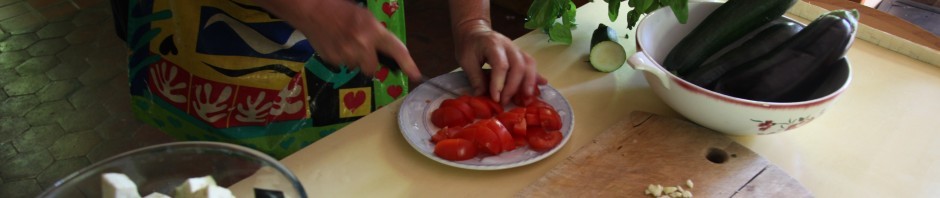
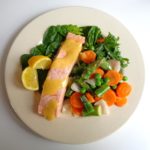
 I’ve been serving a medley of seasonal vegetables this spring — asparagus, young carrots, peas and red spring onion — and wanted to try it out in a salad version. So here it is, bathed in lemony homemade mayonnaise and served alongside steamed salmon on a bed of tender greens. The veggie combination is a fresh take on macédoine, a classic French dish of chopped vegetables in mayo that today feels decidedly old-fashioned.
Assiette saumon macédoine / Salad of salmon and spring vegetables
Macédoine has an interesting story. It is named after the Balkan region of Macedonia, which once covered a large swath of territory. The mixture of veggies is said to recall the mixture of populations that shared the region, and indeed an ethnic map of the area from the 19th century is a mosaic of different colors. Amusingly, in the Balkans today, the dish is known as salade française (French salad), while in other parts of Europe it is called salade russe (Russian salad). But when I was living in Russia, chopped veggies in mayo was a dish known simply as maïonez (a catered version of which once brought down the entire newsroom of The Moscow Times when the mayonnaise had gone bad).
I was curious about the difference, if any, between macédoine and salade russe, and looked into the matter. It turns out that a true Russian version is more complex due to the addition of chopped pickles, hard-boiled eggs and one or more types of meat or sausage to the basic mixture of veggies and mayonnaise. It is said to have been invented by Lucien Olivier, a Belgian chef who worked at a fashionable Moscow restaurant in the 1860s. (A version of the dish was already popular in Belgium at the time, so whether he actually invented it is open to question.) The dish became known as salat Olivier — until the chef’s assistant ran off to another restaurant and renamed the salad Stolichy (for the capital city, even though Russia’s capital was actually Saint Petersburg at the time).
Those two salads still exist in Russia, and have given rise to multiple foreign variations. A Swiss chef, Joseph Favre, created a gourmet version by adding chicken, partridge or grouse, ham, roast beef and anchovy fillets to the veggies and mayo. A Spanish version includes tuna, roasted red pepper and green olives. In Spain, by the way, the name ensaladilla rusa was banned during the Franco years, with the dish rechristened as ensaladilla nacional. Other countries that wanted no mention of Russia in their culinary repertoire were Romania and Moldavia, where it was called salata de boeuf, or beef salad.
Beef salad? We’ve strayed from the recipe in this post, which has no meat, eggs, pickles or olives and in fact is far lighter than the French macédoine of yore. When I first arrived in Paris, a scoop of inspid canned veggies drowned in thick mayo was commonly seen as a starter in unpretentious bistros. But thankfully French cuisine has evolved since then.
Happy cooking.
Note: I have added a privacy policy to this site in line with the new European regulations. Basically, my policy is that I do not collect personal data from visitors to the site. To view the policy, click here.
 Pho, the remarkably fragrant, herb-topped Vietnamese beef and noodle soup, is ubiquitous in Paris. I never considered preparing it at home until a recent day when my daughter asked me to make it for dinner. As one who enjoys a challenge, I looked into the matter and informed her that we could have it the next day — as preparing the broth for pho takes several hours. I went ahead and made the soup, with moderate success, then consulted an expert.
 The French love affair with asparagus and eggs blooms every spring, when the spears — green, white or violet — are served bathed in luscious
 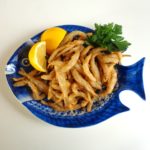 This quintessential French dish evokes happy days at the seaside, where plates of small crispy fish are served up along with a chilled bottle of white or rosé. For me, petite friture inevitably makes me think of summer, which is perhaps why — after this long, dark, cold Parisian winter — I decided to try making it at home when I came across an inviting mound of tiny, silvery fish at a market the other day. Preparation proved surprisingly simple.
 There’s an easy way and a hard way to make the delectable French strawberry dessert known as charlotte aux fraises, as I learned when setting out to make one for this post. A charlotte is an unbaked cake of ladyfingers with a creamy filling. Many modern recipes for strawberry charlotte use a thick dessert cream known as a bavaroise for the filling, and this involves the use of gelatin. As it turns out, that’s the hard way…
 Because the easy way is so easy, the dessert is fun to make. If kids will be sharing it, you can skip the cassis and use strawberry syrup for flavoring the ladyfingers. Once assembled, the charlotte needs to be refrigerated for at least four hours, after which you can decorate it with sliced strawberries and mint. And no, the second time, it didn’t collapse…
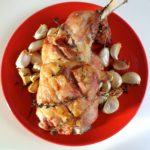 Roast shoulder of lamb makes a fine centerpiece at Easter, Passover or any time of the year. In this recipe, the meat is surrounded by whole cloves of garlic, which soften while roasting into a sweet, succulent paste. The garlic cloves are roasted in their jackets, and the lamb may be boned for easy carving. Not counting the roasting time, preparation takes about 5 minutes. Add some roasted cherry tomatoes, and you’ll have a feast.
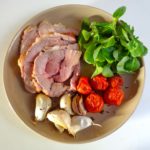 The lamb is imbued with the garlic flavor while it is roasting, and some sprigs of fresh thyme lend a taste of the wildness of Provence. Thyme may also be used on roasted cherry tomatoes, which you can pop in the oven at the same time as the lamb. They come out sweet and very tender.
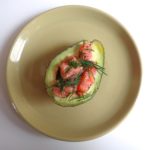 Here’s a fresh take on avocat vinaigrette, a popular starter on bistro menus when I arrived in Paris 40 years ago. In the original, avocado halves were filled with a thick, mustardy sauce. This version is both lighter and prettier, the pink-orange of smoked salmon contrasting with the pale green of the avocado and darker green flecks of dill. Although it has the look of spring, it can be made in any season — and it’s incredibly quick to prepare.
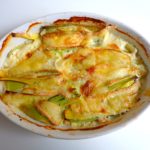 Leek gratin is traditionally made with Reblochon, a pungent cheese from the French Alps, but it has been snowing in Paris. The snow brought the city to a standstill, and by the time it stopped the stores were empty. No Reblochon to be found! I wanted to make this recipe, so I improvised with raclette, a similar cheese. Tantalizing waves of aroma spread through the house as the leeks baked. This is winter comfort food at its best.
 This is what I found. At the front of the store, the salad shelves were empty, a sign announcing that due to the weather, delivery trucks had been unable to get through. This was two days after the snow stopped. The dairy shelves, usually packed with a thousand types of yogurt, were empty too. In the cheese department, after hunting in vain for Reblochon, I found a lone packet of raclette and snatched it up. I already had the leeks.
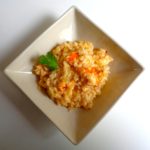 The lobster known as le homard — the one with alarming claws — is hugely expensive in Paris, and so is its kinder, gentler cousin, la langouste (no pinchers). But this winter frozen langouste tails began appearing at a reasonable price, so I brought some home and began to experiment. I served them French style, butterflied and grilled with a vermouth-flavored
  Butternut soup is suddenly the rage in Paris. Walk down any street and you will see it listed on menu-of-the-day chalkboards outside bistros. This is all the more surprising given that butternut squash was virtually unknown in France until a few years ago, when it began appearing in farmers’ markets. Having captured the national imagination, it also captured mine, and today I’m offering two versions of this pleasant winter soup.
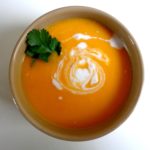 Perhaps in their (probably hopeless) effort to protect the language, the French have rebaptized what is originally a New World vegetable as courge doubeurre, which translates loosely as ‘sweet butter squash’. But I have never seen it marketed under that name, and you would most likely get a quizzical look if you asked at a grocery store for doubeurre. In fact, you might instead be given a packet of butter (du beurre). Better to use the French pronunciation of butternut — boo-tair-NOOT.


