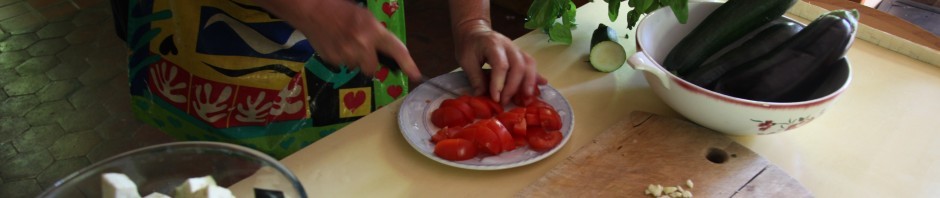
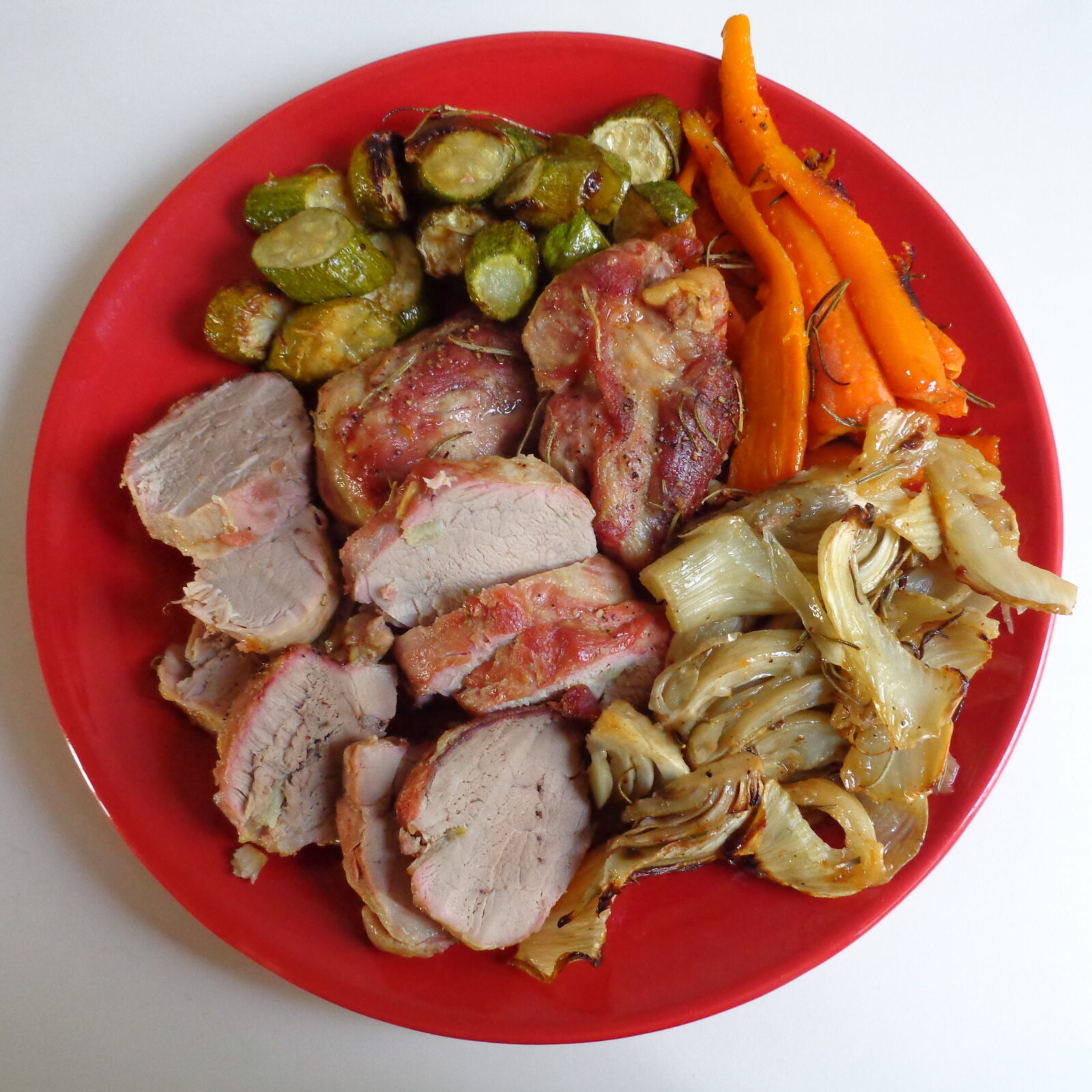
 There’s a wintry chill in the air in Paris, and nightfall comes early these days. It’s the time of year when comfort food makes a welcome appearance on the table. In this recipe, succulent fillet of pork is surrounded by autumn vegetables and slow-roasted in the oven. The aromas will tantalize your guests as they tuck into a first course, for example a spinach salad with roquefort or a plate of briny oysters with some lemon on the side.
Porc aux légumes d’automne / Roast pork with autumn vegetables
Speaking of oysters, this is definitely the season. I bought a dozen at the market on Sunday, wrapped them in a damp tea towel, and headed for my cottage in the country. The scene that evening: a roaring fire, a plate of freshly opened oysters on the table, and three people expectantly awaiting the feast. One of those people — me — was sporting a bandaid.
Yes, I impaled myself while opening the oysters. It’s not my favorite sport, but I will do it if necessary (i.e. if no volunteers are around to help out). You need a strong sharp knife, or a special oyster knife, to get the shells open. I will post about this one of these days. But as I was struggling in the kitchen, with soul music pouring from the speakers in the other room, I have to say I started musing about how much easier it must have been to open oysters in another age — the Stone Age, to be precise.
As I may have mentioned before, I am now involved in a project about our prehistoric ancestors, and this has led me to think about how the women who preceded us managed to get dinner on the table. You can picture the scene — the kids clamoring for their evening meal, their father still out hunting with the guys. All their mother has on hand is the nuts and berries she gathered that afternoon and, if they live by the sea, perhaps some oysters. Metal tools have not been invented yet, so what does she do? She simply smashes the oysters open with a rock. Which is what I may try next time…
Whether you opt for oysters as a starter or not, you can follow this week’s roast pork with a cheese platter or just go straight to a seasonal dessert — for example, an apple tart or caramelized pears. It will make for a satisfying autumn meal, for family or friends.
Happy cooking!
P.S. If you’re interested on following my progress as I research the deep ancestry of myself and my adopted daughter in hopes of finding our most recent common mother, you can visit my new Facebook page, Footprints Through Time. It tracks recent advances in human evolutionary genetics, and raises the personal issues I’m encountering as I go back in time to find the link between my East European Jewish ancestors and the lineage of my daughter, who was born in Mali of unknown parents.





 Let’s face it — foie gras is controversial. Beloved in France, where it is served as a special treat on festive occasions, it is shunned elsewhere by people who object to the force-feeding of geese or ducks to fatten their livers. Two years ago, the state of California actually banned foie gras, and this summer India followed suit. Other countries, among them England, have sought to find alternative methods of fattening the fowl. And yet this controversial food is not only considered one of the finest products of French gastronomy, it has ancient roots. Foie gras was enjoyed by early Egyptians, Greeks and Romans, and by East European Jews for whom the fat could replace butter. Its use spread from Hungary to the Urals before it made its way to France via Alsace a few hundred years ago.


