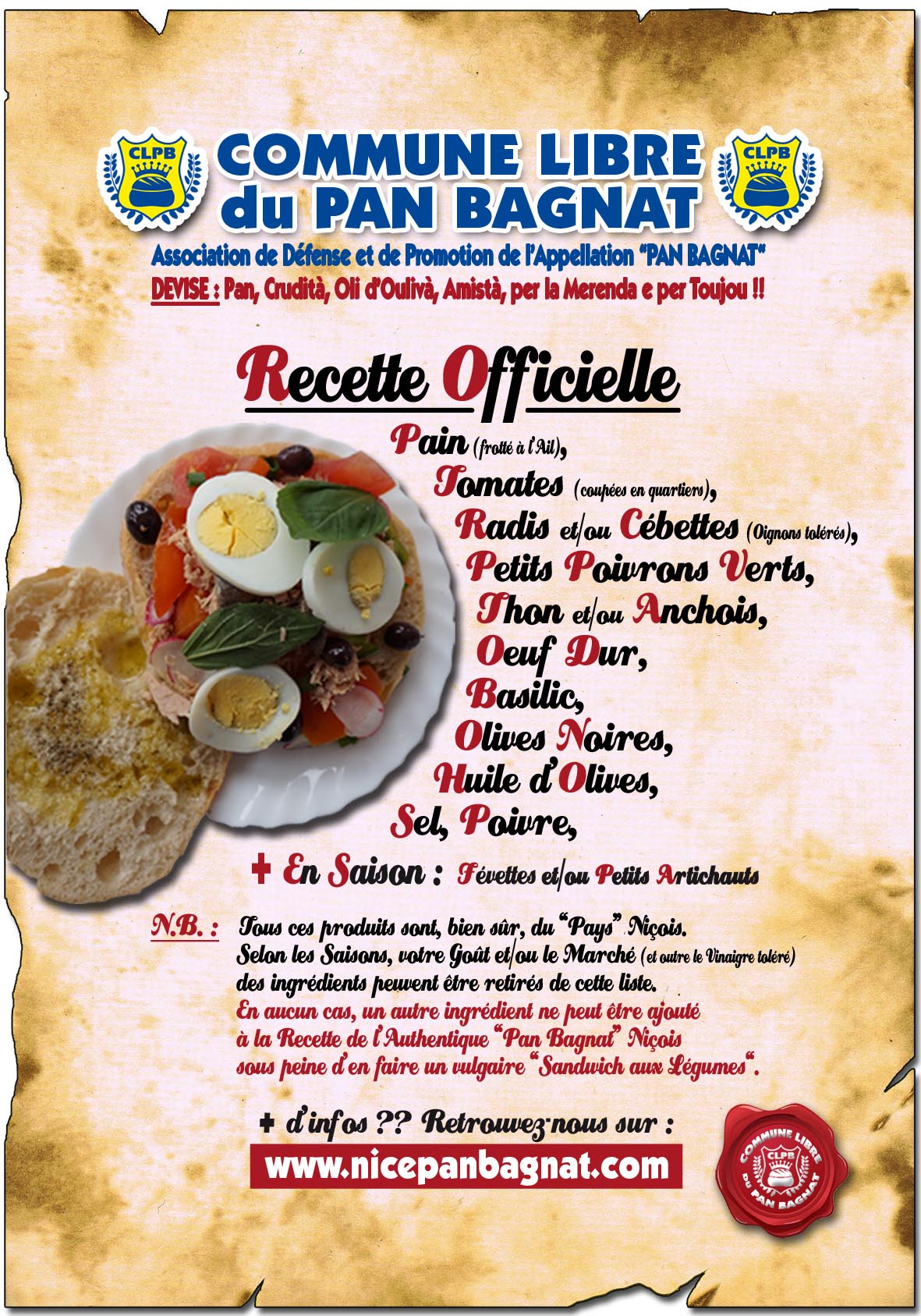
 If you’ve ever been to Nice, you will have encountered the pan bagnat, that city’s trademark sandwich: a large roll stuffed with tuna, tomatoes, black olives, hard-boiled egg, anchovies, green pepper, green onion, radishes and basil. It’s like a salade niçoise in a bun. The city is so proud of the sandwich that citizens have formed an association to defend and promote it, with a web page entitled, no less, The Official Site of the Free State of Pan Bagnat.
Pan bagnat / Pan bagnat sandwich from Nice
On that site they’ve posted what they call the official recipe, which would be just like mine except that it has no green pepper and notes that baby broad beans and/or little artichokes may be added in season. But beware. The site adds a warning: ‘In no case may any other ingredient be added to the authentic Pan Bagnat of Nice under penalty of creating a vulgar vegetable sandwich.’ A vulgar veggie sandwich? Really? How do you say oy vey in French?
So let’s talk about authenticity. According to food historians, the original pan bagnat contained no tuna, which at the time — the 19th century — was considered a food for the rich. The pan bagnat was a poor man’s meal, often made with stale bread (‘pan’ in Provençal) that was bathed (‘bagnat’) with a little water to soften it. These days, the rolls ‘bathe’ in drizzled olive oil and juice from the tomatoes. And while the so-called official recipe may not include green pepper, it is hard to find another recipe without it.
I first encountered the pan bagnat when, as a 19-year-old student, I found myself digging for pre-Neanderthal man in a cave outside Nice for the last three weeks of a summer study program. In the evening after work, the other student diggers and I would walk into town along the corniche, the beautiful coastal road overlooking the Mediterranean. Often as not, we’d pick up a pan bagnat for supper. The sandwich is big enough to be a meal in itself.
Now that spring is finally turning sunny and warm in Paris, it felt like the right time to try to make a pan bagnat at home. Problem No. 1: Where to find the bread? Pan bagnat rolls measure 6-8 inches (15-20 cm) in diameter, i.e. as big as or bigger than a jumbo hamburger bun. They’re crusty outside, tender inside, with an olive oil tang. I had never seen one at a Paris bakery, but a quick online search revealed that at least one Paris baker makes them, and by luck the shop — Tout Autour du Pain — is a short walk from my place.
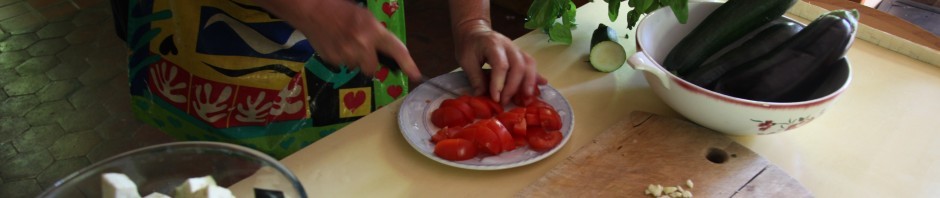
 Happily I phoned ahead, as the pan bagnat rolls had to be made to order. The next day I collected four beautiful crusty rolls. The rest was easy. I made a sauce of olive oil, garlic and basil, boiled an egg, sliced the veggies, sliced the roll and layered on the ingredients, drizzing with olive oil from time to time. In a very short while the venerable sandwich was ready.
What to do if there is no such baker in your vicinity? Improvise! You can make your pan bagnat on a Kaiser roll, a pita, a chunk of a crusty French loaf. If you don’t broadcast your deviation from authenticity, the defense committee will never hear about it…
For the record, concerning sandwiches in a bun, the venerable pan bagnat predates the venerable hamburger by at least a century, although the origin of neither is totally clear. When I told an Italian friend I’d be posting the pan bagnat recipe on my French cooking site, she bristled: ‘But that’s an Italian sandwich!’ Since Nice used to be part of Italy, she may have a point. But who cares? The real point is that the sandwich is a treat.
Part of the magic of the pan bagnat is that its taste changes according to the weather. It’s best outdoors on a hot sunny day — at the beach, on a boat, at a picnic. Bring along a bottle of chilled rosé and plenty of napkins to catch the olive oil. The other part of the magic is that, wherever you are when you bite in, the Mediterranean will not be far away.
Happy cooking.
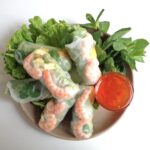 What better time than spring to make fresh spring rolls? In this Vietnamese-inspired recipe, a very thin rice-flour crepe is rolled up around lettuce, mint and the zesty filling of your choice: shrimp, chicken or mango, mixed with Asian flavorings, peanuts and cilantro. The rolls — not to be confused with fried spring rolls (called nems in France) — are served with a tangy sauce. They’re light, fun to make and a great way to exercise your creativity.
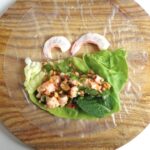 When you’re ready to roll, the rice-flour wrapper is dampened in hot water, then placed on a board. Lettuce and mint are placed on the bottom third and topped with a couple spoonfuls of filling. Shrimp halves are then placed on the middle of the wrapper. You fold in the sides and wrap up tightly, bottom to top. If making the vegetarian/vegan mango version, you can skip the shrimp and instead use cilantro leaves for decoration.
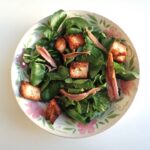 Is there such a thing as a new recipe? This zesty salad of watercress topped with anchovy fillets and croutons may fit the bill. I created it one day when I’d been to the market and had a bunch of fresh watercress in the fridge. How was I inspired to add the anchovies and croutons, along with a drizzle of olive oil and a few drops of lemon juice? Don’t know, but when I surfed the web afterwards in search of a similar salad, I found none.
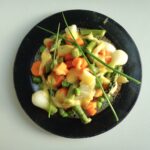 A swirl of lightened mayo over gently steamed carrots, asparagus, peas, spring onions and turnips creates a thoroughly modern version of a very traditional French dish — macédoine. In this update, the veggies may be served either chopped or whole, with homemade mayonnaise on top, on the side or as a sauce. Add some fresh herbs for garnish, and you have a flavor-packed starter, salad or side dish that highlights the beauty of spring.
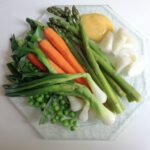 So I have taken liberties with the traditional recipe, which typically combined diced carrots, green beans, turnips, peas and flageolets, or small, pale green, kidney-shaped beans that are popular in France but may be hard to find elsewhere. This version dispenses with the beans in favor of asparagus and spring onions, which are bountiful in farmers markets here at the moment.
 It may be argued that serving the veggies whole, as shown just above, is too much of a stretch, given the origins of the dish. Amusingly, macédoine takes its name from the multiethnic Balkan region of Macedonia. The multicolored chopped vegetables were seen as resembling ethnographic maps of Macedonia in previous centuries, such as the one at left.
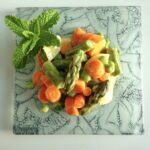 As for the veggie version, macédoine-style chopped vegetables may also be served warm with butter or cold in aspic, according to the Larousse Gastronomique. But personally I think the mayo version is by far the tastiest. If you’d like to go traditional, you can served your modernized macédoine bathed in homemade mayonnaise lightened with lemon juice, as shown at right. Or you can decompose and recompose as you prefer.
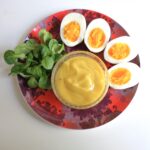 Spring has sprung with a vengeance in Paris — chestnuts in blossom, demonstrators in the streets — meaning it’s time once again for Crème de la crème, with ‘best of’ seasonal recipes from the first ten years of The Everyday French Chef. This time I’d like to highlight oeufs durs mayonnaise, a classic bistro dish. And, you may well ask, what’s so special about hard-boiled eggs? Well, homemade mayo boosts this simple dish into the stratosphere.
 Starters
 Soups
Soups Salads
 Eggs
Eggs Savory tarts
 Fish
Fish
 Meat
Meat Veggies
 Pasta and grains
 Desserts
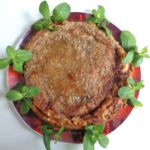 Here’s a cake that’s both Moorish and ‘more-ish’. Moorish because its ground walnuts and almonds, orange zest, cinnamon and rose water are evocative of North African cuisine. More-ish because, as I discovered when I served it this week, one serving was not enough for the guests around my table. This cake is also unusual because it contains no flour. That makes it both gluten-free and ideal for serving during the Jewish holiday of Passover.
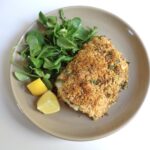 This fish dish with a crusty topping is extremely popular in France and a breeze to make. The topping ‘à la bordelaise‘ — literally Bordeaux style — combines breadcrumbs, shallots, garlic, parsley, salt, pepper, olive oil, lemon and a splash of white wine. Cod or hake are often used, but in fact any white-fleshed fish is fine. The upshot is a sophisticated French take on breaded fish. But does this family friendly dish actually hail from Bordeaux?
 Then I discovered thanks to ‘pingbacks’ that my site was being pirated. It wasn’t the first time this has happened, but after I posted my last recipe, for
  Meantime the people who pirate my site are publishing ads, which I decided from the outset not to do in order to keep the site reader friendly — although I am solicited several times each week by people wanting to advertise or publish sponsored content on my site. Thus the pirates are not just committing theft of intellectual property but also making money from my work, and there doesn’t seem to be anything I can do about it. If anyone has a recipe for putting an end to this situation, please let me know. Nonetheless…
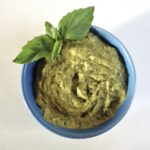 Basil hummus? Why not? I discovered this recipe thanks to my friend Yana, a Ukrainian artist who’s lived in Paris for the last 30 years. What she makes is idiosyncratic, often with an artist’s touch. Her anchovy dip is fantastic, but when I discovered that it involved nothing but anchovies and pure butter, I gasped at how much I’d consumed. The basil hummus is lighter. She served it on a summer’s evening, with basil plucked from her garden.
 Meantime I have updated The Everyday French Chef’s
  Happy cooking.
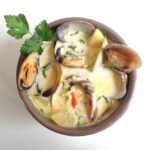 I tried this clam chowder at the Hog Island Oyster Co. in Napa, California, and when I finished it I knew I needed the recipe. What I didn’t know is that chowder, an American dish, has French roots — or that the word ‘chowder’ derives from the French chaudrée, meaning cauldron. This I discovered upon my return to Paris. I quickly went out and bought the ingredients — clams, potatoes, leek, celery, carrot, bacon and heavy cream.
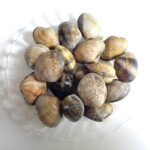 The recipe is easy and takes about half an hour to prepare. The key to success is to use the small, sweet clams known as palourdes in French, Manila clams or steamers in English, and vongole in Italian. The clams should be as fresh as possible — at
  Or the eye-popping $700 bill for dinner for four at
 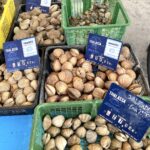 Despite its French roots, clam chowder is not served in restaurants in Paris — at least, in my nearly 50 years here, I’ve never encountered it. Which means that in order to enjoy this warming, ultraflavorful soup, you need to go hunting for clams. This I did at my local farmers market, where various types of clams — including two sorts of palourdes, small and large — were on sale on a recent Sunday. If fresh clams aren’t available where you live, you can buy them online
 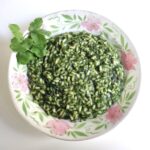 I discovered spinach risotto many years ago at a dinner party in Venice. Our host, a genial fellow named Giorgio, was chatting me up, so I followed him into the kitchen and watched as he chopped and sautéd and ladled and stirred. Distracted by his charm, I didn’t know what he was making until he brought the dish to the table. ‘Risotto agli spinaci’, he announced with a flourish. One earthy, creamy, tangy mouthful and I was in heaven. Pure bliss.