 The French love stuffed cabbage in winter. They serve it two ways — with meatballs rolled up in individual cabbage leaves and, impressively, as a reconstituted whole cabbage with the stuffing inserted between the leaves. This recipe, which uses the far easier first method, puts a French twist on a dish my grandmother used to serve, with flavors redolent of her Jewish Ukrainian roots.
Choux farcis / Stuffed cabbage rolls
Prepartion takes time, but it’s worth the effort. The first step is blanching the outer leaves of a large head of cabbage. In Eastern Europe, white cabbage is generally used, but the French prefer dark green Savoy cabbage, which has the advantage of being easier to handle. The next step is making meatballs and rolling them up in the blanched leaves. A sauce is then made of the shredded inner leaves of the cabbage, onion, garlic, tomatoes and broth. Red wine vinegar and sugar are added to produce a sweet-and-sour taste. The rolls are cooked in the sauce in two stages, first on the stovetop and then in the oven.
One thing that differentiates this version from more typical French recipes is the use of ground beef on its own rather than a mixture of beef, pork and/or veal. Another is the absence of bacon, which is often used in France to bard individual stuffed cabbage leaves that are then tied up with string. And then there’s the sauce, which in France rarely includes tomato and is never sweet and sour (at least I’ve never encountered it that way).
What makes this recipe more French than my grandmother’s version is the use of herbes de Provence, France’s go-to mixture of dried rosemary, thyme, savory and oregano. Preparation of the sauce is also different, as the veggies are sautéd in olive oil before the cabbage rolls are added. Grandma Anne simply boiled everything all together.
If you’d like to experiement with the whole cabbage version, typical of the rugged Auvergne region of central France, there are two ways to go about it. In the first, large blanched cabbage leaves are used to line a pot. The meat stuffing and more cabbage leaves are then layered in, with the large leaves folded over the top to form a globe. In a more elaborate version, a whole cabbage is boiled and, when cool, the center leaves are removed, the outer leaves are pried apart, the stuffing is inserted and the cabbage is formed back into a globe and tied up with string or crépine, a lacy pork membrane.
Now for a little history. In Ukraine, stuffed cabbage rolls are known as holubtsi, or little doves, because they are thought to resemble birds in a nest. In Yiddish, they are known as holishkes. I never heard this name in my family because my grandparents only spoke Yiddish in front of the kinder when they didn’t want us to understand. But my grandma — who was born in the States in the 1890s but conceived in Ukraine, then part of the Russian empire, before her family departed — would have known them this way.
According to Wikipedia, stuffed cabbage rolls have been part of Jewish cuisine for 2,000 years. Preparation varied according to region. Syrian Jews added cinnamon, while Persian Jews added dill and mint. The dish was often served on Simchat Torah, an early autumn holiday marking the end of the yearlong reading of the Torah scrolls and the start of a new cycle (rolls perhaps because the year was rolling around again?).
But Jewish versions are just one incarnation of a dish that has been served for centuries across much of Europe as well as the Near East and North Africa. Cabbage rolls may be stuffed with rice or another grain, mushrooms, potato, crushed walnuts or eggs, with or without meat. They may be served with sour cream on top, alongside or in the sauce (but not in Jewish families). In the Nordic countries, they are served with lingonberry jam on the side. There are apparently even Chinese, Vietnamese and Japanese versions.
In France wine is often included in the sauce for stuffed cabbage rolls, but I prefer my grandmother’s recipe without it. Yet nothing says the dish cannot be accompanied by wine — in fact, in this country, that would be a travesty. I’d recommend a smooth red, for example a Bordeaux such as a Médoc or a Côtes du Rhone. For starters, you could serve beet salad with walnuts, winter salad with walnuts and pears or, if you’re feeling ambitious, homemade gravalax (which needs to be prepared one day in advance). For dessert, I’d suggest pears in red wine and cassis or sliced oranges with star anise.
Happy cooking.
 Winter’s here, bring on the comfort food! This is the second chapter of ‘Crème de la crème’, a seasonal feature marking the tenth anniversary of The Everyday French Chef. On the menu are my favorite winter recipes (not including holiday recipes — if you’re still thinking about what to serve on Christmas or New Year’s, click
  Starters
 Soups
Soups Salads
 Savory tarts and sandwiches
 Fish and shellfish
 Meat dishes
 Pasta and grains
 Desserts
 It’s no secret that a highlight of French Christmas is the bûche de Noël that crowns a festive meal. What is less well known is that the traditional Yule log cake is rarely — but I mean, really rarely — made at home in France. This is because prettily decorated bûches in all sizes are on offer at every pastry shop in the country during the season. And yet, as I discovered in my kitchen, it’s both possible and amusing to make one yourself.
 Duck has always been a big deal in France, culinarily speaking, and what with the popularity of a certain American import it was inevitable that the French would put their own twist on it and create the duck burger. Some recipes use
 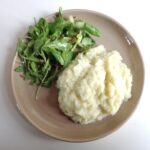 Many years ago, when making boeuf bourguinon for a party, I discovered a sophisticated side dish with laughably humble origins — cabbage purée. How I discovered it is a mystery. I thought it might have been via Patricia Wells, but when I looked through her cookbooks it wasn’t there. Perhaps it was Julia Child? Negative. Well, whatever. I’ve been making it for years, and am always delighted when my guests can’t figure out what it is.
 This savory pie of chicken, mushrooms and leeks in a creamy sauce encased in puff pastry (pâte feuilletée) makes a lovely autumn dish for lunch or a light supper. Full disclosure: I don’t make the pastry myself, but instead use a couple rolls of high-quality, all-butter store-bought puff pastry. This saves a lot of time. Then all you need to do is invite a couple of guests, make a salad, open a bottle of wine and voilà — your meal is ready.
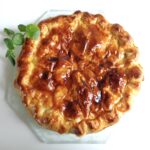 To allow steam to escape while the pie is baking, the French often cut a coin-shaped round out of the center of the top crust and insert a rolled piece of paper to create a chimney (cheminée). But I chose instead to cut a few slits into the top and, with leftover pâte feuilletée, added some cut-out diamonds for decoration. No sooner did the pie come out of the oven than it disappeared.
 This salad is a Paris bistro classic — tender leaves bathed in a light mustard vinaigrette and topped with cubed ham and cheese, boiled potatoes and quartered eggs. Or with other ingredients. Green beans, tomatoes, mushrooms, croutons, you name it. It’s a salad I’ve never encountered in a Parisian home, yet it is omnipresent in Paris cafés. I’ve put off posting about it for years for the simple reason that no one can agree on what it actually is.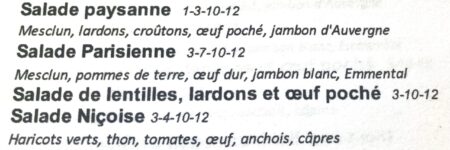
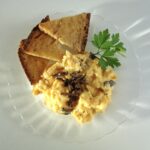 For a supremely elegant brunch dish, you can’t do better than scrambled eggs with truffles. Wait! Did she say truffles? But yes, my friends. You may have heard that truffles cost as much per ounce as gold, but that turns out to be false. You may think they’re hard to find, but that’s also not true in these days of online ordering. Preserved truffles are fine in this quick and easy recipe. So go ahead — invite some guests and knock their socks off.
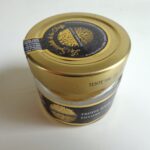 I’d been wanting to make scrambled eggs with truffles for a very long time, but when I went to my local farmers market recently in search of a truffle I couldn’t find one. Turns out they’re not in season. The season for the prized French black winter truffle begins only in mid-November, while the season for summer truffles ends in mid-September. But a shop in my neighborhood,
  At last it’s time to make the eggs. This takes about three minutes. Slice the truffle thinly, reserve a few slices for garnish, beat the eggs with the cream, salt and pepper, and add the truffle slices. But how to cook them? The French method involves stirring the eggs into a creamy mass in a pan set over boiling water (au bain marie). But this is not strictly necessary. You can also scramble them as usual in a pan coated with melted butter.
 This week marks the 10th anniversary of The Everyday French Chef. When I started the site, back in 2012, I could never have imagined that readers would check out my recipes more than a million times. Thank you!! I’d like to celebrate by sharing a personal ‘best of’ list of recipes for autumn (I will post similar ‘best of’ lists this year for winter, spring and summer as the seasons change.) And by saluting the site’s most popular recipe…
 Starters
 Soups
Soups Salads
 Fish and shellfish
 Poultry and game
 Meat dishes
 Vegetables
 Pasta and grains
 What could be better when the temperature soars than a zingy cold soup? This one combines zucchini with tiny lentils, Indian flavorings and mint, and can be topped with coconut milk and/or any number of embellishments. The idea for it popped into my head as yet another heatwave loomed in Paris. With the mercury due to hit 100 degrees – that’s around 40 Celsius – I wanted to make something cool ahead of time…


