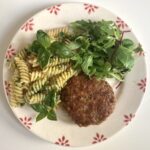
 This sophisticated French take on the burger is made of ground veal flavored with grated Comté cheese, garlic and herbs, then lightly breaded and fried. Serve it on a bun, and it becomes child friendly. But it also makes a surprisingly elegant main dish that marries well with anything from pasta to veggies to salad. And despite its name, which makes it sound like an Italian dish from Milan, this dish is totally French — and rather unusual.
Milanaise de veau haché / Veal burgers, French style
You will not find many recipes for milanaise de veau haché on the web (I looked). Nor will you find these burgers served in many Parisian bistros. I’ve been making them since discovering them quite a while ago at my butcher’s counter, already breaded and ready for the skillet. But I never thought about making them from scratch until recently, when my daughter, who loves them, asked me to try. Her verdict? ‘Incredible!’
This dish is not to be confused with escalopes à la milanaise (breaded veal scallops fried in oil), which are ubiquitous in France and do indeed hail from Italy — although the Italian version generally incorporates grated Parmesan into the breading, while the French version does not. And while I did find Italian veal burger recipes online, they, too, use Parmesan, are topped with tomato sauce and are very different from the French kind.
So where does this recipe come from? I asked around but didn’t get any clear answers. Not every French butcher carries the patties, and those who do are loath to part with their secrets. But as milanise de veau haché always contains Comté or a similar French cheese, e.g. Gruyère or Emmental, which are produced in the Franche-Comté and Savoie regions bordering Switzerland and Italy, my best guess is that the dish evolved over time as it made its way northwards. If anyone has a better explanation, please write in…
And so, to the kitchen. I would suggest serving the veal with pasta, such as fusilli with zucchini or ravioli with butter and sage; with risotto, for example with wild mushrooms or with saffron; with veggies, such as ratatouille or homemade French fries; and/or with a mesclun salad of mixed greens. You could start off with green tapenade or cured country ham with fresh figs, and end with a walnut tart or ricotta with lavender and plums.
Happy cooking!
 It’s the tail end of summer, so let’s make pickles! Not the tiny, vinegary French kind, but home-style dill pickles with an East European flavor. I am dedicating this post to my Ukrainian friend Valya, who returned to Kyiv this week after three-and-a-half years as a war refugee in Paris. It’s as dangerous there as ever, but for her it was just time to go home. I made these pickles for her as part of the picnic I gave her for her two-day bus journey back.
 Four hours later you can already try your pickles! They’ll be crunchy, with plenty of flavor. If you’d rather save them for later, you can transfer them to a clean jar and refrigerate for up to a week — no sterilization needed. It’s also possible to preserve the pickles by canning, but this is a far more complicated procedure. Many sites online explain how to do it, if you’re interested.
 An artist, she went out every day to draw and paint Paris. Here is one of her works. It shows Marianne, the symbol of the French republic, draped in a Ukrainian flag. Valya made the sketch at the Place de la République shortly after a pro-Ukraine demonstration when people still thought the war would be brief. She gave it to me for my birthday three years ago. And the war goes on…
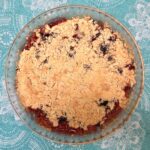 It’s blackberry season and, when down in Provence last week, I couldn’t resist the temptation to make a blackberry-nectarine crumble. The two fruits married beautifully. Blackberries on their own would have been difficult because Provence got hammered by extreme heat and dry weather this summer. The blackberries on the bushes lining the road near my friends’ place were less plump and juicy than usual, and fewer and farther between.
 So now let’s leave this thorny subject (pun intended, sorry) and return to our two-fruit crumble. To tell you the truth, I cheated a little by adding some store-bought blackberries, which are far larger than the fruit one finds growing wild and therefore suspect, in my view. However, in this case it made for a juicier crumble. You can improvise, too — with peaches instead of nectarines, or blueberries instead of the mûres, or whatever strikes your fancy.
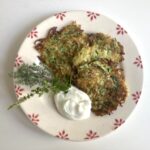 Move over, potato pancakes. This lighter, summery version with zucchini is perfect in hot weather. The pancakes combine grated zucchini and potato with egg and plenty of herbs — mint is my favorite. Fried in olive oil until crispy and golden, they may be served on their own or with a tangy yogurt-garlic sauce. You can make them in half an hour for a couple of people. Or, if serving for a crowd, make a lot — you’ll find them going like pancakes…
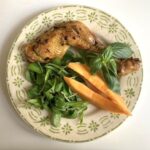 Grilled chicken with rosemary and thyme is one of the delights of the summer season, particularly if you have access to a barbecue — but even if you don’t, as I experienced once again last weekend while staying at a friend’s place in Normandy. We marinated the chicken in olive oil, lemon juice, minced garlic and the herbs, fresh from her garden. We had planned a barbecue, but alas the heavens opened. So we grilled it in the oven. Ab fab…
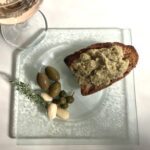 The green olive spread from Provence known as tapenade verte is delightful at cocktail hour on warm summer evenings. Like its cousin,
  If you prefer white, choose a crisp, fruity variety. Or you may like to serve pastis, the oh-so-Provençal anise-flavored apéritif. Pastis, of which there are many varieties (Ricard, Casanis, Pernod, etc.), comes out of the bottle deep yellow but turns a cloudy pale yellow when water is added. Pour about an inch (2.5 cm) of it into a glass, add ice and top up with water. This goes brilliantly with tapenade — green, black or both.
 Forget everything you’ve ever heard about jam-making taking all day. It doesn’t! A few jars of apricot jam, for example, can be made in less than an hour, setting you up with a burst of summery flavor all year long. The key words being ‘a few jars’. If you make your jam in small batches, you can fill your cupboards as the seasons unspool. So far this year, I’ve made strawberry and apricot. I’ll go on to
  For one kilo of fruit, you will get 3-4 jars of jam. That may not sound like much, but if you do it several times a summer with different types of fruit, you’ll end up with enough to last the winter. I missed the red and black currant season this year, but plums and figs are yet to come, and with any luck I might find some blackberries in the autumn.
 Bo bun, which originated in Vietnam and has taken Paris by storm, is an ultrafresh, healthy, flavor-packed bowlful of lemongrass beef, rice vermicelli, veggies, fresh herbs and peanuts, bathed in a tangy sauce. It is often topped with nems (mini fried spring rolls). Making it at home is a bit of a challenge, as there are many steps. But how else to enjoy this fantastically tasty salad bowl if you don’t live within range of a place that sells it?
 Meantime, if you’re into growing your own herbs, I’d like to point you in the direction of
  Making a French cheese tart is — dare I say it? — as easy as pie. And it can also be creative if you put your own imprint on this classic dish by combining the cheeses of your choice. Of course, if you want to keep it French, then Comté is the cheese most often used over here — either on its own or mixed with another French cheese. For example, chèvre (goat cheese), Epoisses (a Burgundy cheese) or Roquefort, as shown in the photo.
 Is there a truly French version of eggs Benedict, or is this dish — which has taken Paris by storm — just a copy of the American original? The basic recipe of poached eggs, Canadian bacon, English muffin and hollandaise sauce has been ‘Frenchified’ over the years. The most surprising variation, oeufs bénédictine, was created by the great chef Auguste Escoffier in 1903 and consists of truffled


