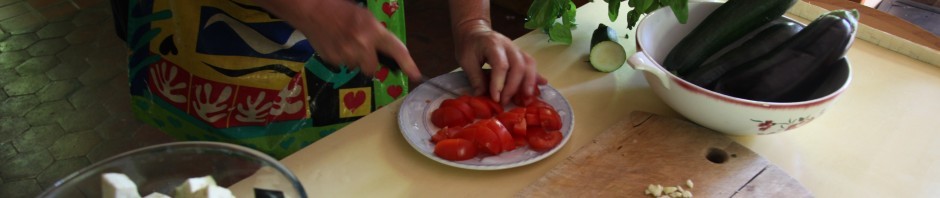
 A bowl of sliced peaches poached in rosé wine with rosemary makes a light and refreshing dessert for hot summer evenings. You can serve the peaches on their own, as I prefer, or take a page from my daughter’s book and serve them over a luxuriously rich burrata. The recipe is simple — the peaches are slipped out of their skins, sliced and poached in a syrup flavored with the rosé and rosemary. A dash of freshly ground black pepper adds bite.
Pêches au vin au romarin / Peaches poached in wine and rosemary
I dreamed up this recipe in late July, shortly before leaving for 10 days in England — more on that later — but, as sometimes happens, the photo didn’t turn out well. So I put it on hold until I could make it again. This time I also used a different kind of peach. Here in France, peaches come in several varieties — round (pêches rondes) or flat (pêches plates), with flesh that is either peach-colored or white. The flat ones look like somebody stepped on them — they’re as wide as the round ones but only about an inch (2.5 cm) high.
I used flat white peaches the first time I made this recipe, with less than spectacular results. The slices came out more like small wedges due to the shape of the fruit, and the color of the peaches in wine was less beautiful than the second time, when I used round peach-colored fruit. So I’d recommend the second version.
And now to England, where I visited friends in Surrey and London and had various misadventures along the way, including 10 straight days of rain. Oh well. No one goes to England for the weather but rather for its charm, its theater and the British sense of humor (humour). And sometimes also for the food. I had a couple of truly spectacular meals and have brought home two recipes that I hope to share with you in future posts.
The first was at a country inn set in beautiful grounds. It was too wet to eat outside, so we perused the menu concocted by the inn’s very creative chef in a cozy room next to the very lively bar. My lunch companion and I both chose as a main course a risotto of mint and peas with watercress, fresh basil and parmesan. It was to die for. When the rain stopped and we went outside for coffee we crossed paths with the chef, who was kind enough to share the recipe. I hope to try it out at home soon.
The second was at a small, Spanish-themed restaurant in Covent Garden where the pre-theater menu included a dish of black rice with small bits of octopus and baby squid, and dots of aïoli flavored with red pimento peppers. Absolutely fabulous. That time I did not talk to the chef but will phone up one of these days to ask, among other things, whether he/she used black rice (less likely) or turned white rice black with squid ink (more likely). Once I’ve tried it out, I’ll let you know.
I like picking up new recipes when on the road. It happens less often here in Paris as I go out less often, mainly because restaurants have become very pricy and the food is often less good than what you could make at home. Which is why, for the foreseeable, I’ll continue to regale you with stories about my adventures as an everyday French chef.
Happy cooking.
 Colombo, a spice mix widely used in the French Caribbean, gives its name to this dish of spicy chicken balls in a coconut-curry sauce. The dish is generally served over rice to temper its heat. Start off the meal with
  Colombo with chicken balls is both easy and fun to make. You first chop skinless chicken breasts in a food processor with onion, garlic, cilantro, hot pepper, lime juice, salt and pepper. You then shape the mixture into balls and sauté them with the colombo spice mix, coconut milk, more lime juice and a little sugar. This process is even more fun if you have a glass of ti punch handy.
 This post featuring favorite summer dishes wraps up my 10th anniversary series on the best of The Everyday French Chef. And I have to say that, given the bounty of the season, it was hard to choose one special dish to highlight. My first thought was
  Starters
 Soups
Soups Salads
 Eggs
Eggs Savory tarts and sandwiches
 Fish and shellfish
 Poultry
 Meat dishes
 Vegetables
 Pasta and grains
 Desserts
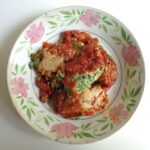
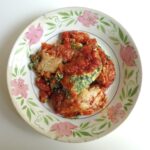 Storzapretti are Corsican dumplings made with spinach or chard and cheese, topped with tomato sauce and more cheese, and baked until bubbly and golden. According to legend, a priest once found the dumplings so delicious that he stuffed himself to the point of choking, hence their name, which translates roughly as ‘strangle the preacher’. One might think they’d be heavy, but after eating a plateful my guest pronounced them delightfully light.
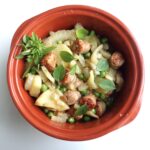 Italian-style sausages marry beautifully with finocchio, aka fennel, in this one-dish meal for all seasons. It’s a crowd pleaser that also includes potatoes, and you can round out the dish with a seasonal veggie — e.g. peas in springtime, butternut in the fall. Here in France I used the readily available saucisses de Toulouse, which like Italian sausages are about 1 inch (2.5 cm) in diameter. But it could be argued that the Italian variety is better.
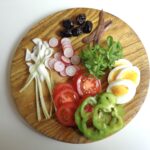 Happily I phoned ahead, as the pan bagnat rolls had to be made to order. The next day I collected four beautiful crusty rolls. The rest was easy. I made a sauce of olive oil, garlic and basil, boiled an egg, sliced the veggies, sliced the roll and layered on the ingredients, drizzing with olive oil from time to time. In a very short while the venerable sandwich was ready.
 What better time than spring to make fresh spring rolls? In this Vietnamese-inspired recipe, a very thin rice-flour crepe is rolled up around lettuce, mint and the zesty filling of your choice: shrimp, chicken or mango, mixed with Asian flavorings, peanuts and cilantro. The rolls — not to be confused with fried spring rolls (called nems in France) — are served with a tangy sauce. They’re light, fun to make and a great way to exercise your creativity.
 When you’re ready to roll, the rice-flour wrapper is dampened in hot water, then placed on a board. Lettuce and mint are placed on the bottom third and topped with a couple spoonfuls of filling. Shrimp halves are then placed on the middle of the wrapper. You fold in the sides and wrap up tightly, bottom to top. If making the vegetarian/vegan mango version, you can skip the shrimp and instead use cilantro leaves for decoration.
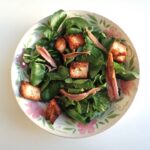 Is there such a thing as a new recipe? This zesty salad of watercress topped with anchovy fillets and croutons may fit the bill. I created it one day when I’d been to the market and had a bunch of fresh watercress in the fridge. How was I inspired to add the anchovies and croutons, along with a drizzle of olive oil and a few drops of lemon juice? Don’t know, but when I surfed the web afterwards in search of a similar salad, I found none.
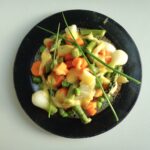 A swirl of lightened mayo over gently steamed carrots, asparagus, peas, spring onions and turnips creates a thoroughly modern version of a very traditional French dish — macédoine. In this update, the veggies may be served either chopped or whole, with homemade mayonnaise on top, on the side or as a sauce. Add some fresh herbs for garnish, and you have a flavor-packed starter, salad or side dish that highlights the beauty of spring.
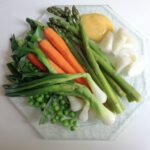 So I have taken liberties with the traditional recipe, which typically combined diced carrots, green beans, turnips, peas and flageolets, or small, pale green, kidney-shaped beans that are popular in France but may be hard to find elsewhere. This version dispenses with the beans in favor of asparagus and spring onions, which are bountiful in farmers markets here at the moment.
 It may be argued that serving the veggies whole, as shown just above, is too much of a stretch, given the origins of the dish. Amusingly, macédoine takes its name from the multiethnic Balkan region of Macedonia. The multicolored chopped vegetables were seen as resembling ethnographic maps of Macedonia in previous centuries, such as the one at left.
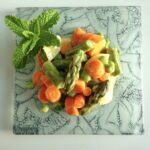 As for the veggie version, macédoine-style chopped vegetables may also be served warm with butter or cold in aspic, according to the Larousse Gastronomique. But personally I think the mayo version is by far the tastiest. If you’d like to go traditional, you can served your modernized macédoine bathed in homemade mayonnaise lightened with lemon juice, as shown at right. Or you can decompose and recompose as you prefer.
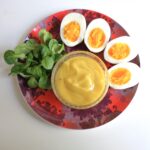 Spring has sprung with a vengeance in Paris — chestnuts in blossom, demonstrators in the streets — meaning it’s time once again for Crème de la crème, with ‘best of’ seasonal recipes from the first ten years of The Everyday French Chef. This time I’d like to highlight oeufs durs mayonnaise, a classic bistro dish. And, you may well ask, what’s so special about hard-boiled eggs? Well, homemade mayo boosts this simple dish into the stratosphere.
 Starters
 Soups
Soups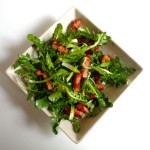 Salads
 Eggs
Eggs Savory tarts
 Fish
Fish
 Meat
Meat Veggies
 Pasta and grains
 Desserts