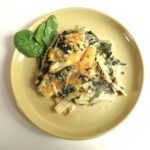
 Swiss chard makes a beautiful gratin that is as packed with nutrients as it is with flavor. I made the gratin this week on Bastille Day, on which I will say more later. My first question, as I was preparing the dish, was: Why did it take me so long to discover Swiss chard? Not until I moved to France did I encounter this wonderful vegetable. My second question was: Since there’s nothing Swiss about it, how did Swiss chard get its name?
Gratin de blettes / Swiss chard gratin
Research turned up a couple of theories on how the name arose. One is that it was first described by a Swiss botanist, even though it is not native to Switzerland. Another is that ‘Swiss’ got added to ‘chard’ in the 19th century to distinguish it from what was then called ‘French chard’, i.e. spinach. But while the two leafy green vegetables have similarities, they are from different botanical families — as chard is in fact related to the beet.
And indeed, the veggie’s name in French reflects this connection. Or should I say names. Chard is known here as both blettes and bettes, the latter very close to the name for beet: betterave, or literally ‘root of beet’. And the wide stalk in the middle is known as carde, which helps explain the ‘chard’ part of ‘Swiss chard’. (Making matters more complicated, another name in French for the same vegetable is poirée, which apparently derives from purée because chard was used in earlier centuries to make a thick soup, and which is confusing because of its closeness to poireau, or leek, another animal entirely.)
But getting back to the gratin, it is quick and simple to prepare. The chard is sliced, boiled until tender, then mixed with cream, a little garlic and grated cheese before being popped into the oven for half an hour. What emerges is a golden, bubbly dish that can be served on its own as a light meal, or as a side to accompany meat, poultry, fish or grains.
While my gratin was in the oven, I was watching the Bastille Day ceremonies on TV. The traditional military parade down the Champs-Elysées before huge crowds was scrapped this year because of the virus, and instead the forces presented their arms before President Macron at the Place de la Concorde in a smaller but deeply moving event. There was not a dry eye in the house — mine, or at the reviewing stand — when doctors, nurses and hospital workers were called to join the men and women in uniform standing at attention.
Recognition of the heroic efforts of this civilian medical corps was a moment of national pride, and for me it brought to mind the song by Josephine Baker: J’ai deux amours, mon pays et Paris — ‘I have two loves, my country and Paris’. I was born as an American, but I’ve spent most of my adult life in France, and in fact am now a citizen of both countries. I love my first, even in the era of the very stable genius in the White House, but am proud of my second, where we have now returned to near normalcy thanks to the population’s cooperation with sensible government efforts to combat the pandemic.
As a backdrop to the ceremonies, a giant red-white-and-blue poster was hung outside the National Assembly, just across the Seine from the reviewing stand. Une nation engagée, unie et solidaire, it proclaimed. Rough translation: ‘A nation of commitment, unity and solidarity’. This interesting tweak to the national motto — Liberty, Equality, Fraternity — perfectly encapsulated the attitude of the French during the health crisis. We were locked down for two months, and the vast majority of the population obeyed the rules.
Beyond party politics, the French were united in commitment to each other’s health — witness the nationwide clapping from balconies every evening — and the government showed its solidarity by granting unemployment benefits to people who couldn’t go to work during the lockdown. Nobody lost their health insurance (take that, Donald). And now, as we head into what is expected to be a brutal economic downturn, a new prime minister is negotating with employers and unions on how best to cushion the shock.
I had the gratin for lunch, and in the evening my friend Nancy came over for a combined Independence Day/Bastille Day dinner since we had both missed celebrating the Fourth of July this year. The food was more American than French — guacamole and corn chips followed by barbecued chicken and potato salad, with a red-white-and-blue dessert of vanilla and raspberry ice cream with cherries, blueberries and crème de cassis on top. As I planted mini American flags in the ice cream — a gift someone gave me years ago — I thought to myself that I should try to get hold of some mini French flags as well.
I have two loves — my country and Paris.
Happy cooking.
The Everyday French Chef will be on vacation in late July, returning with a new post on August 14.
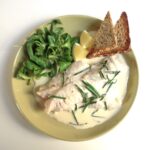 Paris bistros often serve fish in a lemony cream sauce that I’ve never seen served in a French home. Why not, one wonders? It proved remarkably easy to prepare when I tried it out in my kitchen the other day after scouting around online for tips. And the beauty of this sauce is that it may be served over any type of filleted fish — cod, haddock, salmon, sea bass, you name it — and would also be delicious over scallops, lobster or other shellfish.
 The sauce is a mixture of cream, butter, lemon juice, salt, pepper and fresh herbs. Chives are traditional, but you can branch out and use the herb or your choice, for example dill, tarragon, cilantro, thyme, parsley or chervil. Unlike sauces involving egg yolks (hollandaise, mayonnaise), or emulisification (beurre blanc), this sauce requires no special culinary wizardry. For equipment, you will need only a small saucepan and a spoon.
 A pumpkin soufflé might be just the ticket this year for those of us who are under lockdown but still want to celebrate Thanksgiving. Here in Paris, where the lockdown is in effect until at least Dec. 1, a friend and I who give a gala dinner every year have begun thinking about how to get creative when gatherings are essentially banned. For the moment, we’re planning a twosome — meaning roast turkey with stuffing is off the menu. What is to be done?
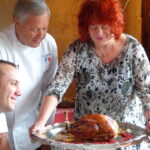 My role as the token American was supposed to be simple — to make cranberry sauce and bring it to Blanc’s table in Vonnas, just south of Burgundy. At the last minute, I was asked to provide cornbread as well (oops, not my specialty). When we sat down, Georges Blanc produced a roast turkey unlike any I’d tasted before — stuffed with veal, pork, walnuts and thyme — and a fabulous
  Strong drink may be needed to get through the next couple of weeks, so here’s a rum cocktail from the French Antilles and crispy cod fritters to go with it. The cocktail, ti punch, is based on rhum agricole, a clear rum distilled from cane sugar juice with a flavor remarkably different from other rums on the market. Add some lime juice and raw sugar, and your mood will definitely improve. The fritters are fun to make and come with a spicy salsa.
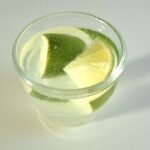 Let’s start with the cocktail.
  Now for the fritters.
 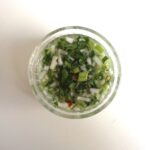 The fritters marry well with
 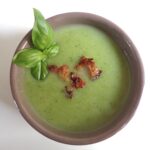 Some days you just need a nice bowl of soup. And the French take on broccoli soup is just right for easing body and soul given the climate of this turbulent autumn (and I’m not talking about the weather). The basic recipe is ultrasimple. Broccoli is simmered with potato, leek, and garlic, then puréed to smoothness. Add a dash of lemon juice, stir in some cream and top with croutons. That’s the French way — but there are many variations…
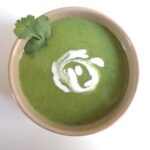 You can go Italian, stirring in some olive oil and topping each bowl with grated parmesan. For a Spanish flavor, add chorizo chips. Or — one of my favorites — skip the cream and instead add finely grated ginger and a swirl of coconut milk. All of these versions are healthy and tasty, and two are vegan — with croutons (no cream), and with ginger and coconut milk.
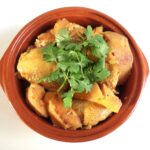 One day a colleague of mine at the International Herald Tribune arrived with a bagful of quinces and handed it over. ‘Do you know what to do with these?’ he asked. Thus began my adventure in cooking with quince, a fruit I had rarely encountered before. Every autumn I try my hand at one dish or another. This year, I made chicken with quinces, a dish richly spiced with cumin, cinnamon, coriander and saffron, and sweetened with honey.
 If you’ve never encountered a quince, it’s an exquisitely perfumed yellow fruit that looks like a cross between an apple and a pear. In France, it is mainly used to make pâte de coings, a sturdy jelly that is served in sugar-coated squares. In Spain, this firm jelly is known as membrillo and is served with Manchego cheese. Other countries, like Iran and Azerbaijan, use quinces in various savory dishes, often paired with lamb or poultry.
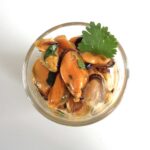 Mussels with garlic, hot pepper, olive oil and fresh herbs, served in small glasses at cocktail hour, is a specialty of the charming Mediterranean port of Sète. This is local cuisine at its finest — le piste de moules, as it’s known, can be found at the many bars lining the canals of this Venice-like town, and in the homes of its residents, but practically nowhere else in France. I have a friend who lives there, and he was kind enough to share the recipe.
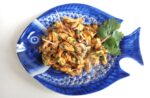 I discovered le piste de moules on a visit to Sète a few years back during the height of summer, when the town is crowded with tourists and the beautiful white beaches are packed with lounge chairs, umbrellas and happy swimmers. I went back a couple of times, but decided not to go to the Mediterranean shore this year because of the virus. Nonetheless, I had a hankering for the dish and made it twice over the summer — in July in Normandy, and in August in Paris. Traditionally the fresh herb used is parsley, but I innovated, using basil once and cilantro the other time. Fine.
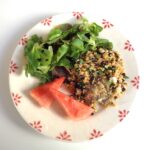 When staying with friends in Provence this summer, I was served a mixed-grain salad that knocked my socks off. The star of this salad was petit épeautre, or einkorn wheat, a rustic grain with a nutty flavor that is grown locally and has become popular among foodies throughout France. It married delightfully with the other ingredients — quinoa, lentils, chopped herbs, shallots, ginger and an Asian-inspired sauce of sesame oil, soy and lemon juice.
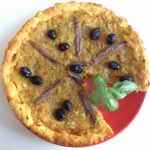 This onion-anchovy-olive tart from the south of France looks remarkably like pizza. (And it’s name, pissaladière, would seem to be related to pizza, too. More on that later.) I had the good fortune on a recent trip to Provence to be treated twice to pissaladière, one homemade and the other from a bakery. When I got back to Paris last week, I decided to try my hand at this classic dish, which hails from the Mediterranean city of Nice.
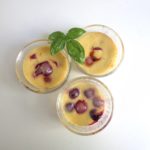 It’s cherry season in France, so when guests came the other night I served mini cherry cheesecakes made with goat cheese. A surprise and a delight! A surprise because I invented the recipe. This is a rare event. Most of the dishes on this site are French classics that I reinterpret in the everyday chef style — simple and modern. And a delight because the goat cheese lends a delicate edge to a dessert that’s both light and deeply flavorful.


