Are cookbooks finished?

cookconfThis is the question nobody wanted to ask out loud at the Roger Smith Cookbook Conference, a gathering of cookbook writers, editors, publishers, agents, food bloggers and food historians that has just concluded in New York. But it was lurking during two days of panel discussions as the people in attendance tried to figure out whether cookbooks have a future – or whether other (digital) means of obtaining recipes, from blogs and ebooks to mobile apps and online video, are making cookbooks into a relic of the past.

Here are a few key points:

* Everyone’s getting recipes online, even people who still use cookbooks. Okay, we already knew that. But now it appears that the younger generation is bypassing ‘old’ new media like blogs and going directly to You Tube for recipes. In other words, video is the next big thing.

* You want to write a cookbook? Don’t expect to make money. The size of advances has plummeted as the book publishing industry suffers from online competition. And despite the fact that cookbooks have resisted better than other categories of books, fewer are selling than in the past. So profits decline right down the line – for publishers, agents, authors and booksellers.

* 24 percent of all cookbooks published today are ebooks, and that figure stands to increase as time goes on. This was from a study by Bowker Market Research that also found that cookbooks in the form of apps for phones and tablets were doing slightly better than ebook cookbooks in 2012.

Of course, this being a cookbook conference, the bottom line here was that we still love cookbooks. You can do with them what you cannot easily do with digital media – write in them, dog-ear them, read them from cover to cover, enjoy them as literary works, etc.

There is much, much more to report from the conference – information of interest to foodies everywhere! – and I plan to blog about it once I get back to Paris. In the meantime, I welcome your thoughts on the matter. Please use the Comment form below.

And watch this space…

— Meg Bortin (aka The Everyday French Chef)


Posted in Et cetera | 7 Comments

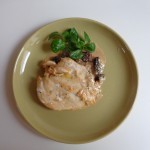
Suprêmes de poulet aux morilles

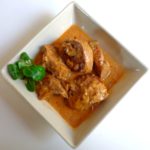
poulet morilles1Tender chicken breasts poached in white wine with a little cream and the woodsy succulence of morel mushrooms – sounds great, right? Wish I could remember. I’m having a little trouble conjuring up this dish right now because I’m on an airplane on my way to New York for a cookbook conference. But as you can see from the photo, I did actually make and serve chicken with morels back in Paris the other day. Once I’d soaked the dried mushrooms it took not even 15 minutes. And was thoroughly enjoyed by all…

Suprêmes de poulet aux morilles / Chicken breasts with morel mushrooms

Dried morels are essential at this time of year because the fresh ones won’t appear in the woods until spring. You won’t get exactly the same flavor, but it’s close enough. In fact, any kind of mushrooms will work – from wild chanterelles to the less exciting white cultivated variety. But in France this is a dish typically served with morels, the black wrinkly mushrooms that look rather frightening when you first encounter them. As for my trip, I’ll tell you more about it in my next post. It’s the Roger Smith Cookbook Conference, and I think it’s going to be a blast.

Posted in 6. Poultry | Tagged , , | Leave a comment

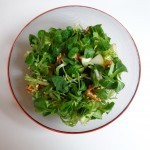
Salade d’hiver aux poires et aux noix

mesclun poire4Take a couple handfuls of mixed winter greens, add bits of pear and walnut, spritz on some lemon juice, add olive oil, salt and pepper, et voilà — a zesty winter salad that takes no more than five minutes to prepare. I owe this recipe to my Sicilian friend Gisella, who made a version of this salad for a sumptuous feast held under the volcano last Christmas. Mount Etna, of course.

Salade d’hiver aux poires et aux noix / Winter salad with walnuts and pear

I’ve made this salad three times in the last three days — once as a first course (preceding an earthy dish of chicken with morel mushrooms, which I’ll be posting here on Friday), once as a main dish (at lunch), and once as a side dish (with grilled steak). Just to say that it’s a salad as versatile as it is simple to prepare.

And now for more site news: I’ve just posted my first two how-to videos: how to make mustard vinaigrette, and how to make mayonnaise. Take a look — and send me your feedback! In the meantime, happy cooking.

Posted in 3. Salads | Tagged , , , , , , | Leave a comment

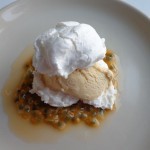
Vacherin aux fruits de la passion

vacherin1Ethereal, sweet, light as air, meringues make a lovely dessert in various guises. In France, when meringues are combined with whipped cream, ice cream or both, the dessert is called vacherin. Julia Child explains how to make a large ice cream vacherin using three large concentric rings of meringue. In this simpler version, individual meringues filled with vanilla ice cream and whipped cream are set on a coulis, or sauce, of lightly sweetened passion fruit. I first tasted this dessert at Spring, the Paris restaurant of Daniel Rose. His creation was so heavenly that I had to try to replicate it at home.

Vacherin aux fruits de la passion / Meringues with passion fruit and vanilla ice cream

Meringues have been served as a gourmet dessert in France for about 300 years and came into their own in the early 1800s, popularized by Antonin Carême, chef to kings, nobility, diplomats, bankers and even a tsar. Carême used meringues to garnish  fabulous almond-paste constructions of Greek temples and other monuments. Early in his career, possibly with Talleyrand as his sponsor, he sold large meringues out of a pastry shop on Rue de la Paix. I know this because I’ve just finished reading Carême’s rags-to-riches story, as told by Ian Kelly in a biography called Cooking for Kings (Walker, 2003). It’s a book I would recommend highly, not just for the engaging narrative but also for the many recipes it includes. They amusingly demonstrate how much French cooking and tastes have evolved in the last two centuries — and how much simpler our recipes have become. Carême’s recipe for ‘Apple Meringue as a Hedgehog,’ for example, calls for 40 apples that must be cored, peeled, boiled in syrup, and rubbed through a sieve or stuffed. The meringue, used as a topping, is a mere afterthought.

Site news: The ‘Menus’ section of this web site has been updated, with new winter menu suggestions for every day and special occasions, and new menu pages for vegetarians and vegans. I have also expanded the ‘Your Kitchen’ section with a photo catalogue of useful cooking equipment as exemplified by the equipment in my Paris kitchen. Coming soon: The site’s first 2 how-to videos.

Posted in Desserts | Tagged , , , , | 1 Comment

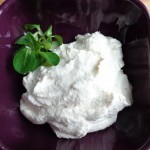
Purée d’amandes

puree amandes4When I was lunching at the Paris restaurant Spring last week, the main course — roast guinea fowl — was served with something hard to identify. It was satiny and pure white, and tasted ambrosial in a creamy, melt-in-your-mouth sort of way. But what was it? The waitress was summoned. ‘A purée of almonds with a cauliflower base,’ is how she described it. Almonds? I needed to know more, so I spoke with Daniel Rose, Spring’s genial owner, chef and culinary creator, who kindly gave me the recipe.

Purée d’amandes / Almond purée

Daniel Rose traces the genealogy of this dish to one of his mentors, Jean-Luc L’Hourre, chef until very recently at a one-star restaurant in Brittany — known as France’s cauliflower-growing region. ‘It’s perfect for him,’ Rose said, because Jean-Luc L’Hourre also has a connection to southern France, where almonds are grown. Rose says he likes making almond purée because it is so versatile. ‘I have served it with all kinds of meats,’ he said. ‘And with grilled calamari. Or as a parmentier’ — a layer of the purée over a layer of ground meat or duck, browned in the oven. ‘You can also serve it by itself, or add some chicken broth to turn it into a soup.’ When I brought the recipe home and made it myself, I found it remarkably easy. And when I served it to friends on Saturday night, it won a round of applause. Happy cooking!

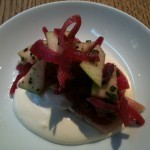
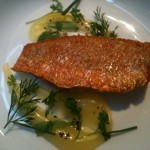
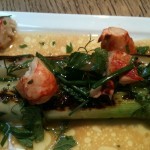
Also served for lunch at Spring (left to right): a salad of apples, red cabbage and smoked eel served on a horseradish sauce; red mullet with fresh herbs and a sweet-and-sour sauce; baby leeks with lobster in a gentle vinaigrette.

spring1 spring2 spring3

Posted in 8. Vegetables | Tagged , , , , , , | Leave a comment

Sauté de veau

Veal stewed gently in wine, infused with garlic, tomato and herbs, and served with a touch of cream — this supremely French invention is far from the stews of my childhood. I first tasted it in the 1970s at the home of my friend Nicole, a superior cook. She liked to have people over for dinner on short notice, and one day as we chatted in the kitchen she prepared this succulent dish in what seemed like no time. I of course demanded the recipe.
Sauté de veau / Veal stewed in white wine

Nicole and I worked together as chefs around that time at an improvised bistro that took shape every Saturday night in a place that functioned as a day care center during the week. For 30 francs, or about $4.50, our merry customers were served a three-course meal with wine — a great deal, even back then. We cooked all afternoon and, as evening approached, various shaggy-haired friends of Nicole’s turned up to help convert what looked like a house for garden elves into a dining establishment. When the place filled up, it felt like a microcosm of hip post-May-’68 Paris. The people who came to dine at our bistro très parallèle were still riding high on the wave of revolt that had swept France ten years earlier — contesting the ordinary, seeking the extraordinary, engaged politically, hungry for life. It was the best crowd I’d encountered since arriving in France. And thanks to Nicole, I was soon becoming part of that scene.

Posted in 7. Meat Dishes | Tagged , , , | Leave a comment

Sole meunière

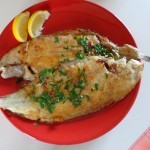
sole meuniere5In her book My Life in France, Julia Child gives a rapturous account of her first encounter with French cuisine: sole meunière for lunch at a restaurant in Normandy. ‘The flesh of the sole was delicate, with a light but distinct taste of the ocean that blended marvelously with the browned butter,’ she writes. ‘It was a morsel of perfection.’ Yet, mysteriously, there is no recipe for sole meunière in Mastering the Art of French Cooking, Volume One. Why did Child omit this supremely elegant dish?

Sole meunière / Sole meunière

Could it be because it’s too simple to prepare? Sole meunière, after all, is fish dipped in flour and fried in butter (with a little French trick or two to lift it from the ordinary to the sublime). Its name betrays its humble origins — the word meunière derives from moulin, or flour mill. Nothing fancy here. But as Child recalls in My Life in France, written with Alex Prud’homme, the sole meunière she tasted in Normandy was fish ‘of a higher order than any I’d ever had before.’ Indeed, she says, that first lunch was ‘the most exciting meal of my life.’ And, as you’ll see when you make this dish, that’s no fish story.

Posted in 5. Fish and Shellfish | Tagged , , | 1 Comment

Soupe à l’oignon gratinée

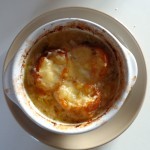
onion soup4Just how French is French onion soup? It clearly originated here in France, and became famous as a midnight snack at the huge Les Halles market in central Paris until the Baltard Pavilions were torn down in 1971 to make way for a shopping center. Based on its status as the iconic dish of the ‘belly of Paris,’ French onion soup jumped the Channel and the Atlantic to great applause. In Paris today it is featured on bistro menus all over town. But the fact remains: I don’t know a single French Parisian who actually eats French onion soup.

Soupe à l’oignon gratinée / French onion soup

This is a pity, for French onion soup is not just intensely flavorful, it is hearty enough to warm the coldest of winter nights (and the coldest of hearts?). I first encountered it as a teen on my first trip to Paris. My dad had been invited to a medical conference and he brought the whole family with him. As the only one with even a modest notion of French, I was appointed tour guide and restaurant organizer. ‘Let’s have a late supper at Les Halles,’ my dad suggested. This was before the market was moved out of town. I flipped through a going-out guide, found a restaurant called Au Chien Qui Fume (The Smoking Dog’s) and off we went. It was just like in the movies — delivery men carrying half-sides of beef, cries of vendors, hookers in the doorways, and all this amid a glorious profusion of food — artichokes and feathered poultry and sausages everywhere you looked. We found our table and were not disappointed. The onion soup, with its thick layer of bubbling cheese on top, was out of this world. In fact, to my dad’s lasting regret, the whole experience of our trip was so memorable that a few years later I came back to Paris and never moved home again. Now that’s saying something about the power of soup!

Posted in 2. Soups | Tagged , , | 2 Comments

Assiette de crudités

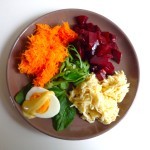
crudites1Let’s get one thing straight right from the start: there is nothing crude about crudités. This lovely fresh vegetable plate — my all-time favorite starter — is the dish I most long for whenever I’m away from France for a while. There is something quintessentially French in the way the vegetables are prettily arranged in mounds, then topped with a zesty sauce. It’s so fresh it feels like visiting a garden – and finding it on your plate.

Assiette de crudités / French vegetable plate

So how did it get its name? The word crudités is what the French call a false friend (it looks like an English word but has a different meaning). Like our word crude, it derives from the Latin crudus, meaning raw, even though some of the veggies on a modern assiette de crudités may be cooked.

The vegetable plate pictured above is a winter version, with raw carrots, cooked beets, celeriac remoulade, a boiled egg with a dollop of mayo, and some tender leaves. But the assiette de crudités is a dish for all seasons. One could argue that it’s best in summer when veggie gardens are at their most opulent. But personally I find the plate’s bright colors even more of a joy to behold in the bleak midwinter.

Happy cooking!

Posted in 1. Starters, 3. Salads | Tagged , , , , | 2 Comments

Risotto à la trévise

Risotto radicchio2When I first tasted risotto al radicchio I was dining alone in Venice and chose it almost at random from a menu with many other dishes that were unknown to me. Bitter red salad with rice? Why not, I thought, figuring it was worth trying something new. How could I have imagined the sublime dish that was brought to my table, rich and subtle, the flavor of the radicchio leaves tamed to a hint of something wild mellowed by creamy rice, butter and parmesan cheese? But there was something more to this dish, something unusual. Intrigued, when I returned to Paris I phoned the chef, who let me in on his secret…

Risotto à la trévise / Risotto with radicchio

In most risottos, the rice is sautéd with onions and moistened with white wine before broth is added. In this one, a specialty of Venice, the rice is moistened with red wine, which lends body and color to the dish. There are exceptions — some recipes for this risotto call for prosecco, the dry Italian sparkling wine brought out for festive occasions. But my first taste of the dish was the version made with red wine, and it’s the one I prefer.

Now, you may be asking, how did a recipe from Venice end up on the site of The Everyday French Chef? Radicchio — trévise in French, after the northern Italian city of Treviso — has been cultivated since antiquity in the Venice region and over the centuries made its way to France. When I encountered some in the market last week, with memories of my friend Gisella’s fabulous lasagne with radicchio on my mind, I had to buy it and try my hand at my favorite risotto recipe. Which, by the way, was a specialty of a great little Italian bistro around the corner from me, L’Osteria, while Toni Vianello was its owner and chef. This dish is a fine example of the way contemporary cuisine in Paris is becoming more multi-culti — at restaurants and in homes as well. Risotto with radicchio is inexpensive and easy to make. It may be served as a first course or a main dish accompanied by salad and wine. Its flavor is unique. I suggest you try it.

Posted in 9. Pasta, Rice, Grains | Tagged , , , | 3 Comments