 This spring in Paris has seen a great profusion of white asparagus. It came onto the market in early March, ahead of the green variety, and at prices so tempting I couldn’t resist. This, plus a request from a Japanese cooking student, has sparked my creativity this season. I have served white asparagus many times, with a wide variety of sauces. For the delicate flavor of this versatile vegetable can be complemented in many ways.
Asperges blanches / White asparagus
Opinions differ on white asparagus, but the French generally consider it a greater delicacy than the green variety. Its white color stems from the fact that it is grown underground. It is generally available only during the spring. In terms of preparation, the main difference between white and green asparagus is that the white spears must be peeled. This is not a major conundrum, however. A light touch with a vegetable peeler will do the trick.
And now to the sauces. The asparagus shown in the photo above is adorned with a sauce of crème fraîche, lemon juice, salt, pepper and chives that I invented in my kitchen (well, perhaps someone thought of this before, but I’ve never seen a recipe). It is light and fresh, and marries well with the asparagus without overwhelming it.
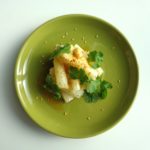 Another sauce I invented combines sesame oil, lemon juice and salt. It is shown here on asparagus spears that have been cut into segments and piled up for an elegant starter. The asparagus is sprinkled with toasted sesame seeds, drizzled with the sauce and topped with fronds of fresh cilantro.
If you’d like to go for a more classic combination, serve white asparagus with mustard vinaigrette, balsamic vinaigrette or, the princess of sauces, hollandaise. For an egg-based sauce that is far easier to prepare than hollandaise, you could try another of my springtime creations, a ‘mimosa’ sauce made of a minced soft-boiled egg mixed with olive oil and lemon juice. (This sauce came about on a country Sunday when we had a leftover soft-boiled egg after breakfast. As they say, or as Frank Zappa might say, necessity is the mother of invention.)
Moving on, some restaurant news. Le Monde ran a big article this week on the revival in Paris of old-fashioned bistros — places that serve old-fashioned dishes like blanquette de veau, oeufs durs mayonnaise and … white asparagus, and where red-and-white checked tablecloths, bread baskets and pyrex glassware hark back to an earlier era. The author attributes the trend to a quest in our complex era for l’authentique (the authentic), which he goes on to rename le fauxthentique, (a play on the word ‘false’), for of course we can never recapture the true nature of what used to be.
One restaurant highlighted in the article is Aux Bons Crus, a bistro located near the town hall of the 11th arrondissement. I dined there recently with a friend and would have to say the false comes through more strongly than the true. The place has all the touches of an old-fashioned bistro — chalkboard menus, retro decor, etc. — but the food did not live up to the reputation, or my memories, of classic French cooking in days gone by.
 What the article did not mention is another trend in Paris, of young chefs putting a modern spin on classic dishes. The latest such establishment to open is JJ, a very contemporary bistro located, I am extremely happy to say, right downstairs from my apartment. It is run by two friends — John, the British-born chef, and Jérémie, who takes care of the front of the house — and the cooking is absolutely inspired. For example, at a private opening last weekend, they offfered a delicate, creamy carrot soup with cockles and herbs (to die for), foie gras with hazelnuts and a foamy morel appetizer served in a small cup.
I am looking forward to visiting JJ as often as possible. They have a lunchtime menu priced at 20 euros for two courses or 22 euros for three, and the place, which opened on Tuesday, is already packed. As time goes on, I hope to be able to offer you an Everyday French Chef rendition of some of their creations. And in the meantime…
Happy cooking.
 A Russian friend was coming over for a cooking lesson. He wanted to learn to make easy dishes he could prepare ahead of time to serve when friends came for supper at his dacha. Top of his list was … beef stroganoff. I found the idea of teaching beef stroganoff to a Russian to be rather fanciful, so I suggested poulet bonne femme, an earthy dish of chicken, bacon, mushrooms and onion that, like stroganoff, is finished with cream.
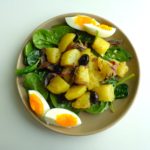 The other day a friend brought me a humble present — a jar of anchovies. But not just any anchovies. They were from Collioure, a picturesque fishing port on the French Mediterranean coast, which by some accounts produces the best anchovies in the world. I decided to try them out in a tangy salad of potatoes and black olives, set on a bed of baby spinach leaves, with mellow eggs on the side. The combination proved to be a knock-out.
 Are French fries the ultimate French food? They may have been, but their quality in bistros has declined so much over the years that their enduring popularity here in France is a mystery. I would walk across Paris for good frites — crispy on the outside, meltingly tender on the inside — but they are not so easily found. There is another solution. Making your own fries is remarkably simple, and they are just as good as the delectable original.
 That time having passed, why not try making them at home? French fries marry well with many dishes on this site, among them all the omelets,
 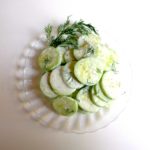 Simple starters are having a moment in Paris, and today I am featuring one of my favorites, cucumbers in cream. This tasty dish may be enhanced with the herb of your choice – cilantro, dill, chives or chervil – and served on its own, with another simple starter or two, as part of an
  Returning to
  When the French are asked to name their favorite dishes, couscous invariably comes near the top of the list. And why not? This import from North Africa is delicious, economical and healthy. The fluffy semolina grain forms a bed for veggies and chick peas cooked in a rich broth flavored with mildly exotic spices. Then along comes your choice of meat, poultry, spicy sausage, fish or a combination, as in this ‘royal’ version.
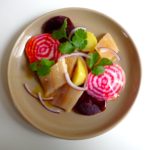 Smoked herring and potatoes bathed in a gentle vinaigrette is a classic French bistro starter. In this rendition, two types of beets are added to the plate — cooked red beets and raw, striped heirloom beets — along with onion and cilantro. I was inspired to prepare the dish this way after encountering it last winter at one of my favorite Paris bistros, Le Desnoyez, where presentation is an art form and the food is modern and delicious.
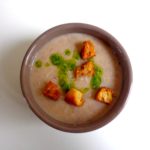 With the holidays behind us, it’s time for simpler fare. Rustic and wholesome, French white bean soup makes a fine January meal. Begin or follow with a salad, add some cheese and fruit, open a bottle of red and voilà. In this version, the soup is flavored with garlic, onion and rosemary. When I cooked up a pot of it on a recent gray Paris day, I topped the soup with a drizzle of herb-and-garlic infused olive oil and some freshly baked croutons.
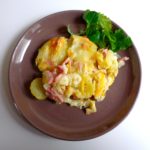 Tartiflette
 Endives gratinées au jambon de pays
 Linzertorte is one of my favorite desserts, and when better to serve it than over the holidays? This classic cake, which takes its name from the Austrian town of Linz, is now enjoyed worldwide. The nutty shortbread-style pastry is filled with jam — typically black or red currant or plum — but in Alsace, where it is often served over the Christmas season, raspberry jam is preferred.
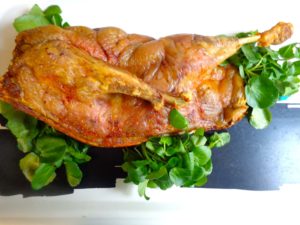
 Roast goose was a traditional Christmas dish in France for many years, probably for centuries, but it is rather rare on holiday tables these days, having ceded its place to turkey, capon or duck. Nonetheless, roast goose is delicious. This year I decided to roast a goose well before Christmas in order to post it here in time for you to think about it, and perhaps make it. But getting the goose proved harder than anticipated. In fact it was a bit of a feat.
 If you’ve never roasted a goose before, there are tips on the


