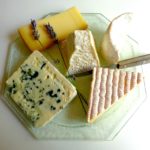
 Cheese stands as a course of its own in France — and why not, in a country with more than 400 varieties to choose from? It is usually presented between the main course and fruit or dessert, with the number of cheeses ranging from one to many depending on the occasion and the number of people at the table. But which cheeses to choose and how to present them? A reader wrote in to ask this question. The subject is vast. Here goes.
Assiette de fromages / Assorted cheeses
The first point is that, in a proper French meal, cheese is a must. You can’t skip it, as French friends tartly remarked one year at an American Thanksgiving dinner in Paris where the co-hostess and I had presumed that no one would have room for cheese, given the bounteous nature of the meal. We were taken to task and have not repeated the mistake. Is this to say that I serve cheese at every meal? Absolutely not! But when guests are present — and unless it is a meal where cheese would be inappropriate, like Vietnamese food — I prefer to err on the side of caution and bring out the cheese.
When I first came to France in 1969, I spent several weeks as a lodger with a family in Avignon while on a summer study program. This was my introduction to French cheese. It was served twice a day, at lunch and dinner, almost always accompanied by fresh fruit. Sometimes a single cheese was brought out, and sometimes an assortment, served on a simple plate, a board or a platter. The variety was astounding.
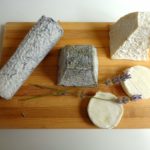 With so many cheeses to choose from, where to begin? Cheeses are seasonal, varying according to the time of year when the milk is at its best and the amount of time needed for the cheese to mature. Cheeses at their best in spring include all types of chèvre (goat cheese, seen at right) and soft cheeses like Camembert, Brie and Epoisses. Cheeses that take a bit longer to mature, like Reblochon or Saint-Nectaire, come into their prime in summer. Autumn is the time to choose cheeses that have acquired character through longer maturation, like Roquefort, Ossau-Iraty (a hard Basque cheese made from ewe’s milk), Maroilles or Livarot. Winter is when cheeses needing the longest maturation come into their own: Comté and Beaufort, Cantal and Laguiole, and the unmatchable Mont d’Or, a meltingly delicious cheese eaten out of its round wooden box with a spoon.
Now the next question: How to compose your assortment? If you’ll be serving a considerable number of cheeses, as shown in the platter above, it’s best to present a wide variety — guests can each taste a couple of their favorites. The platter shows, going around the rim from top right, Chaource, Pont l’Evêque, Roquefort and Comté, and in the center Pouligny-Saint-Pierre. This assortment has three cheeses made of cow’s milk. The Roquefort is made of ewe’s milk and the Pouligny-Saint-Pierre is a chèvre.
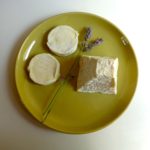 Harmony becomes more important when assembling a cheese plate for fewer people. As I’m partial to goat cheese, sometimes I’ll compose a plate with two or more types of chèvre, as seen at left. The plate includes Pouligny-Saint-Pierre (from south of the Loire) and two Rocamadours (from the Périgord).
 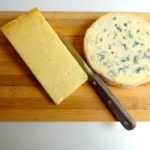 Sometimes I’ll go regional, selecting cheeses from, say, the rugged Auvergne region of south central France. The board at right includes Laguiole and Fourme d’Ambert, both made from cow’s milk. By the way, since blue cheeses, including Roquefort, are not to everyone’s taste, I usually include at least one non-blue cheese in the assortment. (An excellent site for taking a look at French cheeses is Chez Loulou.)
The cheese should be served at room temperature, which means taking it out of the fridge about an hour before you plan to bring it to the table. Much more could be said on the subject, such as how to cut the cheese (a conundrum even for the French), whether to bring it to the table still bearing its label (don’t), and what kind of cheese to choose if you’re not in France. I have touched on this here, and await any further questions.
Now then — getting back to France’s many types of cheese. The number has risen since President Charles de Gaulle famously said, ‘How can you hope to govern a country that has 258 varieties of cheese?’ According to the French dairy producers’ site, France today counts at least 1,200 varieties of cheese, of which 46 bear the label Appellation d’Origine Protégée, which attests that they come from a specific region and are made according to traditional methods. But they go on to say that the number could range up to 1,800. Which means that you could try one a day for nearly five years without repeating yourself…
Happy eating!
The Everyday French Chef will be on vacation for the next few weeks. Here’s wishing you all a very pleasant summer.
 This is a versatile salad featuring two types of greens that come into their own in late autumn and winter: mâche (aka lamb’s lettuce) and Belgian endive. Mustardy vinaigrette sauce and plenty of garlic turn the leaves into a zesty salad that may be served as is or enhanced with walnuts, Alpine cheese and/or country ham. This adaptability will allow you to enjoy it whatever your culinary proclivity — omnivore, vegetarian or vegan.
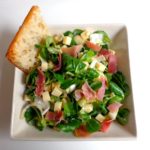 While either mâche and Belgian endive may be served on its own as salad, they pair nicely and can form the basis for a quickly prepared and tasty salad at lunchtime, with or without extra ingredients, or a salad course to precede or follow a main dish. The garlic adds zing, as does the homemade mustard vinaigrette, a French classic that also harks back to days of yore.
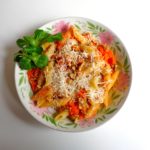 This dish gives an interesting twist to pumpkin that may be of interest as the holidays approach. Yes, I’m thinking Thanksgiving. The combination of pasta and pumpkin is popular in both France and Italy, and the walnuts add depth. This version also has a touch of Meg thanks to the spicing — not nutmeg, as my childhood friends delighted in calling me, but cumin which, combined with a spritz of lemon juice, adds a welcome zest.
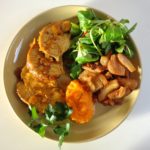 My friend Vera, a superlative cook, served this spicy slow-cooked veal dish on the occasion of her husband’s birthday last year. It was summer, and the birthday dinner was in the garden of their country house in Provence. There were many guests and many speeches, much wine and much merriment. Cheery lanterns hung from a mulberry tree over trestle tables festooned with patterned cloths. I loved it all, but what blew me away was the food.
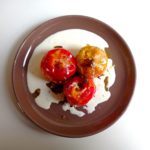 One of the delights of autumn is the baked apple — pomme au four in French. Served with cream or without, it’s a classic dessert that’s both healthy and easy to make. But is it so totally basic that it doesn’t belong on a French cooking blog? I thought it over, called a couple of friends and, with their hearty encouragement, decided to go for it. I’ve been wanting to add pommes au four to the desserts on this site for a very long time. Et voilà.
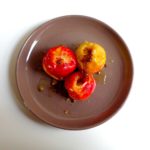 However, as the summer was very hot and very dry, they were smaller than usual. Although in the past I’ve tended to use large apples for this dessert, I decided to give it a try with the small ones, serving two or three per portion, as shown above and, with caramelized sauce but no cream, here.
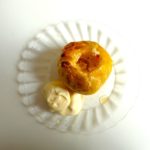 There were a few big apples left on another tree, however, and I gave that a try also. The first one I baked exploded (i.e. its skin popped off) — see the recipe page for a photo. When I tried again, I took care to score the apple skin before baking, and it turned out perfectly, shown here with a dollop of crème fraîche.
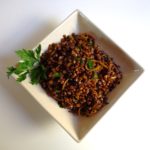 The humble lentil comes into its own in this simple, earthy dish flavored with gently sautéd onions, ground spices and fresh herbs. Lentils prepared in this way can be served as a flavor-packed side dish with meat, poultry or fish, or as part of a vegetarian meal. I served the dish recently with grilled guinea hen with walnut sauce, with a spinach salad alongside, and my guests were very happy. The full meal, with recipes, is described below.
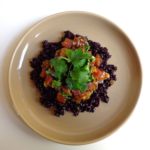 Fusion is hot in Paris at the moment, with Asian, African and Latin American-inspired dishes popping up on menus created by French chefs at trendy bistros. And among the popular dishes, raw fish — served as tataki, ceviche or simply tartare — might well top the list. In this version, raw tuna is marinated in a mixture of Asian flavors and set atop a bed of black rice, another new-ish addition to the Parisian culinary repertoire.
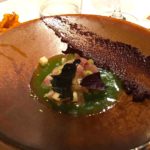 But before I got around to attempting to replicate that dish, I was treated to dinner at another, pricier restaurant, Le Comptoir du Relais, where a ceviche of mulet noir was the first course of a five-course, fixed menu (no choice). The fish, mixed with tiny bits of Granny Smith apples, avocado, celery and cucumber juice (!), was served in a shallow bowl with a smear of tapenade alongside, as shown in the photo snapped by my friends.
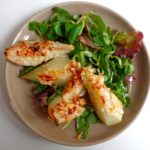 Fruit became a major issue this summer down in Burgundy, where a great year for fruit of all kinds — cherries, plums, apples and pears — turned my garden into a paradise for fruit-loving wildlife of the alarming variety (more on that later). Now that I’m back in Paris, where I can safely gather fruit from the market, I decide to try my hand at a salad featuring pears topped with parmesan and roasted to mouth-watering succulence.
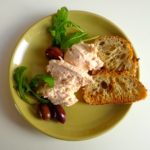 I first discovered tarama in France, where it has been popular as a starter for decades or possibly longer. It is traditionally made from bottarga — cured and salted roe that has been pressed and sealed in wax. But, as I learned when shopping for this blog post, it is more often made these days with fresh salted roe, which is a fraction of the cost of the cured variety. The other ingredients are oil, bread, milk and lemon juice, and preparation is easy.
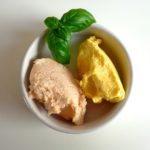 I decided to experiment for this post and bought both kinds of roe — fresh and cured. The fresh roe cost 2.80 euros for 100 grams (about 1/4 pound), while the bottarga cost 14.50 euros for the same quantity. I also experimented by using sunflower oil with the fresh roe and a half-and-half mixture of sunflower and olive oil with the bottarga. You can see the results in this photo.
 It’s that strawberry time of year. So when friends were coming to dinner the other night I couldn’t resist the temptation to make a strawberry tart. This involves a little work, but the results are well worth it. And the assembly is fun. The strawberries are placed in concentric circles on layer of French pastry cream that you’ve spread over a delectably crumbly, pre-baked sweet tart shell. A bright red glaze produces the brilliant sheen. Sweet and fresh.


