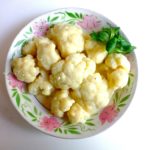
 Hello and happy new year! After all the celebrating, this light but satisying dish of cauliflower in a velvety cheese sauce will hopefully help you get 2020 off to a good start. Don’t be put off by the fancy name — the Brits call it simply ‘cauliflower cheese’. But the French version is slightly different. Mornay sauce is a Béchamel, or cream sauce, enriched with an egg yolk as well as with Gruyère-style cheese. But who, you may ask, is Mornay?
Chou-fleur sauce Mornay / Cauliflower in Mornay sauce
I asked myself the same thing and had a heck of a time coming up with an answer. My (relatively) new, 989-page encyclopedia of French cooking, Le Grand Larousse Gastronomique, includes four entries on sauce Mornay: a definition, a brief entry on how to make it and two recipes that use it (over sole fillets and over any cooked fish set in a the shell of a sea scallop, in both cases browned in the oven). Interesting, but nothing is said about the origin of the sauce’s name. So I started browsing the web.
It appears that the sauce was created in the 19th century at the ultra-chic (at the time) restaurant Le Grand Véfour, which sits beneath the arcades of the Palais Royal gardens in the heart of Paris. It may have been named for a nobleman who frequented the establishment, the Marquis de Mornay, or for his brother, the count of Mornay. There seems to be no agreement on this point, however. Others who dined there included Victor Hugo, Colette (who lived virtually next door) and many other writers and political figures. The restaurant, originally a café, knew such success when it was taken over by its namesake, Jean Véfour, that he was able to retire within three years.
A few years after I began working as a journalist in Paris, I had the occasion to visit Le Grand Véfour to interview its star chef, Raymond Oliver, for a radio program in English. The time was the early 1980s and the theme was the French Christmas dinner. Monsieur Oliver, a charming man, regaled me with stories and descriptions of Christmas dinners past and present. But though I also deployed all my charm, he did not invite me to dine there, alas, and I never had the occasion to do so afterwards.
I did go back once, however, when Le Grand Véfour was bombed by unknown assailants on Dec. 23, 1983. I was the duty reporter for Reuters that evening and had been enjoying a pre-Christmas dinner with a man I fancied at a much humbler restaurant on the Left Bank when the call came through. So much for that. I had to find a cab and race over there. The scene was chaos. Twelve diners had been wounded and Raymond Oliver was beside himself. Happily, though, the restaurant reopened and is still serving diners today.
Returning to sauce Mornay, it was apparently served at first over barbue, or brill, a flatfish similar to a turbot, but its range has expanded in modern times. You can find it in recipes for eggs benedict, pasta, salmon, sea scallops and veggies from broccoli and brussels sprouts to leeks and asparagus. And, of course, cauliflower. Often, a dish bathed in Mornay sauce is popped into the oven to brown, in the process becoming a gratin. As for the cheese to use, in France it is always Gruyère, Comté or a similar cheese, while in Britain the go-to cheese is cheddar. Feel free to experiment.
One more detail (on the etymological front). When looking into the origin of the sauce’s name, I knew it had referred to a person, not a place, for a simple reason. The word ‘Mornay’ was capitalized, while place references in French cuisine never are. For example, la sauce hollandaise, which points to Holland, takes a small ‘h’, while la sauce Béchamel, named for Louis de Béchameil, takes a capital ‘B’. Similarly, if you are mentioning the French language in French, it’s le français (small ‘f’). Interesting, no?
Happy cooking.
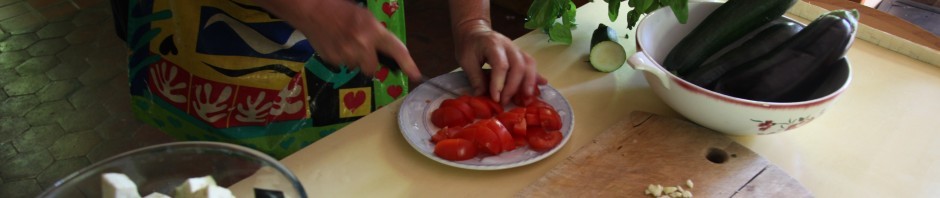
 I first tasted this knock-your-socks-off red-bean-and-walnut salad in Moscow in 1984. Russia was still part of the Soviet Union, and young people from other parts of the empire still flocked to the capital to study or work. A friend introduced me to a Georgian woman who was studying particle physics. When she invited us over for dinner, I had no idea what to expect. Then she produced this fabulous dish. I’ve been making it ever since.
 The French tend to rave about daube de boeuf, a flavorful beef stew from Provence, without it being clear exactly why. Like Proust’s madeleine, this dish must evoke memories of childhood. And indeed, daube harks back to a simpler time, when dishes simmered for hours in a pot set over an open fire, their aroma filling the house until the family was seated to enjoy a tender moment of togetherness. But after all, it’s only beef stew — right?
 One of the charming traditions of France is the annual gathering of friends and family in early January to share the cake known as galette des rois, or kings cake — frangipane-filled puff pastry with a dried bean or token hidden inside to designate who will be king or queen for the day. The tradition marks the Jan. 6 Christian holiday of Epiphany, celebrated to commemorate the visit of the magi — the three kings of Orient — to the newborn Jesus.
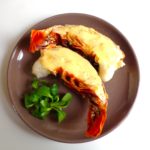 Lobster is a rare treat in Paris, largely because of the price. At my local farmers market the other day, they were selling small live lobsters for 30 euros a piece — far more than you would pay in other countries, or even parts of France where lobsters are grown, for example Brittany. But with the end-of-year festivities coming, I couldn’t resist offering you this elegantissimo recipe for lobster tails bathed in a buttery, vermouth-flavored sauce.
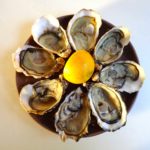 Lobster is often served in France as the star of a Christmas or New Year’s meal, preceded or accompanied by Champagne. If you decide to try it this year, you could start with an
 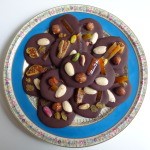 While the cheese and fruit are optional, a dessert is de rigueur — perhaps a
  With Thanksgiving and the holiday season around the corner, here’s a crisp, citrus-flavored apéritif from the Loire Valley to add sparkle to the festivities. Soupe angevine, literally soup from the Anjou region, combines sparking white wine with lemon juice, sugar syrup and Cointreau. It is traditionally mixed by pouring the bubbly into a large bowl and adding a soup ladle of each of the other ingredients — hence, perhaps, its name.
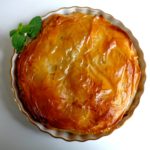 Tangy and delightfully crispy, the Mediterranean spinach-cheese pie known variously as spanakopita, borek or boureka is both fun and easy to make. In this version, cinnamon is added to the spinach-feta filling for a slightly exotic taste that seems to please. When I made this pie for lunch the other day, it disappeared in minutes. Although the dish can be found in Greek shops in Paris, it tends be bland. The best idea is thus to make it yourself.
 I did a little research into the origins of this dish and, although it is often assumed to be Greek, or perhaps Turkish, it apparently reached the Mediterranean via the nomadic Turks of Central Asia, spreading west across the Balkans, north to Romania and Moldova and south to North Africa. In most versions, the pie is constructed using paper-thin filo dough — the name of which, I just learned, is Greek for feuille, or leaf.
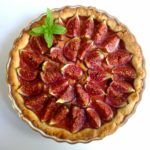 Pretty as a picture. That’s what my daughter said when this tart of fresh figs set on vanilla-flavored cream came out of the oven the other day. She posted a photo on Instagram and got, like, a jillion likes (so she said). That evening I took the tart to a friend’s birthday dinner where it was speedily consumed with evident satisfaction — all the more so since this elegant dessert can only be made when figs are in season, a few months a year.
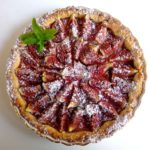 tart and pop it in the oven. When it comes out, you can add a sprinkle of powdered sugar if you like.
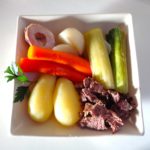 As cool, rainy weather set in the other day, I had a hankering for pot au feu. Ran out for the ingredients, came home to look up my recipe on this site — and was astounded to find it wasn’t there. So today I offer you this classic French dish of broth, beef and veggies. In past centuries, pot au feu (literally ‘pot on the fire’) was made in a cauldron, simmering for hours over a fire. Although the ingredients are humble, the result is regal.
 I also make a simple version, although it’s a lengthy process. The beef is boiled for more than four hours, reaching a sublime tenderness and producing a deeply aromatic broth. The veggies are added at the end to retain maximum flavor. This is a healthy dish, as the fat is skimmed away during cooking. It is served in two stages — first the broth, then the meat and vegetables arranged on a platter, often with sea salt, Dijon mustard and sharp French cornichons (little pickles) alongside.
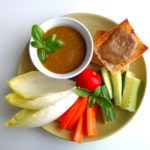 ‘Cauchemar en cuisine’ is a popular French TV show starring a celebrity chef: it translates as ‘Nightmare in the kitchen’, which pretty much defines the situation over here for the last couple of weeks. In a word (well, two), no water. But limits can spark creativity. I needed to make something quick and easy for the blog this week. And so I offer you anchoïade, a zingy anchovy-based dip from Provence that can be whipped up in minutes.


