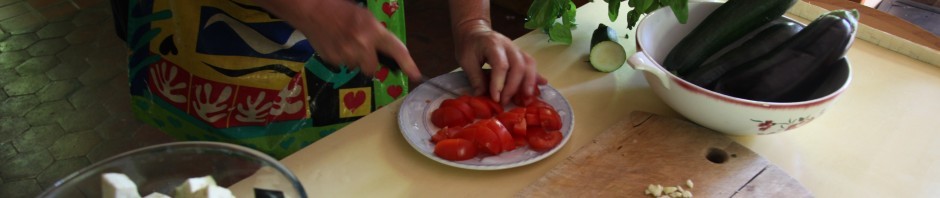
 When the French are asked to name their favorite dishes, couscous invariably comes near the top of the list. And why not? This import from North Africa is delicious, economical and healthy. The fluffy semolina grain forms a bed for veggies and chick peas cooked in a rich broth flavored with mildly exotic spices. Then along comes your choice of meat, poultry, spicy sausage, fish or a combination, as in this ‘royal’ version.
Couscous Royal / Couscous with lamb, chicken and merguez
If you’ve never encountered couscous, or even if you have, it’s important to note that the word has a dual function: ‘couscous’ the grain and ‘couscous’ the dish. I have prepared couscous the grain thousands of times to use as a side dish for meat, fish or game, or as a breakfast cereal with butter, sugar and cinnamon, but have relatively rarely made couscous the dish, which is readily available in restaurants here and is a bit of a production to prepare at home. Nonetheless, home cooking allows you to be creative in your choice of ingredients and to spice the broth as you desire.
The ‘royal couscous’ featured here, with a mixture of meats, is a French take on the original, which became a fixture of the French culinary repertoire after the country’s North African colonies gained independence in the mid-20th century. There are many regional variations. In Algeria, the broth may be made without tomatoes (clear) or with (red), while in Morocco and Tunisia it is typically red. Morocco uses spices such as saffron, ginger and cinnamon to impart a subtle flavor, while fish couscous is popular in Tunisia and Algerians often add broad beans. Beyond these generalities, every community has its own speciality, and sweet couscous with almonds or raisins is a popular dessert across North Africa.
According to Wikipedia, the French had tasted couscous by the 16th century — Rabelais mentions it his novel Pantagruel — and the dish gained ground in southern France during World War I when Algerian workers were sent north to replace French soldiers called away from their factories to the front. It became a nationwide phenomenon when pieds-noirs, or ethnic French born in North Africa, surged north at the end of the Algerian War in 1962 for fear of reprisals, bringing the local cuisine with them.
Today there is no contesting the popularity of couscous among the French. In a recent major poll on favorite dishes, couscous came in third, after magret de canard (duck breast) and moules-frites (mussels with French fries), and ahead of such classics as blanquette de veau (veal stewed in cream), côte de boeuf (thick rib steak) and leg of lamb.
I am delighted to be able to say that recipes for versions of most of the top 10 are already on this site, the main exception being French fries (coming soon). Here’s the list:
1) Magret de canard
2) Moules-frites
3) Couscous
4) Blanquette de veau
5) Côte de boeuf
6) Gigot d’agneau
7) Steak-frites
8) Boeuf bourguignon
9) Raclette
10) Tomates farcies
Happy cooking!
 Smoked herring and potatoes bathed in a gentle vinaigrette is a classic French bistro starter. In this rendition, two types of beets are added to the plate — cooked red beets and raw, striped heirloom beets — along with onion and cilantro. I was inspired to prepare the dish this way after encountering it last winter at one of my favorite Paris bistros, Le Desnoyez, where presentation is an art form and the food is modern and delicious.
 With the holidays behind us, it’s time for simpler fare. Rustic and wholesome, French white bean soup makes a fine January meal. Begin or follow with a salad, add some cheese and fruit, open a bottle of red and voilà. In this version, the soup is flavored with garlic, onion and rosemary. When I cooked up a pot of it on a recent gray Paris day, I topped the soup with a drizzle of herb-and-garlic infused olive oil and some freshly baked croutons.
 Tartiflette
 Endives gratinées au jambon de pays
 Linzertorte is one of my favorite desserts, and when better to serve it than over the holidays? This classic cake, which takes its name from the Austrian town of Linz, is now enjoyed worldwide. The nutty shortbread-style pastry is filled with jam — typically black or red currant or plum — but in Alsace, where it is often served over the Christmas season, raspberry jam is preferred.
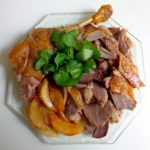 Roast goose was a traditional Christmas dish in France for many years, probably for centuries, but it is rather rare on holiday tables these days, having ceded its place to turkey, capon or duck. Nonetheless, roast goose is delicious. This year I decided to roast a goose well before Christmas in order to post it here in time for you to think about it, and perhaps make it. But getting the goose proved harder than anticipated. In fact it was a bit of a feat.
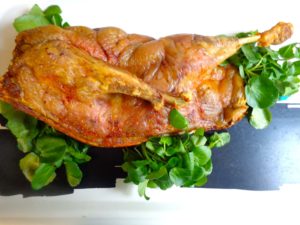 If you’ve never roasted a goose before, there are tips on the
  This is a versatile salad featuring two types of greens that come into their own in late autumn and winter: mâche (aka lamb’s lettuce) and Belgian endive. Mustardy vinaigrette sauce and plenty of garlic turn the leaves into a zesty salad that may be served as is or enhanced with walnuts, Alpine cheese and/or country ham. This adaptability will allow you to enjoy it whatever your culinary proclivity — omnivore, vegetarian or vegan.
 While either mâche and Belgian endive may be served on its own as salad, they pair nicely and can form the basis for a quickly prepared and tasty salad at lunchtime, with or without extra ingredients, or a salad course to precede or follow a main dish. The garlic adds zing, as does the homemade mustard vinaigrette, a French classic that also harks back to days of yore.
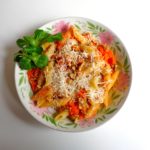 This dish gives an interesting twist to pumpkin that may be of interest as the holidays approach. Yes, I’m thinking Thanksgiving. The combination of pasta and pumpkin is popular in both France and Italy, and the walnuts add depth. This version also has a touch of Meg thanks to the spicing — not nutmeg, as my childhood friends delighted in calling me, but cumin which, combined with a spritz of lemon juice, adds a welcome zest.
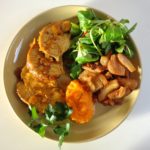 My friend Vera, a superlative cook, served this spicy slow-cooked veal dish on the occasion of her husband’s birthday last year. It was summer, and the birthday dinner was in the garden of their country house in Provence. There were many guests and many speeches, much wine and much merriment. Cheery lanterns hung from a mulberry tree over trestle tables festooned with patterned cloths. I loved it all, but what blew me away was the food.
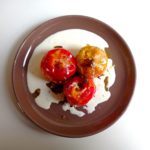 One of the delights of autumn is the baked apple — pomme au four in French. Served with cream or without, it’s a classic dessert that’s both healthy and easy to make. But is it so totally basic that it doesn’t belong on a French cooking blog? I thought it over, called a couple of friends and, with their hearty encouragement, decided to go for it. I’ve been wanting to add pommes au four to the desserts on this site for a very long time. Et voilà.
 However, as the summer was very hot and very dry, they were smaller than usual. Although in the past I’ve tended to use large apples for this dessert, I decided to give it a try with the small ones, serving two or three per portion, as shown above and, with caramelized sauce but no cream, here.
 There were a few big apples left on another tree, however, and I gave that a try also. The first one I baked exploded (i.e. its skin popped off) — see the recipe page for a photo. When I tried again, I took care to score the apple skin before baking, and it turned out perfectly, shown here with a dollop of crème fraîche.
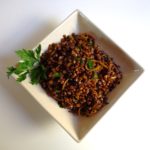 The humble lentil comes into its own in this simple, earthy dish flavored with gently sautéd onions, ground spices and fresh herbs. Lentils prepared in this way can be served as a flavor-packed side dish with meat, poultry or fish, or as part of a vegetarian meal. I served the dish recently with grilled guinea hen with walnut sauce, with a spinach salad alongside, and my guests were very happy. The full meal, with recipes, is described below.


