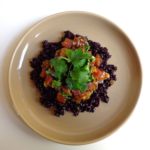
 Fusion is hot in Paris at the moment, with Asian, African and Latin American-inspired dishes popping up on menus created by French chefs at trendy bistros. And among the popular dishes, raw fish — served as tataki, ceviche or simply tartare — might well top the list. In this version, raw tuna is marinated in a mixture of Asian flavors and set atop a bed of black rice, another new-ish addition to the Parisian culinary repertoire.
Tartare de thon sur riz noir / Tuna tartare on black rice
I was inspired to make this after dining at Le Desnoyez, a moderately priced bistro in the increasingly hip Belleville neighborhood. The chef, formerly a lawyer, creates a new menu every night. Everything is beautifully presented and, in my view, fabulously delicious. The tartare he made on the night I was there featured black rice topped by mulet noir, a variety of mullet that can be served raw. I was blown away not just by the fish but by the black rice, which I had never encountered before. Its nutty flavor married sublimely with the tartare. I phoned up to ask for the recipe, but the chef wasn’t there. So I decided to wing it.
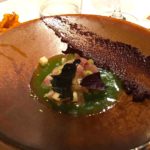 But before I got around to attempting to replicate that dish, I was treated to dinner at another, pricier restaurant, Le Comptoir du Relais, where a ceviche of mulet noir was the first course of a five-course, fixed menu (no choice). The fish, mixed with tiny bits of Granny Smith apples, avocado, celery and cucumber juice (!), was served in a shallow bowl with a smear of tapenade alongside, as shown in the photo snapped by my friends.
As creativity seems to be the name of the game here, I decided to go with a black rice version but to top it with tuna instead of mullet, mainly for reasons of availability. Black rice is produced across Asia and in Italy, and I was lucky enough to find some at a gourmet store across the street. An online search showed that it can also easily be ordered via the web. I picked up the tuna at an outdoor market and made the dish the same day.
So what about preparation? The marinade combines sesame oil, soy sauce, onion, ginger and lime zest and can be made in less than five minutes. The tuna simply needs to be cubed. While the fish is marinating, you cook the rice, and when it’s done you add a little sauce to it, too. Assembly involves piling the fish on the rice and topping it all with fresh cilantro. As this dish was an experiment, I cannot tell you how pleased I was when my dinner guest went into ecstasy as she tried it. I hope you will enjoy it too. And…
Happy cooking.
 Fruit became a major issue this summer down in Burgundy, where a great year for fruit of all kinds — cherries, plums, apples and pears — turned my garden into a paradise for fruit-loving wildlife of the alarming variety (more on that later). Now that I’m back in Paris, where I can safely gather fruit from the market, I decide to try my hand at a salad featuring pears topped with parmesan and roasted to mouth-watering succulence.
 Cheese stands as a course of its own in France — and why not, in a country with more than 400 varieties to choose from? It is usually presented between the main course and fruit or dessert, with the number of cheeses ranging from one to many depending on the occasion and the number of people at the table. But which cheeses to choose and how to present them? A reader wrote in to ask this question. The subject is vast. Here goes.
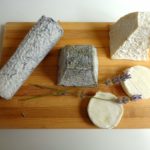 With so many cheeses to choose from, where to begin? Cheeses are seasonal, varying according to the time of year when the milk is at its best and the amount of time needed for the cheese to mature. Cheeses at their best in spring include all types of chèvre (goat cheese, seen at right) and soft cheeses like Camembert, Brie and Epoisses. Cheeses that take a bit longer to mature, like Reblochon or Saint-Nectaire, come into their prime in summer. Autumn is the time to choose cheeses that have acquired character through longer maturation, like Roquefort, Ossau-Iraty (a hard Basque cheese made from ewe’s milk), Maroilles or Livarot. Winter is when cheeses needing the longest maturation come into their own: Comté and Beaufort, Cantal and Laguiole, and the unmatchable Mont d’Or, a meltingly delicious cheese eaten out of its round wooden box with a spoon.
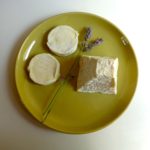 Harmony becomes more important when assembling a cheese plate for fewer people. As I’m partial to goat cheese, sometimes I’ll compose a plate with two or more types of chèvre, as seen at left. The plate includes Pouligny-Saint-Pierre (from south of the Loire) and two Rocamadours (from the Périgord).
  Sometimes I’ll go regional, selecting cheeses from, say, the rugged Auvergne region of south central France. The board at right includes Laguiole and Fourme d’Ambert, both made from cow’s milk. By the way, since blue cheeses, including Roquefort, are not to everyone’s taste, I usually include at least one non-blue cheese in the assortment. (An excellent site for taking a look at French cheeses is
 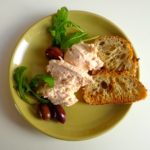 I first discovered tarama in France, where it has been popular as a starter for decades or possibly longer. It is traditionally made from bottarga — cured and salted roe that has been pressed and sealed in wax. But, as I learned when shopping for this blog post, it is more often made these days with fresh salted roe, which is a fraction of the cost of the cured variety. The other ingredients are oil, bread, milk and lemon juice, and preparation is easy.
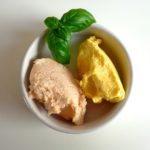 I decided to experiment for this post and bought both kinds of roe — fresh and cured. The fresh roe cost 2.80 euros for 100 grams (about 1/4 pound), while the bottarga cost 14.50 euros for the same quantity. I also experimented by using sunflower oil with the fresh roe and a half-and-half mixture of sunflower and olive oil with the bottarga. You can see the results in this photo.
 It’s that strawberry time of year. So when friends were coming to dinner the other night I couldn’t resist the temptation to make a strawberry tart. This involves a little work, but the results are well worth it. And the assembly is fun. The strawberries are placed in concentric circles on layer of French pastry cream that you’ve spread over a delectably crumbly, pre-baked sweet tart shell. A bright red glaze produces the brilliant sheen. Sweet and fresh.
 I’ve been serving a medley of seasonal vegetables this spring — asparagus, young carrots, peas and red spring onion — and wanted to try it out in a salad version. So here it is, bathed in lemony homemade mayonnaise and served alongside steamed salmon on a bed of tender greens. The veggie combination is a fresh take on macédoine, a classic French dish of chopped vegetables in mayo that today feels decidedly old-fashioned.
 Pho, the remarkably fragrant, herb-topped Vietnamese beef and noodle soup, is ubiquitous in Paris. I never considered preparing it at home until a recent day when my daughter asked me to make it for dinner. As one who enjoys a challenge, I looked into the matter and informed her that we could have it the next day — as preparing the broth for pho takes several hours. I went ahead and made the soup, with moderate success, then consulted an expert.
 The French love affair with asparagus and eggs blooms every spring, when the spears — green, white or violet — are served bathed in luscious
 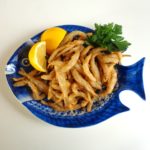 This quintessential French dish evokes happy days at the seaside, where plates of small crispy fish are served up along with a chilled bottle of white or rosé. For me, petite friture inevitably makes me think of summer, which is perhaps why — after this long, dark, cold Parisian winter — I decided to try making it at home when I came across an inviting mound of tiny, silvery fish at a market the other day. Preparation proved surprisingly simple.
 There’s an easy way and a hard way to make the delectable French strawberry dessert known as charlotte aux fraises, as I learned when setting out to make one for this post. A charlotte is an unbaked cake of ladyfingers with a creamy filling. Many modern recipes for strawberry charlotte use a thick dessert cream known as a bavaroise for the filling, and this involves the use of gelatin. As it turns out, that’s the hard way…
 Because the easy way is so easy, the dessert is fun to make. If kids will be sharing it, you can skip the cassis and use strawberry syrup for flavoring the ladyfingers. Once assembled, the charlotte needs to be refrigerated for at least four hours, after which you can decorate it with sliced strawberries and mint. And no, the second time, it didn’t collapse…


