 This is the omelet ‘to die for’ made famous when Emily’s boyfriend Gabriel cooked one up for her in the first season of Emily in Paris. A French classic, it uses a mixture of fresh herbs — parsley, chives, tarragon and chervil — that are collectively known as fines herbes. Unlike most omelets, where the filling ingredients are placed on top of the omelet as it sets, this recipe incorporates the herbs directly into the eggs.
Omelette aux fines herbes / Omelet with fresh herbs
Let’s start by talking about the herbs. Three distinct herb combinations are common in French cuisine: bouquet garni, herbes de Provence and fines herbes. In the bouquet garni, dried herbs — usually thyme, rosemary and bay leaf — are used to flavor soups and slow-cooked dishes like boeuf bourguignon or blanquette de veau. Herbes de Provence, which feature in many dishes on this site, are a mixture of dried thyme, rosemary, marjoram, oregano, basil, chervil, tarragon and/or bay, sage and fennel seeds.
What differentiates fines herbes is that they are fresh, not dried. They have featured in French omelets for centuries, but the mixture has evolved over time. At first, only parsley and chives were used. Then, in 1903, the great chef Auguste Escoffier defined the mixture as including tarragon and chervil as well. This remains the standard, although Paris cafés are known to cheat and use only parsley and chives, or even just chives. Quelle horreur!
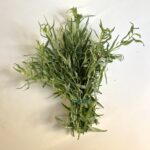 I find that the fresh tarragon (estragon) adds a particularly delightful tang. Tarragon may be grown on your windowsill or balcony, assuring a constant supply (except in winter — the snow in Paris this week had its way with my tarragon, but it will resprout in the spring). Estragon, by the way, was the name chosen by Samuel Beckett for one of the two main characters in Waiting for Godot. Who know why? Estragon, nicknamed Gogo, and his friend Didi spend their time on stage waiting for … well … God.
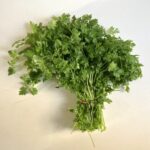 But I digress. Fresh chervil, with its cute ferny leaves and sublimely delicate flavor, is widely used in French cuisine but may be difficult to find elsewhere. What to do, what to do? A small amount of fresh basil may be substituted, or — the best solution in my view –you can leave out the fourth herb altogether. Chervil appears in various recipes on this site, most notably in a bistro salad of thinly sliced raw mushrooms and cream.
 Parsley needs no explanation, other than to say that the French prefer the flat-leaf variety, which I encountered only after moving here. In the States, we only used curly parsley.
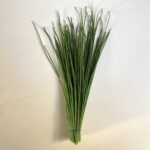 As for the chives, the most delicate member of the onion family, they will give zest to your omelet. But not to overdo it, with any of these herbs.
A perfect omelette aux fines herbes uses similar quantities of each, as the Emily In Paris cookbook explains in its recipe for Gabriel’s omelette. (For the record, in Episode 4 of the first season, you see him make an omelet, but you don’t see him add the herbs. The scene lasts just a few seconds.)
And what about the eggs? Free-range or organic eggs are best for omelets. While I usually count two eggs per person, this omelet calls for three, due to the lack of a filling. Break the eggs, whisk in a little water, add the chopped herbs and some salt and pepper, and make the omelet — in a seasoned pan if at all possible. That’s all there is to it.
Happy cooking!
 P.S. Here’s a reminder for readers of this site. I’ve written a recipe booklet to go with my recently published novel, The Rites of Man, a story of seduction and betrayal, both romantic and literary. To receive the booklet, email me via the Contact page with a photo of yourself with the novel and I’ll send the recipes over to you.



In our house, Omelettes are the best way to start the weekend.
Love this!!